Translation
THE ETHICS OF SHUKRACHARYA
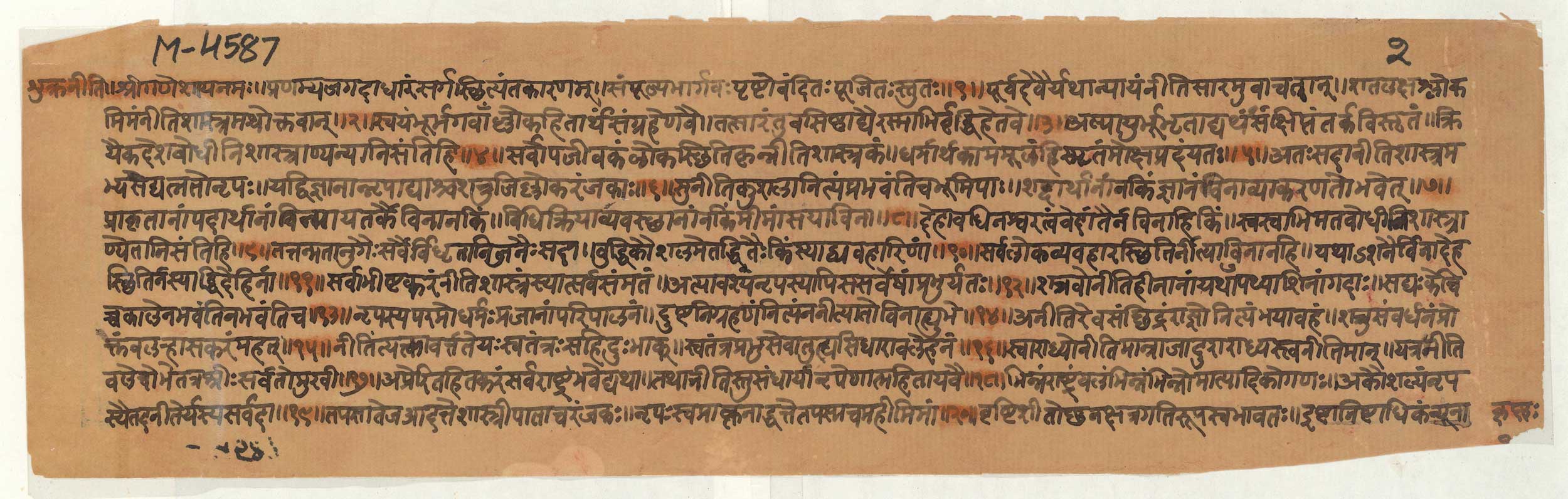
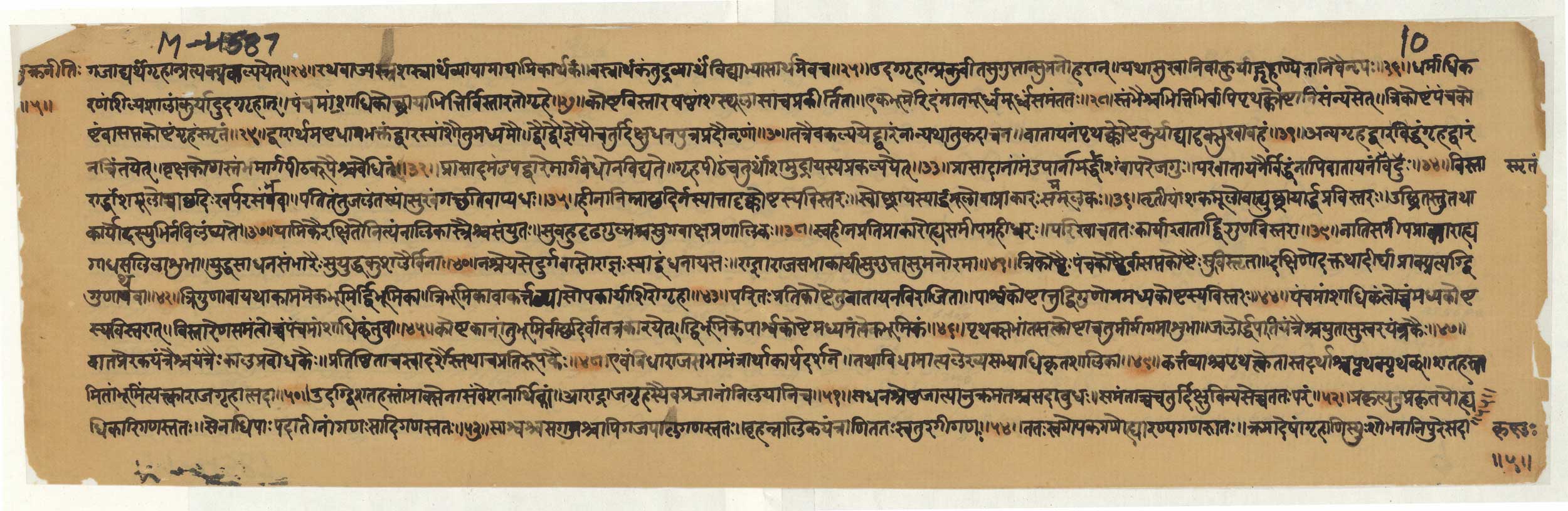
//Om Salutations to Lord Ganesha // After bowing down to the Creator, Preserver and the Destructor of the universe, Bhargava ( ShukrachArya, the son of Bhrigu) gave a discourse on ethics and the substance of morals to the purvadevas (the demons) after they asked, praised and worshipped him // 1 //He narrated these one lac and a hundred verses on Nitishastra // 2 //The self-created God (Lord BrahmA) had spoken this treatise on morals for the good of people, the substance of which was taken for the growth of (prosperity) by Vashishtha and others like me // 3 //(That NItishAstra)which was voluminous and argumentative has been abridged for the kings on the earth and others whose life span is short |Certainly the other Shastras(knowledge) tell only of a particular field // 4 //(but) the NItishAstra is useful to all and in all cases and is the means to preserve the human society //since (NItishAstra) is known to be the root of virtue, wealth, enjoyment and salvation, // 5 //the king should always practice it with great effort//by knowing which the kings and all gain victory and become popular amongst the people // 6 // The rulers who are an expert in good morals they always are very powerful // Is the knowledge of words and meanings not acquired without the knowledge of grammar // 7 // can the knowledge of material substances not be acquired without logical discussions // Can the process of rituals not be known without the knowledge of MImAmsA philosophy // 8 //can the perishability of the human body etc. certainly not be known without the knowledge of VedAnta // all these ShAstras tell only about their own fields // 9 // hence they are kept only by the persons who follow that particular field //as this particular knowledge is of no avail to the persons following their own affairs // 10 // without NIti ( the system of moral philosophy)there can be no maintenance of stability in the person’s conduct like if the food is not taken then the physical body of the human being will not be there // 11 //The NItishAstra should be desired and followed by all //it is also indispensable for the king because he is the lord of all // 12 // Like in case of patients the who do not take the prescribed food then the diseases come and manifest themselves, similarly if the kings are not trained in NItishAstra, the enemies surface soon // 13 // The greatest duty of the king is to look after his subjects and to constantly punish the offenders but both these things are not possible if he does not work according to the NIti (the prescribed ethics) // 14 //The absence of NIti is always harmful to the king like a leaking vessel //it is said that it increases the enemies and makes them stronger and diminishes the king’s strength // 15 //The one who does not follow NIti and follows his independent path he certainly experiences sorrows as being independent in NIti is like licking the edge of a sword(means as dangerous and harmful)// 16 // The king who follows NIti is well respected but the king who does not follow it is not respected // An all-round prosperity flourishes where NIti and might-both are followed // 17 // In order that the entire nation may be for the welfare of the subjects it is a must for the king to follow and maintain NIti for his own interests // 18 // The king who does not follow NIti then always his state is divided, his might is destroyed and his ministers have differences and it is due to his not being not (with his duties) // 19 // The king is the ruler, protector and the benefactor of the people and acquires strength by penance // and he is the lord of this earth due to his penance and the deeds done in previous births // 20 //Time is divided into many periods like rains, cold, heat; the astronomical conditions, according to the movements, shape and the nature of planets and (also) in small or great measures according to the
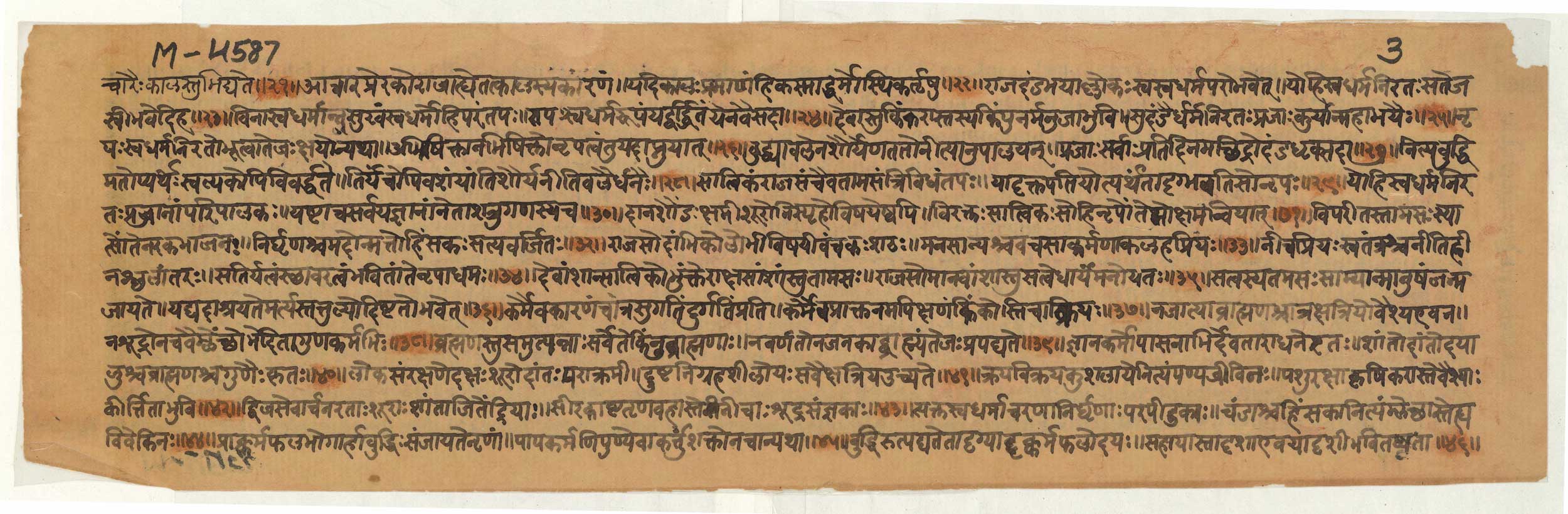
deeds of the people (it is beneficial or harmful) // 21 //The king, certainly, inspires the practice of the customs and hence is the maker of time // in case the time was the cause then there would be no virtue in persons’ // 22 // due to the fear of being punished by the king people follow their own duties //whoever follows his own duties in this world that person shines(here) // 23 //There is no happiness and comfort without doing own duty, the greatest penance, certainly following one’s duty is a penance , is doing one’s duty // 24 // Even the gods work according to his wishes what to talk of the human beings on the earth //the subjects that are disinterested in doing their duties, the king should punish them nicely // 25 //By doing his duties the king shines otherwise being averse towards his duties the his sheen diminishes //whenever he is anointed or without being anointed when he gets the kingship(he should start doing his duties) // 26 // He should look after his subject by using his intellect, might and valor every day following the NIti and always being above board and ever holder of the scepter // 27 //The ones who are always intelligent(their) for them even the small wealth increases daily//Even the animals can be controlled by bravery (and other things) by NIti, strength and wealth // 28 // there are three types of penances- sAttvika, rAjasika and tAmasika// The king certainly becomes according to the penance he performs // 29 //The king who surely is busy doing his duty and looks after his subjects and performs all the sacrificial rituals and is the leader of enemies // 30 // and is charitable, forgiving, brave, indifferent with things of enjoyment, is dispassionate he(the king) is called sAttvika and attains salvation after death // 31 //The king who has characteristics opposite this ie. tAmasika he goes to hell in the end //as he is merciless, mad with his pride, violent and untruthful // 32 // the one who has vanity, cupidity and attachment for enjoyable things, who is deceitful and villainous, whose thoughts, speech and actions are not coherent, who picks up quarrels // 33 // and associates himself with lower classes, who is independent and does not follow NIti, who is fraudulent-is called rAjasika and in the end gets the condition of animals or nonliving types // 34 // The sAttvika king enjoys the blessings of the gods, the tAmasika of the demons //the rAjasika (enjoys the blessings)of the men, so the mind should be devoted to sattva // 35 //The human birth takes place through the mixture of sattva and tamasa// the men of the world have their luck and character according to the nature of the penance they adopt // 36 // One’s own doings are the cause of his prosperity or adversity //even that which is called prAktana (coming from the previous birth) is his own work,can anyone be without work at any time // 37 // No one is a brAhmaNa, kshatriya, vaishya, shUdra or a mlechcha by birth, he becomes one by his virtues and work // 38 //All have descended from BrahmA so can all be called brAhmanas ? //neither through colour nor through ancestors can the spirit, worthy of a brahmaNa, be generated // 39 // The brAhmaNa is called so because of his virtues; he is habitually a worshipper of the gods with knowledge, practices and prayers and he is peaceful, restrained and kind // 40 // The man who is an expert in protecting people, who is brave, restrained and powerful //and who removes all the wicked ones is called a kshatriya // 41 //The ones who are experts in sales and purchases, who earn their livelihood through commerce // who are tenders of cattle and who cultivate lands ,they are called vaishyas in this world // 42 //The people of the lower order who engage themselves with the service and following of the twice-born (brahmans) who are bold, peaceful and have controlled their senses //and who run the plough, draw woods and grass, they are called shUdras // 43 // Those who have given up on their own duties, who are cruel and troublesome to others// and who are always very excited, jealous and foolish ,they are mlechchas // 44 // As per the effects of the deeds done in the previous births the mind of people is inclined towards virtues or vices//It is not possible to do otherwise // 45 //The intellectual disposition takes place as per the fruits of the work show //The means and instrumentalities used are
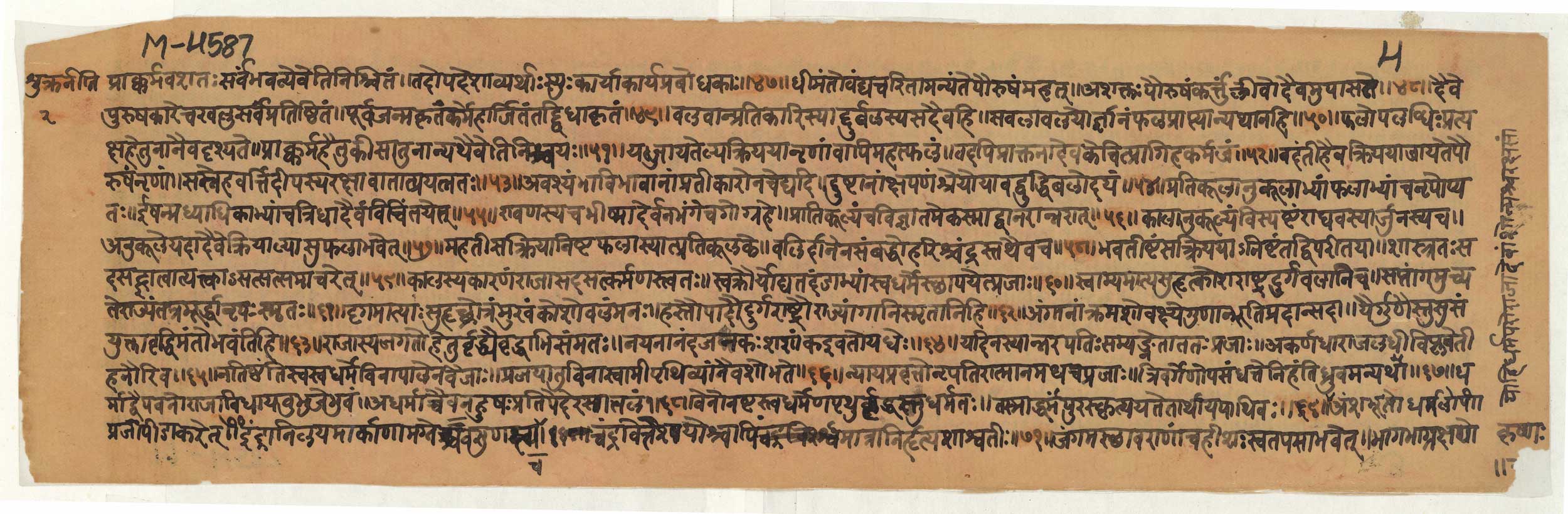
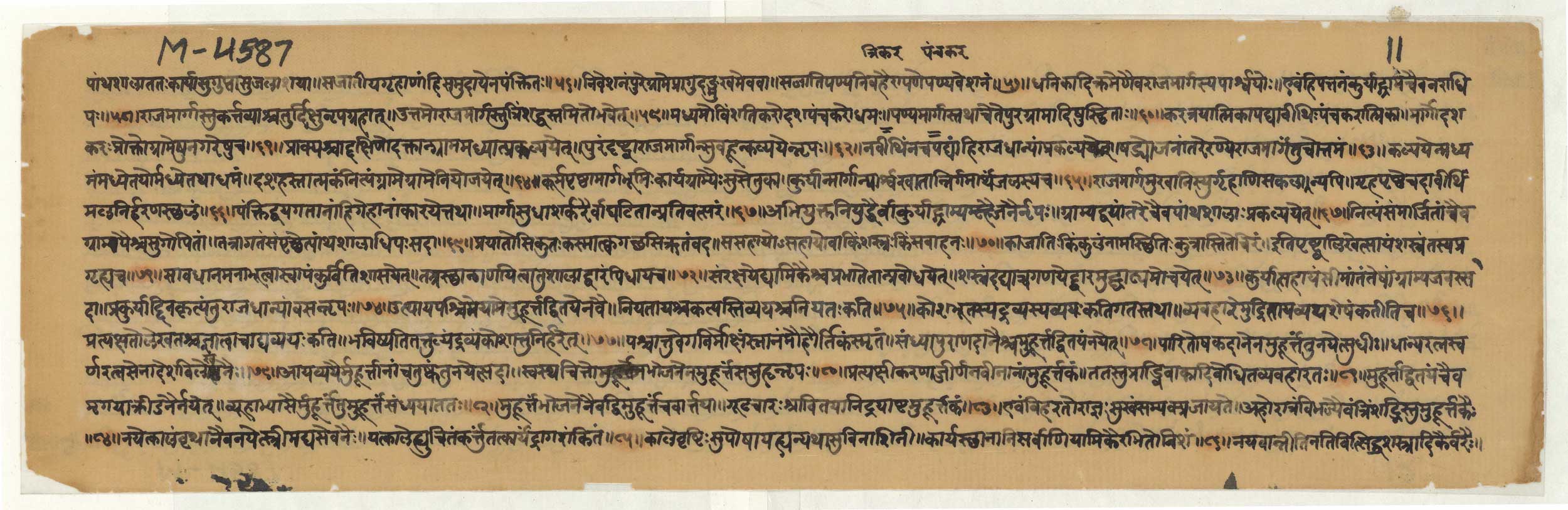
also such as are adapted to the predetermined fate // 46 //Everything happens according to the deeds done earlier, so the preaching on what to do and what not to do is pointless// 47 //The men with intellect are praiseworthy, they consider that one’s own effort is great // the weak ones are like impotent who instead of working depend on fate // 48 //Certainly everything in this world depends on both-the fate as well as on efforts; the efforts, further, are divided into two categories-the ones done in previous life and the ones done here (in this life) // 49 // The strong, certainly, is the enemy of the weak; the difference between the strong and the weak is known by seeing the results and not otherwise // 50 //The achievement of results is not experienced by seeing it directly; that definitely is due to the deeds done in previous life and not otherwise // 51 // If sometimes great results come out of small deeds that is due to the deeds done in the previous life, some say that it is due to the earlier work done in this life // 52 // The paurusha ( strength) of men is born out of his deeds in this life as it is possible with great care to protect the wick of an oil lamp from the wind // 53 // If it is not possible to remedy certain destinies then it is better to discard the evils by raising intelligence and might // 54 // The king should recognize three kinds of fate i.e. light, moderate and great according to the favorable and unfavorable consequences // 55 // In vanabhanga and gograha the fate was unfavorable to RAvaNa and BhIshma //when one was opposed by a monkey and the other from a single man // 56 //Fate certainly was favorable to RAghava and Arjuna //when the fate is favorable then even small doings get good results // 57 // But when it is not favorable then even great efforts produce no good as Bali was bound by his charity and so was Harishandra // 58 // Out of good deed benefits come and out of bad deeds opposite of this happens //so after knowing from the shAstras what is good what is bad one should leave the evil and practice good // 59 //The king is the cause of time i.e. the maker of his age and also the good and bad practices //by strictly using his powers he should maintain each of his subjects in his proper sphere // 60 // the master, the minister, the friend, the treasure, the nation, the fort and the army //these are said to be the seven parts of the kingdom where he is said to be on the top // 61 // Of these seven constituents of the kingdom (the king is the head),ministers are said to be the eyes, the friend is the ear, treasure is the mouth, army is the mind // fort is the arms, state is the legs, certainly these are known as the parts of the state // 62 // I will gradually describe the qualities of each of these constituents which are always success giving // the kings certainly become bigger when they are joined with these qualities // 63 //The king is the cause of the prosperity of this world, is respected by the experienced, old people, // gives pleasure to the eyes of the people like the moon gives to the sea // 64 // If the king is not a good guide then his subjects // will get into trouble like a boat without a boatmen sinks into the sea // 65 //without the king the subjects do not keep to their right duties //without the subjects the king also does not look good on this earth // 66 // the king who himself and his subjects also work as per the dictates of justice // he supplies himself and the subjects with the trio(of virtue, wealth and enjoyment) otherwise he destroys both // 67 //The Yavana king rule the earth by following righteous path //but king Nahusha got hell by not following it and by doing incorrect things // 68 //Vena was ruined because he did not follow the righteous path and Prithu was prosperous by following it // so the king should cultivate his interests by following the virtuous path // 69 //The king who follows the righteousness is a part of the gods and who is otherwise he is a part of the demons // an enemy of religion and oppressor of subjects // 70 // Indra, VAyu (wind),Yama, Sun, Fire, VaruNa // Moon and Kubera (lord of wealth)-the king is made of these five permanent elements //71//
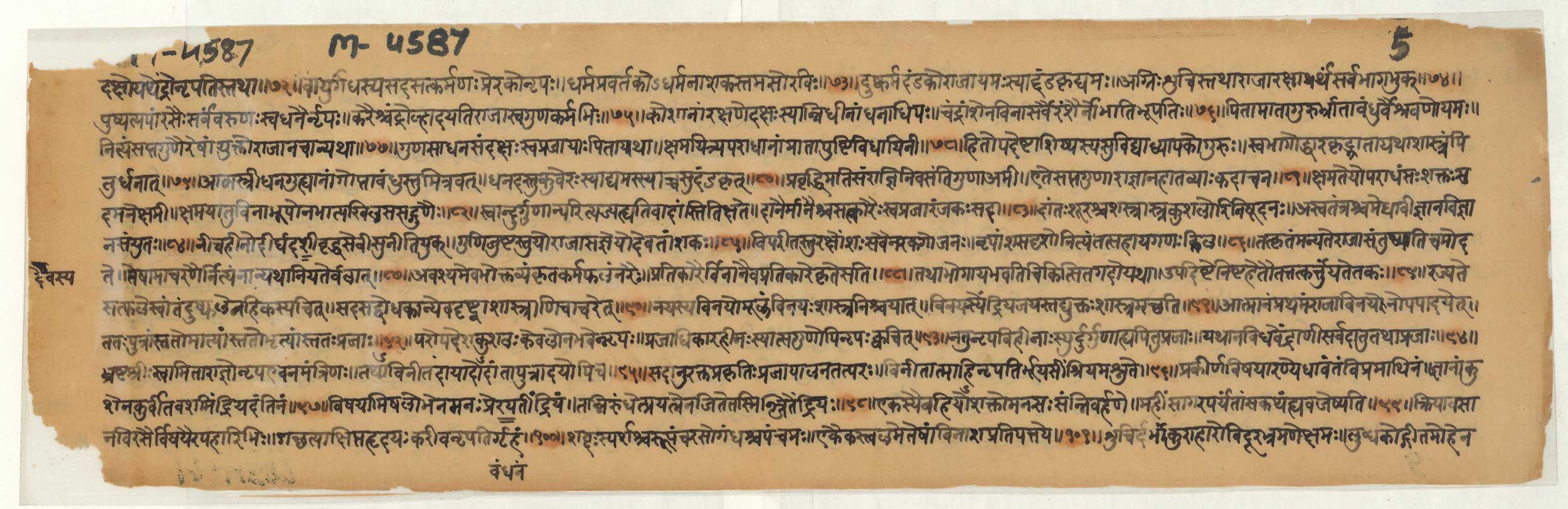
He is the lord of both –the movable and immovable worlds through his penance // like Indra, the king is able to protect the wealth and the possessions // 72 //Like the air spreads the aroma, similarly the king inspires good or bad deeds // as the sun is the dispeller of darkness and the creator of light similarly the king is the founder of righteousness and the destroyer of what is not along the lines of righteousness // 73 //As Yama(the god of death) punishes human beings after death so also the king is the punisher of offences //like the fire the king is the purifier and the enjoyer of all gifts // 74 // As VaruNa (the god of water) sustains everything by supplying moisture, so also the king maintains everybody by his wealth //as the moon pleases human beings by its rays, so also the king satisfies everybody by his virtues and activities // 75 //as the god of wealth protects the jewels of the universe so the king protects the treasure and possessions of the State //as the moon does not shine well if deprived of one of its parts similarly the king does not flourish unless he has all the parts described above // 76 //The king should always have the qualities of a father, mother, teacher, brother ,friend VaishravaNa (Kubera) and Yama //the king should always have the qualities of these five and not otherwise // 77 //As a father provides his off springs with all the means so the king can endow his subjects with good qualities // the mother pardons all the faults of her children and nourishes them // 78 // The teacher is the one who tells the pupil things for his welfare and teaches him good lessons // the brother takes out his own legal share from ancestral property as per the shastras (wisdom books) // 79 //A relative is like a friend who is a confidante(protector) of self, wife, wealth and secrets (so also is the king)// Kubera gives wealth( so also the king) and Yama is the punisher(so also the king) // 80 // These attributes abide in the king who is prospering // These seven qualities should never be deserted by a king // 81 //The one who can pardon and is able to uproot and subdue(the offenders),he is the powerful one // the king does not look good with all the qualities having no mercy // 82 // The king should give up his faults and should avoid being a loud mouth // he should always make his subjects happy with gifts, with honour and by treating them properly and respectfully // 83 // The king who is restrained, brave, skilled in the use of arms and shAstras, who is the queller of enemies //who is not independent (of NIti),who is brilliant and has knowledge of arts and science // 84 //who is not an associate of the lower classes, who is farsighted, respects old people and attends to NIti //who is respected by meritorious ,is known to be a part of the gods // 85 // The king who is opposite of this is a part of demons and gets hell //the attendants of the king always certainly are according to the parts of the king // 86 //The king abides by their actions and is always content and happy by their conduct //he cannot be otherwise because of the strength of fate // 87 //People have to endure the results of their deeds //if the remedies are followed then the effects have not to be endured // 88 //like the one has to endure the disease for which he is undergoing treatment //who will try to follow the advice that causes harm // 89 // Mind is gratified only with good results, nobody’s heart is attracted by evil consequences //so no one should follow the shAstras after discriminating between those that treat of good and those that treat of evil consequences //90 //Discipline is the main thing for the king, this comes through following the shAstras //this gives mastery over senses and the one who has mastered the senses acquires the shAstras // 91 // First the king should be disciplined himself // then he should discipline his sons, then ministers, servants and then the subjects // 92 //he should never just be advising and preaching others //sometimes a king, though well qualified, may be without any subjects or rights // 93 // Even if the subjects have many vices ,they should not be without a king //just like IndrANi is never a widow so also the subjects (should never be without a king ) // 94 //In a kingdom if there is only a king and no ministers then it is deprived of its beauty //and also if there are no well-disciplined kinsmen and restrained off springs // 95 // The king whose subjects are devoted, who is devoted to the protection of his subjects // and who has disciplined himself, enjoys great prosperity // 96 //Running here and there in a destructive manner in the vast forest of enjoyable things //one should discipline the elephant of senses by the hook of his knowledge // 97 //The mind attracted towards the meat like enjoyable things encourages the senses //so one should carefully check the mind, for when the mind is controlled the senses are conquered // 98 //The one who is unable to control one mind //how can he master the world extending to the sea// 99 //The king whose heart is agitated by the enjoyable things //gets into a trap like an elephant// 100 // Sound, touch, sight, taste and smell, each of these five // alone is sufficient enough to cause destruction //101 //
The deer which is innocent and eats pure grass and newly grown plants and can roam far and wide // gets killed attracted by the music of the hunter // 102 // The elephant with his body like the peak of a mountain and who can uproot trees with ease //is caught because of the attraction of the touch of the female elephant // 103 // The wasp dies suddenly falling into the light of the oil lamp // because of its passion for the light // 104 // The fish though it dives into unfathomed depths and lives in distant abodes //tastes the meat in iron angle only to die // 105 // Although the bee has the power of cutting holes and can fly with wings //however gets caught within a lotus because of its desire for smell // 106 //These poison-like vishayas are each capable of ruining anyone //what to say of the five combined, will they certainly not cause destruction ? // 107 // Gambling, indulgence in women and drinking cause many disasters //but when within due limits, they give wealth, sons and intelligence // 108 // Nala, Yudhishthira and many others were ruined by honest gambling //but when played with dishonesty it is productive of much wealth to those who know it // 109 //Even the names of the females are captivating and they adulterate the mind //what to speak of the effect of the sight of those whose eye brows are decorated for luxury // 110 // Skilled in the art of a secret conversation, who talks softly and sweetly // whose eyes are read whom does not this kind of a woman subdue // 111 // With passion a woman can control the heart of an ascetic also // who has conquered the senses(then ) what to talk of the men whose senses are uncontrolled // 112 // many of these kings have been ruined by the attachment to women //like Indra, DaNakya, Nahusha, RAvaNaand others // 113 // A man who is not extremely attached with his wife ,is also for his happiness // for without her there is no other companion in domestic work // 114 //A man who drinks wine excessively, his intelligence certainly disappears //wine drunk with control increases the talent, intelligence, patience and makes the mind more steady // 115 //Drinking with control increases (these things) otherwise it is for destruction //sensuousness and anger both are like wine and should be used correctly // 116 //Desire in the maintenance of the subjects and anger against the enemies //the king who wants to be victorious, he should indulge his greed with his army //117 // The king should not be indulging with others’ wives, greed or others’ wealth // he should never have anger while punishing his subjects // 118 // Can a man be called a family man who indulges with other’s wife ? // can anyone be called a hero who punishes his own subjects? can a man be called wealthy by having someone else’s wealth ? // 119 // The king who does not protect, the brahmin who does not perform penances //the rich man who does not do charity-the gods ruin them and leave them down // 120 // The fruits of penance are being a master, having a position of a giver and being rich //The fruits of sins are begging, slavery and poverty // 121 // having observed the shAstras and duly governed one’s own self, the king should discharge his duties for happiness in this world and the next // 122 // Punishing the wicked, charity, protection of the subjects // performing rajasUya and other sacrifices honest earning of the revenues// 123 // Conversion of the kings into tributary chiefs, quelling the enemies //extraction of wealth from land-these are eight functions of the king // 124 //The kings who do not strengthen their armies are like oxen(fools) //by whom the kings are not made to pay tribute and by whom the subjects are not well protected(they are like fools) // 125 //The most miserable king is the one whom the subjects look upon with terror and disrespect //and who is deserted by both rich and virtuous men // 126 //Actors, musicians, prostitutes, athletes, eunuchs and lower castes //the king who is too much attached with these he deserves ignominy and is exposed to the enemies // 127 //The king who is jealous of the wise people and is pleased with cheats // and does not understand his own faults, creates his own destruction // 128 //When the king does not pardon offences, is a great punisher, is the robber of man’s wealth // and oppresses the subjects on hearing of his own faults // 129 // Then the society gets disturbed and disorganized //by making the secret spies he keeps the information as to who are accusing his conduct// 130 // In what light the ministers and others who know it are viewing it // what is the extent of satisfaction and who are discontent with him // 131 //
Owing to his virtues and vices and hearing everything from them in secret || the king deserving praise should always know his own faults from the standpoint of the subjects|| 132 ||For his good fame the king should always get rid of his faults but never punish the people || people criticize the king if he is made to hear things by the spies || 133 || the king gets angry through his wickedness and he hides his own faults ||due to the feeling of what the subjects will say even chaste SIta was abandoned by Rama || 134 || The washer man who was able to do so ,even a small punishment was not given to him ||even when immunity is granted by a king educated in arts and science || 135 || nobody can dare speaking out even about his serious offences in his presence ||it is heard that gods like VishNu are also certainly fond of praise || 136 || What then to talk of the men? Criticism always angers people ||so the king should always be kind, punishing correctly and be affectionate || 137 || Youth, life, mind, beauty, wealth and being a master ||these six are very fickle so knowing this one should be following righteousness || 138 ||If a king does no charity, insults people, deceives them and uses harsh words ||who gives severe punishments, the subjects certainly leave this kind of a king || 139 ||The subject is satisfied with the opposite qualities of this ||if one demerit spreads ill fame, will a combination of all these bad qualities(not do any harm)? || 140 ||For kings hunting, gambling and drinking are condemned ||destruction from these are seen in cases of PANdu, Naishadha and VrishNi respectively || 141 ||Desire, anger, attraction, temptation, vanity and passion ||one should give up all these six, when the king gives up these he becomes happy || 142 ||King DaNakya because of desire, king Janmejaya due to anger ||king Aila due to greed, demon VAtApi due to foolishness || 143 ||Demon Paulastya due to vanity, king Dambodbhava due to passion-certainly these people died by taking one of these six enemies || 144 ||By giving up (these) six enemies the powerful Jamadagnya (son of Jamadagni) || and the fortunate Ambreesha ruled on the earth for a long time || 145 ||Augmenting virtue and wealth which are respected by the good people ||and controlling his senses, the king should worship his teacher || 146 ||Association with the teacher is for the acquisition of the shAstras which is there to increase the humility ||the king who is humble due to his knowledge is always respected by the good people || 147 ||he does not incline towards doing wrong things even if impelled by evil motives || Even if impelled by evil motives (the virtuous ones ) do not incline towards wrong deeds ||they are decided (to do good deeds) by their minds and which are known to be virtuous by Shrutis, Smritis and the traditions || 148 || The knowledgeable one does the work which has been prescribed by the religion || the wise king acquires the various branches of learning daily || 149 || The king who has conquered his senses and who follows the NItishAstra ||his prosperity ascends and fame reaches the skies || 150 ||AnvIkshiki (logic),the TrayI (three Veda),VArtA (economics) and DaNdnIti ||the king should always study and practice these branches of learning || 151 || The science of discussion and VedAnta are founded on the science of AnvIkshakI ||virtue and vice as well as interests and injuries of a man are based on the TrayI || 152 ||Wealth and its opposite on VArtA, good and bad government on DaNdanIti ||thus all the casts of men and the stages of human life are built upon these sciences || 153 ||The six Angas, the four Vedas, MImAmsA (a system of philosophy),NyAya (a system of philosophy) ||DharmashAstras as well as the PurANas-all these constitute the TrayI || 154 ||In VArtA comes treated interest, agriculture, commerce and preservation of cows ||the man who is good in VArtA need not be anxious for earnings || 155 ||Since DaNda is restrain and punishment, the king is also known to be Danda ||the NIti that regulates punishment constitutes DandanIti,so called because it governs and guides || 156 ||Man gives up both pleasure and pain through AnvIkshikI and science of self (metaphysics) || 157 ||Since kindness is a great virtue among men || so the king should rule the poor people with kindness|| 158 || The king certainly should not oppress the miser people for his own comforts ||as dying through oppression the miser ultimately will ruin the king by his death || 159 ||One should associate with the good people both for virtue and happiness || one who is respected by the good, attains great prosperity || 160 || Like the cool rays of the moon, like the newly blossomed lotus of the pond ||the activities of the good people
make others happy || 161 ||One should leave the frightening and inhospitable || company of bad people which is terrible like the desert scorched by the summer sun || 162 || One should associate rather with snakes whose mouths contain poison and whose faces have been darkened by the smoke of fire exhaled by their breathing ||but should never associate with bad people || 163 || Like to honour good people both the hands are folded ||by the one who desires good, the bad people should be accorded even a better treatment || 164 || One should always make everyone happy by pleasing words ||even the person who gives away wealth in charity, terrifies the people if he uses harsh words || 165 || the words by which a person feels hurt like wounded in his heart || the wise people should never use such words || 166 || Whether with good or bad people one should always use pleasant words ||the one who speaks sweet words like a peacock becomes popular amongst people || 167 || The voices of a swan red with passion, the cuckoo bird and the peacock || also are not that attractive as the speech of a wise person || 168 || Those who speak pleasant words and do good deeds || are praiseworthy and prosperous, they are gods in human form || 169 ||There are not such prayers in the all three worlds || such as mercy, friendship, charity and sweet words || 170 ||One should worship the gods with a heart purified by faith in them ||treat the seniors as gods and the equals as himself || 171 ||By salutations to the seniors, by good behavior to the good people || and by good deeds and bent faces one should make all these favourable || 172 || one should attract the friends and relatives by good behavior || and wife by love, the servants by offering distinctions and other gifts || 173 ||The man who is powerful, intelligent and brave || he enjoys the earth full of its wealth and such a king becomes the lord of the world || 174 ||Valor, strength, intelligence and bravery-these are great qualities ||the king who is devoid of these but has other qualities and may be wealthy || 175 ||Still he cannot enjoy even a small region and is soon thrown down from his kingdom || superior to the very wealthy king is the monarch who even with his small territory || 176 ||has his commands unobstructed and is powerful, he can be such with the qualifications mentioned above || men who are other than kings are not competent to rule and beautify the earth || 177 ||The earth(land) is the source of all wealth and mellows down the gods and demons ||for this earth kings can lay down their lives || 178 || People preserve wealth and life for enjoyment || but what use of wealth and life if one has not protected the land || 179 || Accumulated wealth can never be sufficient for any amount of expenditure || truly, without perpetual income nobody not even Kubera is sufficient || 180 ||The king is honoured because of these qualities and not because of being born in a family of kings ||he is not respected so much because of his ancestry as for his prowess, strength and valor || 181 || In whose kingdom an annual revenue of one lakh || up to three lakhs karshas is regularly realized || 182 || That king is called a SAmanta ||the king whose annual revenue exceeds three lakh karshas, is called a MAngalika || 183 || The RAjA is whose income exceeds ten lakh karshas up to twenty lakhs ||the MahArAjA is whose income reaches to the fifty lakh || 184 || The swarAt is whose income exceeds last up to one crore||and after that is SamrAt whose income exceeds a crore up to ten crores || 185 ||VirAt is the one whose income goes beyond that to fifty crores || and SArvabhauma is the one who is above that and to whom the earth is always bound with its seven islands || 186 ||The king has been mad a servant of the people getting his revenue and remuneration || by BrahmA only to always look after and protect his subjects || 187 ||Those servants who have been appointed equal with SAmantas ||and others are also to be known as SAmantas etc. in succession and to be sharers of the royal income || 188 ||Those who have been deprived of the post of the SAmantas etc.||but who are maintained by the MahArajas and others at the same salary are called HeenaSAmantas || 189 ||The governor of a hundred grAmas is also called a SAmanta ||the man who is appointed by a king over a hundred grAmas is called a AnuSAmanta ||The controller of a hundred grAmas is also named as SAmanta || 190 ||The man who is appointed over ten villages (grAma) is called as NAyaka ||the one who enjoys the revenue of ten thousand villages is known as AshApAla, It is also known as SvrAt || 191 ||
A grAma is that piece of land which is one krosha in area and whose yield is 1000 silverkarsha ||the half of a grAma is called palli and half of a palli iskumbha || 192 ||According to PrajApati one krosha is 5000 cubits || according to Manu it is 4000 cubits vast || 193 ||According to BrahmA the area of a krosha is two crora and a half cubits || or two thousand five hundred vinivartanas || 194 ||An angula is the middle part of the middle finger ||eight yavodaras by length and five by breadth or wider length || 195 ||According to PrajApati a cubit is made of twenty four angulas ||this standard is the best for land measurements, other standards are inferior || 196 || A daNda is equal to four cubits and also five cubits || the angula of the cubit for measuring daNda and laghu is five yavodaras (not eight as mentioned above) according to Manu || 197 ||According to PrajApati 768 yavodaras || and according to Manu 600 yavodaras are said to be one daNda || 198 || According to each of them 25 daNdas are nivartana || A nivartana is equal to 3000 angulas ||199 ||15,000 yavas or 125 cubits-according to Manu ||(according to PrajApati) one nivartana is equivalent to 19,200 yavodaras || 200 || 2,400 angulas and 100 cubits, this is what is always said by PrajApati || 201 ||According to both systems the area of a nivartana is 625 dandas ||because on each side there are 25 dandas || 202 ||A parivaratana is made of 75,000 angulas || according to Manu, and 60,000 according to PrajApati || 203 ||According to Manu, a parivartana is 3,125 cubits, || according to PrajApati it is 2,500 cubits || 204 ||According to Manu ,a parivartana is 4 lakh yava minus p = - ¼ lakh || according to PrajApati, it is 80,000 over four lakh yavas || 205 || According to Manu,32 nivartanas would make ||4000 cubits or 800 dandas || 206 ||Bhuja or one side of a parivartana is twenty-five dandas ||the area, therefore, is an ayuta karas || 207 || Parivartana of cultivated land is four bhujas ||according to PrajApati’s system the king should always realize his share(revenue)of the produce from the land || 208 ||But in times of danger and difficulty, according to Manu’s system, not otherwise ||the king who extracts his share with greed gets destroyed along with his subjects || 209 ||One should not give up even two angula of land in such a way as to part with rights to it ||may, however, give away to people for their maintenance but only for as long as the receiver lives || 210 ||The wise man should always give away land for gods || for parks, public grounds and for houses for the peasants || 211 ||Full of different types of trees and creepers, surrounded with animals and birds ||with a lot of water and grains and full of grass and wood || 212 || Such a place, bestirred by the movements of boats up to the seas and is not very far from the hills ||and is an even-grounded picturesque plain, the king should build his capital there || 213 ||(The king’s place) should have the beautiful shape of half a moon or a circle or a square ||should be surrounded by walls and ditches and must contain sites villages and other divisions || 214 ||It should have the Council building ( SabhA ) in the center, must always be provided with wells, tanks and pools ||which is to be furnished with four gates in four directions and which is to have good roads and parks in rows || 215 ||And well-constructed taverns, temples and rest houses for travelers || having built such a capital, the king, well protected, should live there with his subjects || 216 ||The palace should be in the middle of the Council buildings and must have stables for elephants, horses and cattle ||should be well adorned with spacious tanks, wells and water pumps || 217 ||should have equal length in all directions and should be high southwards and low northwards ||the palace should have many and odd numbers of sides except the ordinary buildings || 218 ||For ordinary buildings ,unless they form a square among themselves, they do not look well ||the palace is to have walls guarded by sentinels equipped with arms and weapons and defended by strong machines || 219 ||Should have three courtyards and four beautiful gates in four directions ||the palace is to be watched both during day and night || 220 ||By four, five or six well-armed guards placed in each courtyard and acting in rotation||the king should furnish the palace with various houses, tents, rooms and halls || 221 || (The king should have houses towards east) for washing clothes, for bathing, for performing sacrificial rituals ||for eating and for cooking, the houses should be made in the east || 222 ||For sleep and entertainment, for drinking and crying || for grains and grindstones, for servants and maids || 223 || As well as for creating a nuisance,
houses should be built in an order towards the south || houses should be built towards the west for cows, deer, camels, elephants and other animals || 224 ||for chariots, horses, arms and weapons, gymnasium ||for clothes, provisions and study || 225|| the northern rooms should be built strong and beautiful ||or the king may build these houses according to his wish || 226 ||the king should built the courthouse and the shilpshAlAs to the north of the palace ||the height of the wall of a room is to be one fifth more than its length || 227 ||The wall is to be wide to the extent of one sixth of the room ||The above is the measure for a house of one floor, for houses of more than one floor the measure will rise accordingly || 228 || One should separate the rooms by pillars or walls ||A house should have three, five or seven rooms || 229 || The house is to be broken at eight places for doors||two doors in each of the four sides are effective in giving wealth and children to men || 230 || The doors must be placed there and not anywhere else ||but the windows in different rooms can be made according to one’s liking || 231 ||One should not have a door just obstructed by the door of another’s house ||or a tree, or by an angle or a pillar or a road or a stand or a well || 232 || Obstructions to roads must not be at the gate of a palace or a temple ||the floor of a room should be made one fourth of the height || 233 || But others say that in the cases of palaces and temples it should be one-half ||the window also must not be obstructed by another man’s window || 234 || The roof made of tiles is to be high in the middle to the extent of half of the length ||so that the water falling on it may go down easily || 235 || The roof should not be weak or low so also the floor of the room ||the wall of the town is to be uniform in depth and should have its foundation to the extent of one-half of its height || 236 || or one third of its height and have its width one half of its height ||the wall must be made so high as not to be jumped across by the robbers || 237 || The wall is to be always guarded by the watchmen with guns ||the wall should have many strong shrubs and have a system of well-built windows || 238 ||If a hill is not hard it should have a second wall but less than itself in height ||the ditch is to be constructed, having its width double the depth || 239 ||not very near the rampart and having plenty of good water || Unprovided with the secret instruments and preparations, unattended by men who are proficient in the art of warfare || 240 || It is not good for the king to live in such a fort(without military men and provisions) as such a living for him is for the king’s capture || The council house should be constructed by the king secret and beautiful || 241 || (The council house of the king) should be very big with three, five or seven rooms || The northern and the southern sides should be long, twice or thrice the eastern and western according to the liking || 242 || The house should be built with one floor, two floors or three floors|| and should have tents as the houses on top || 243 ||There should be windows in each room on all sides of the council house ||the width of the central room should be double that of the side rooms || 244 || The height of the middle room(hall) should be one fifth ||more than its width or is to be equal to it || 245 || The floor of the rooms as well as the roof ,are also to be constructed ||The two side rooms have each two floors but the central hall is to be of one floor || 246 ||The Council House is to be a beautiful edifice having good rooms within separate pillars and accessible by all routes ||and it has to be furnished with the instrument for throwing water upwards and musical instruments || 247 ||With instruments for distributing air and for indicating time(clocks) || mirrors as well as pictures || 248 ||Such a Council is for the deliberations of proposals and consideration of problems ||residents for ministers, clerks, members of Council and officers || 249 || should be built separately to the north or east ||leaving a space of hundred cubits the palace || 250 || and 200 cubits towards the east of the palace, military cantonments are to be laid out ||the houses of the subjects should be around the palace || 251 || The wise king should provide for the houses of the people|| in order of wealth and birth near his palace in all directions || 252 || The following are to be stationed according to the order indicated below || first the lower officers and servants, then the commander, then the infantry, then the cavalry || 253 ||Then the men of horses, men with elephants, attendants of the elephants and after that ||the guns and ordnances and then the mares || 254 ||
Then the bodyguards and aid-de-camps, then the foresters; these houses stationed in this order in the city are always nice || 255 || Then the hidden rest houses for travelers are to be built with clean water tanks ||the rooms of the rest houses are to be uniform and in a row || 256 || These should be made before or after the cities or villages ||in the market place, stalls or shops are to be placed according to the classes or commodities || 257 || On both the sides of the road houses are to be arranged according to the wealth of the inhabitants ||the king should plan both town and the village this way || 258 || From the palace of the king, the rAjmArgas(palace roads) are to be constructed in all four directions || The best rAjmArg should be thirty cubits wide || 259 || The average twenty cubits and the worst fifteen cubits only ||these roads are situated in towns and villages both and are used for conveyance of marketable commodities || 260 || The footpath is three cubits wide and the alley is five cubits wide ||and in towns or villages it is said to be ten cubits || 261 || These ways should start from the center of the place towards east, west, north and south || the king should get many roads made according to the number of the towns || 262 || But he should not construct an alley or a footpath in his capital ||the bestrAjamArga is to be constructed in a forest in six yojanas (one yojana is equal to forty eight miles)|| 263 ||in the middle is the average and in between the two is the worst || there should be roads of ten cubits in each village || 264 || For villages the roads are to be made like the back of a tortoise and they should be made with bridges ||and the road should be provided with drains on both sides for water outlet || 265 ||all the houses must have their faces on the main pathway || and on their backs there should be allies and the place for garbage outlet || 266 || The houses should be made in two rows ||the king should have the roads repaired every year with gravels || 267 || He should get this done by offenders or the villagers ||between every two villages he should get a rest house built || 268 || It should be cleaned every day and should properly be protected by the village rulers ||the master of the shAlA should always ask the following questions to the travelers coming there || 269 ||Where are you coming from and where are you going, speak the truth ||are you with attendants, do you have weapons with you ,do you have any conveyance || 270 ||What is your caste? What is your name, which is your family? where is your permanent residence ? || After asking these questions the master of the rest-house should note them down and in the evening taking the traveler by the arms || 271 ||should advise him to sleep carefully || after counting the number of men in the house should shut the gate || 272 ||It should be guarded by the watchmen and they(the people there) should be awakened by them in the morning ||he should give back the arms, count the men and then let them off by opening the gate || 273 || And should always accompany them till the boundary line ||the king living in the capital city should discharge his duties daily || 274 || After getting up in the last YAma, he should certainly study for two muhurtas ||how much is the fixed income and how much the certain expenditure || 275 || How much from the treasury has been used for things and materials ||what is the remainder after the transactions from the fixed income and expenditure || 276 || How much has been used out of the things and materials in the treasury? || what is the remainder after the transactions from the fixed income and expenditure?|| 277 || Then ascertaining from the record as well as by personal knowledge as to the amount expected to be spent ||today he should bring the articles out of the treasury || 278 || The for one muhurta clearing of bowels and bathing are prescribed ||two muhurtas should be spent in prayers, study and charity || 279 || The wise people spent their time in charity and giving prizes by one muhurta||and he should pass one muhurta in donating food, clothes, gold, jewels, army (elephants, horses, carriages),he should spend four muhurtas in writing the income and expenditure || 280 || He should spend four muhurtas over writing orders, together with estimates of income and expenditure about grains, clothes, gold, jewels and soldiers|| In one muhurta he should have his meals in a happy frame of mind along with his kith and kin || 281|| He should observe old and new things for one muhurta ||then he should spend two muhurtas over the matters explained by the officers || 282 || He should spend two muhurtas in hunting and entertainment ||one muhurta over the military exercises of the regiments, then one muhurta in evening prayers || 283 || He should spend one muhurta in meals and two in talking ||and hearing information given by the secret spies and eight muhurtas in sleep || 284 || The king who works in this manner his happiness increases||thus dividing the day and night into thirty muhurtas he should pass the time || 285 || He should never waste his time in indulging with women or drinking wine ||as the work done at the correct time certainly produces good results || 286 ||
Rains on time give rise to nourishment but otherwise they are very harmful || his workplace should continuously be guarded by the watchmen | | 287 || The king adept in use of kind words and proficient in rules of morality and etiquette should have offices of work guarded on all sides without cease by four, five or six excellent watchmen, well trained in use of arms and weapons || 288 || He should hear about the daily affairs of those places through his head clerks , he should use the watchmen by rotation everyday || 289 ||The outpost should be built by the police at the mouth or the end of the lines of the houses ||the king should hear reports of their work from them who are to be maintained by wages raised from the householders || 290 || But those who are of known, illustrious deeds and character, he should allow them without consideration ||watchmen should visit the alleys every half yAma i.e. hour and a half || 291 ||For stopping the thieves and the bad characters (the watchmen should do this )the following laws are to be always promulgated by the king among his subjects || 292 ||Towards the slaves and servants, towards the wife and children or towards the disciple ||no one obeying my (the king’s 0 command should be harsh and cruel in words || 293 || Falsehood must not be used by anyone in the system, || standard of weights and measurements, currency, extracts, some kind of metals and clarified butter (ghee),|| 294 ||Honey, milk, fat, oil, ground substances and other things ||writings or statements must not be forced on the people || 295 || Bribes must not be accepted nor the interest of the master consciously damaged ||one should never protect the men of foul activities, thieves, of bad characters and of malicious, offensive persons || 296 || Nor should one protect the other wrong doers ||Mothers, fathers, elders and scholars should never be insulted || 297 || Insult and jokes should never be dealt out towards the people of good character and behavior||dispute must never be created between husband and wife, master and servant,|| 298 || Brother and brother teacher and the disciple, son and the father ||one must never obstruct the tanks, wells, parks, rest houses, boundaries and drinking places || 299 ||One must not check the movements of the poor, blind and the deformed || (without the king’s permission)the following things are not to be done by the subjects-gambling, drinking, hunting, use of arms|| 300 || Sales and purchases of cows, elephants, horses, camels, buffalos, men, immovable property,||silver, gold jewels, intoxicants and poisons,|| 301 || Distillation of wines, the drawing up of deeds indicating a sale or a purchase|| sale ,purchase or a loan document|| 302 ||and medical practice should not be done by the people without the permission of the king||or taking the treasury (without his permission) is like committing a great sin || 303 || Promulgation of new social rules, defamation of castes||receipt of not owned ,lost goods disclosure of State secrets|| 304 || Discussion about the king’s demerits|| Forsaking one’s own religion, untruth, perjury,|| 305 || Forgery, secret acceptance of gifts,|| realization of more than the fixed revenue, theft, violence|| 306 || One should not do these even in his mind and also not go against the master||in the matter of remuneration , duties or revenues by increasing them through strength or cheating || 307 || Or by violence, one should never do these things ||all measurements should definitely be fixed and ascertained by the king || 308 || All the subjects should be qualified in meritorious actions || In case a violence has been committed, the aggressor must be caught and handed over (to the State) || 309 || Those who have let out the bulls and other animals, must keep them within proper control|| Hearing about my rule of this kind|| 310 ||Who so ever acts contrary to them, I will surely destroy them by giving them severe punishment||the king should always inform the subjects of these laws by the State drums || 311 || The king should write his orders and get them placed on four- ways||the king should always be ready to punish the wicked people and the enemies || 312 || The subjects should certainly be looked after by the king according to the NIti || The king should protect the roads for the comfort of the travelers || 313 || Those who trouble the travelers should be beaten with an effort||the army is to be maintained by three (such parts), charity by half of such a part, ||314||People are to be entertained with half and
officers are to be paid with half ||Personal expenditure (to be met) out of half(of such a part) and the treasury is to be saved by the remainder || 315 || By dividing the income into six such divisions the king should incur the expenditure yearly||this rule is meant to be followed by the SAmantas and above and not by inferiors || 316 || Of the State, fame, riches and virtues||the one which has been achieved ,should be protected but not snatched|| 317 || There should be a good effort in acquiring and preserving these||one should never leave valor, wisdom, oratory, giving charity|| 318 || One should always be very mindful about the acquisition and preservation and never abandon heroism, scholarship, straight speaking and philanthropy||the king should be mindful about strength, prowess and daily preparation of war || 319 || That man is a brave, who without fearing for his life can securely fight battles for his own interest or for the cause of his master||without being partial who can accept the well spoken words of a child|| 320 || And practices the truth of religion, he is a wise and a learned man||the man ,who even in the presence of a king can fearlessly speak out his demerits|| 321 || And never praises them like the merits is a real speaker||the man to whom there is nothing to be kept back from gift i.e. wife, son and wealth|| 322 || The one who can even give away his life to the suitable person is called a giver|| That is called strength by which a work can be done without anxiety || 323 || Prowess is that through which other kings appear to be more like obedient servants||’utthAna’ is known to be the preparation for warfare || 324 || For the fear of poisons the king should examine his food through monkeys and cocks||seeing the poisoned food drakes limp, bees hum and peacocks dance || 325 || Cocks cry, cranes get intoxicated, monkeys pass stools||rats become excited ,bird sarika vomits|| 326 || Thus after checking and examining the food then only it should be eaten||the king should not have just two, three tastes of meals but of six|| 327 || The food should be neither distasteful , nor over tasteful, nor pungent, nor excessively sweet or acid||with ministers the king should hear the petitions and the appeals of the people|| 328 || He should carefully indulge in enjoyments with people in parks||and with women, actors, musicians, poets and magicians|| 329 || He should exercise himself every morning and evening with elephants, horses and chariots||and the military arrangements of the soldiers he should learn himself as well as should teach them || 330 || With tigers and others wild animals, with peacock etc. birds||he should play with and during the course of hunting he should kill the wild ones|| 331 || The advantages of hunting are the growth of ability to strike the aim||fearlessness and agility in the use of arms and weapons|| 332 || These are the qualities of hunting but cruelty is the bigger defect||from his officers he should understand what all has been pointed out by his subjects|| 333 || He should every night hear from the secret spies and informers ||the opinions, sentiments and demonstrations of the subjects and relations|| 334 || He should always hear from the spies at night about the secret behavior of these||he should that carefully and well equipped with arms and weapons should note down the statements of the spies|| 335 || The(king)who does not punish the false-speaking spy||becomes the destroyer of the subject’s lives and money and is called a mlechcha|| 336 || Either directly or by using some art or in the garb of a young hermit or a lower class man or a magician||(the king) should test his spies(directly)or indirectly|| 337 || If the king accepts a spy without testing him as said above, he can get no information and has to repent||and the spy also does not fear to speak lies to a king who has not examined him(the spy)|| 338 || He should protect the spy from both-officers as well as the department of administration||there should neither be one leader in a State and nor many|| 339 || The king should never try to leave any situation without a leader|| 340 || If there are many males in the king’s family then certainly || the eldest of them is to be the king, the rest of the others are to be his assistants || 341 || The one who in spite of being the eldest, is deaf, leprous, dumb, blind or an eunuch ||then he is not eligible for the throne, his brother or son (will be eligible for it) || 342 || Then the eldest son’s junior (the king’s second son) or the son of the king’s brother will get the throne ||the unity on opinion amongst heirs is good for the king || 343 || Differences among them are dangerous for both –the family and the kingdom ||hence the king should arrange for these heirs the same kind of comforts and enjoyment as for himself || 344 ||By the partition of kingdoms there certainly can arise no good||rather the kingdom divided into parts is exposed to the enemies|| 345 ||
He should station them in various quarters by paying them one-fourth of the royal revenues||or make them governors of provinces|| 346 || He may appoint them as heads of cows, elephants, horses, camels and treasure etc.||the mother and the lady who is of the same rank as the mother should be appointed in charge of the kitchen|| 347 || The kinsmen and the brothers-in-law are to be appointed in the military department||critics of one’s own faults are to be made those who are superiors and friends|| 348 || Females are to be appointed in the field of clothes, ornaments and vessels||but he himself must reflect upon and put a seal on all these|| 349 || In some secret place, the inner place of the house, uninhabited forest, by day or by the night||he should consult with the ministers on future actions|| 350 || With friends, brothers, sons, relatives||commanders and members of the Council House he should discuss the royal duties|| 351 || In the center of the western half of the meeting of the royal throne is to be placed||the bodyguard and retinue are to sit by his right and left|| 352 || The sons, son’s sons, brothers, nephews at his back|| the daughter’s sons are to sit back in succession, proceeding from the right towards the left|| 353 || Uncles, elders of the same family, members and commanders||are to sit in front or separate seats at the right hand moving towards the east|| 354 || Superiors in the family of maternal grandfather, ministers, cognate relations||fathers-in-law, brothers-in-law, and officers are to sit in front at the left hand|| 355 || The son-in-law and the brother-in-law are to sit just on the left and right sides||and the friend is to be like him, either near or on half of his own seat|| 356 || In the place of daughter’s sons, nephews, the adopted sons||may be seated and nephews and daughter’s sons may have seats of the sons|| 357 || The preceptor, like the father, is to sit on the same kind of good seats||on both sides and in front the scribes and clerks are to be at the back of the ministers|| 358 || The servants are to be seated at the back of all||two men bearing gold scepters are to be on one side to communicates the presence and salutations(of persons) to the king|| 359 || The king should enter upon the throne provided with his special signs||well-dressed, well-decorated, armoured and with the crown on|| 360 || With effective missiles and uncovered weapons and very careful||you are the greatest of all charitable men and heroes|| 361 || Such remarks he should not hear as those who speak in this way are deceitful men||the ministers are likely to remain silent through passions, greed and fear of the king|| 362 || The king should not consider them friends for his own interest||he should receive in writing the opinions of each of them separately with all his arguments|| 363 || And compare them with his own opinion and then do what is accepted by many||the wise king should every day examine the elephants ,horses, chariots, cattle, servants, officers|| 364 || Provisions and soldiers||he should preserve and maintain the able ones and should give up the very old|| 365 || He should bring in one day the news of a hundred croshas of distance||he should train the officers appointed with salaries in the cultivation of all arts|| 366 || Having seen that they have finished their studies, he should appoint them in their special fields||he should also honour those every year who are very high in arts and sciences|| 367 || The king should always take those steps which advance the arts and science of the country||he should engage near him the services of the soldiers who are to precede and follow him, are fiercely dressed and are adept in the rules of etiquette and morality|| 368 || Who are supplied with useful missiles and naked weapons||he should tour the city on the back of elephants in order to please the people|| 369 || Does even the dog not look like a king when it has ascended a royal conveyance?||is not the king justly looked upon as a dog by the poets|| 370 || Hence he should be accompanied by his kinsmen, friends and State officers who have been made equal to him through qualifications|| never by low class people|| 371|| The wicked and the honest are respectively the men whose practices are false and evil, and good|| The wicked people surely show greater gentleness than the good people || 372 || The king should personally inspect every year the villages, the cities and the provinces||(he) must know which subject has been pleased and which have been troubled by his officers|| 373 || He should deliberate upon the matters brought forward by the people||he should take the side not of his officers but of the subjects|| 374 || He should dismiss the officer who is accused by one hundred men||he should check his minister also and if he finds him going astray more than once || 375 || Then he should privately punish him and dismiss him who by nature commits offences||he should take away the kingdom and the property of those kings who do not follow the NIti|| 376 || In the territories of the conquered kings he should establish courts|| he should give pensions to the
conquered kings as per their characters || 377 || A woman who is devoted to him is well dressed, beautiful and soft and sweetly spoken ||well adorned (with ornaments) and well purified, he should have her as his bedmate|| 378 || He who sleeps for two yamas (six hours ) enjoys much happiness||he should not leave his own place but conquer the enemies through NIti|| 379 || Teeth, nails, hair and kings do not look good when taken out from their proper places||the king should always take a shelter in the hill forts in times of great danger|| 380 || And from those places should try to recover his kingdom by violence and robbery||for marriage, donation and sacrificial rituals 8th part of the wealth|| 381 || The king should seize from all quarters all the wealth of all the enemies like a robber||he should not live forever in the same place and` never have implicit faith in anybody|| 382 || He should always be careful but not think of death||he should be severe, active and unkind in acts of robbery|| 383 || He should be against the attachment to others’ wives and abusing the characters of the daughters of respectable families||if the subjects protected as sons become enemies at times|| 384 || Then there is no fault of your own activity, it is your luck||seeing his work ending in nothing, he should practice penance and go to heaven|| 385 || I have narrated briefly about the duties of a king, I intend to say more in miscellaneous chapters||the first chapter has been said about the duties that should be done for the State|| 386 || Thus the first chapter has been completed ||1|| Even if it is a small work ,then also it can be done by one individual with difficulty ||what can be performed by a person alone without any help, for a kingdom, that is considerable|| 1 || Even the king who is proficient in all sciences and has master the statecraft should never be by himself||and should never study political interests without references to ministers|| 2 || The wise ruler should never abide by the well thought out decisions of councilors, office-bearers, subjects and members attending a meeting||and never by his own opinions || 3 || The king who follows his own will is the cause of miseries||and soon gets estranged from his kingdom and gets alienated from his subjects || 4 || The wealth of intelligence seems to be different in different men||according to the various sources of knowledge, revealed wisdom, intuition, knowledge of shastras and by guessing|| 5 || By direct observation, analogies, adventures, instincts, deceit and by force||there are diversities of human conduct as well as grades of excellence according to the degree in which they are high or low|| 6 || It is not possible for a single individual to know all this||so the king should choose his aides for the development of the state|| 7 || These aides should be high by birth, achievements and character they should be brave, devoted and sweet in speaking||they should be able to advise well and bear pain and always should be indulging in virtuous deeds|| 8 || And who are able to revert back the king, by their wisdom, who has gone astray||men who are kind and pure and who have no envy, passions, anger, greed or laziness|| 9 || Owing to bad friends the king falls off from his duty as well as from his freedom ||the progeny of Diti (kings) were destroyed through bad associates and evil activities|| 10 || Valorous and powerful kings like Duryodhana also were destroyed (due to bad advisors)||hence the king should be without pride and should have good friends with him|| 11 || The crown prince and the group of ministers are the hands of the king||they are also known to be his eyes and ears, in each case right and left respectively|| 12|| Without these two the king would be deprived of his arms, eyes and ears || hence he should appoint them with careful considerations otherwise there would be great calamity|| 13 || The one who is able to perform all the tasks of the State without Idleness||the king should select him as the crown-prince, the offspring of his legally wedded wife|| 14 || He may select as the crown-prince his uncle younger than himself or younger brother or son of his elder brother||his own son or one treated as son or an adopted child|| 15 || Or daughter’s son or sister’s son, successively according to failure||for his own benefit, the king should not even mentally oppress those people who are eligible to crown-prince-ship|| 16 || Those who are virtuous, valorous, faithful and good||and those who are royal children even though they are young,, the king should very carefully protect them with great effort|| 17 || Unless they are very well guarded, they are likely to be tempted by the interests and to destroy the king||even when governed if they get a slight opening somehow|| 18 || They will soon kill the protector as the lion-cubs kill the elephant||sons of the kings are like infuriated elephants without the drivers|| 19 || They kill even the parents what to say about the brother or other persons||even a foolish person and a child desires the lordship, then will a young person not (want that)?|| 20 ||
He should keep the royal children always near himself||and should always know their minds by employing craft through good servants|| 21 || He should make his family children experts in Niti-shAstra, proficient in archery||capable of always undergoing strains and for bearing harsh words and punishments|| 22 || He should keep them habituated to the feats of arms, master of all arts and sciences||upright in morals as well as well-disciplined through his ministers and councilors|| 23 || After having brought them up with good clothing and toys||respected them with good seats, nourished them with good food|| 24 || He should appoint them with crown-prince-ship||the family/dynasty, the children of which are undisciplined, soon gets ruined|| 25 || The prince of bad habits should not be left by the king||if oppressed ,he certainly destroys the father by having resort to the enemies|| 26 || He should harass the child when he is taking to evil ways by persons who are of evil habits||as one should bind the elephant that is wicked and wild|| 27 || The relatives and kinsfolk who are of very evil disposition should be carefully killed ||by tigers or enemies or by deceit for the prosperity of the State|| 28 || Any deviation from this course would lead to destruction of both people and the king||relatives should always satisfy the ruling king through their merits|| 29 || Otherwise they are likely to be deprived of their own shares and lives||those who have no close relatives, those who are born of other persons|| 30 || And the adopted sons should never even mentally be regarded as one’s own children ||they desire to be adopted by a person after knowing him to be rich|| 31 || Hence the son of the daughters belonging to the same dynasty is better than others||because the daughter like a son descends from the same limbs|| 32 || Therefore for the offerings of the rice cakes to the ancestors there is no difference between the son and the daughter’s son||the king is to maintain an adopted son in the interests of his territory as well as subjects|| 33 || The king should have wealth for the protection of his subjects not for other purposes||he bequeaths everything to another’s son by adopting him as his own child|| 34|| What can be more strange if he does not give charities and offer sacrifices?||after attaining crown-prince-ship one should not get demoralized|| 35 || One should not insult one’s mother, father, teacher||brother, sister or the favorites|| 36 || And the dear ones of the reigning king or the commonality of the realm||even after attaining great prosperity he should abide by his father’s command|| 37 || Because for a child his father’s command is his best ornament||the mother was killed by BhArgava and Rama went to forest as per their father’s command|| 38 || It was through the strength of their father’s penances that they respectively got back their mother and kingdom||The command of him who has the two-fold right of cursing and blessing is very weighty|| 39 | | He should not display his greatness to all his brothers||because Suyodhana was ruined through the insult meted to the brothers who had also the right to wealth|| 40 || Owing to the violation of father’s commands royal offspring even after attaining excellent positions are thrown down are menial servants|| 41 || For instance-the sons of YayAti and VishvAmitra||one should always serve his father by words ,thoughts and actions|| 42 || One should do that work with efforts by which the father keeps happy and satisfied||one should not do the thing by which the father becomes unhappy even a little bit|| 43 || One should oneself do that with pleasure in which there is father’s pleasure||and one with whom the father is dissatisfied should be his object of enmity|| 44 || One should not do anything that is disapproved by father||if through the faults of flatterers and informers the father is far from what he ought to be||45||One should study his nature and manage to explain matters to him in a secluded place||otherwise he should always punish the flatterers very severely|| 46 ||And he should certainly always know the inward feelings of the subjects through artifices||every day in the mornings he should bow down to his parents and the teacher|| 47 || He should then narrate too the king the work done day after day||thus living in the house and maintaining the unity of the family|| 48 || The prince should satisfy the subjects well by his learning, actions and characters||he should also be self-sacrificing and vigorous and thus bring with in his sway all around him|| 49 || He is to grow slowly like the portion of the moon in the bright fortnight||thus the prince who behaves himself in this manner described above, having got the kingdom that is thorn- less||50 || Enjoys forever the earth with his associates and councilors||Thus, what is beneficial, has been narrated in brief, the function of the crown-prince|| 51 || Now the functions and the characteristics of the councilors are being related in brief||Like the gold is
parīkṣakairdravāyitvā yathā svarṇaṁ parīkṣyate/ karmaṇā sahavāsena guṇaiḥ śīlakulādibhiḥ//53// Bhṛtyaṁ parīkṣayennityaṁ viśvāsyaṁ viśvaset tadā/ naiva jātirna ca kulaṁ kevalaṁ lakṣayedapi//54// Karmaśīlaguṇāḥ pūjyāstathā jātikulena hi/ na jātyā na kulenaiva śreṣṭhatvaṁ pratipadyate//55// Vivāhe bhojane nityaṁ kulajātivivecanam/ satyavānguṇasaṁpannastathābhijanavān dhanī//56// Sukulaśca suśīlaśca sukarmā ca nirālasaḥ/ yathā karotyātmakāyaṁ svāmikāryaṁ tato’dhikam//57// caturguṇena yatnena kāyavāṅmānasena ca/ bhṛtyāca tuṣṭo mṛduvāk kāryadakṣaḥ śucirdṛḍhaḥ//58// Paropakaraṇe dakṣo hyapakāraparāṅmukhaḥ/ svāmyāgaskāriṇaṁ putraṁ pitaraṁ cāpi darśakaḥ//59// Anyāyagāmini patau hyatadrūpaḥ suvodhakaḥ/ nākṣeptā tadgiraṁ kāñcit tanyū nasyāprakāśakaḥ //60// adīrghasūtraḥ satkārye hyasatkārye cirakriyaḥ/ natadbhāryāputramitracchidradarśī kadācana//61// Tadvad vuddhistadīyeṣu bhāryāputrādibandhuṣu/ na ślāghate spardhate na nābhyasūyati nindati//62// Necchayanyādhikāraṁ hi niḥspṛho modate sadā / taddatavastrabhūṣādidhārakastat puro’niśam//63// Bhṛtitulyavyayī dānto dayāluḥ śura eva hi/ tadakāryasya rahasi sūcako bhṛtako varaḥ//64// Viparītaguṇairebhibhṛtako nindya ucyate / ye bhṛtyā hīnabhṛtikā ye daṇḍena prakarṣitāḥ//65// Śaṭhāśca kātarā lubdhāḥ samakṣa priyavādinaḥ/ mattā vyasaninaścārtā utkoceṣṭāśca devinaḥ//66// Nāstikā dambhikāścaiva satyavāco’pya sūyakāḥ/ ye cāpamānitā yesadvākyairmarmaṇi bheditāḥ//67// Caṇḍāḥ sāhasikā dharmahīnā naite susevakāḥ/ saṁkṣepatastu kathitaṁ sadasadbhṛtyalakṣaṇam//68// Samāsataḥ purodhādilakṣaṇaṁ yat taducyate/ purodhāca pratinidhiḥ pradhāna sacivastathā//69// Mantrī ca prāḍvivākaśca paṇḍitaśca sumantrakaḥ/ amātyo dūta ityetā rājñaḥ prakṛtayo daśa//70// Daśamāṁśādhikāḥ pūrvaṁ dūtāntāḥ kramaśaḥ smṛtāḥ/ aṣṭaprakṛtibhiryukto nṛpaḥ kaiścit smṛtaḥ sadā//71// Sumantraḥ paṇḍito mantrī pradhānaḥ sacivastathā/ Amātyaḥ prāḍavivākaśca tathā pratinidhiḥ smṛtaḥ//72// Etā bhṛtisamāstvaṣṭau rājñaḥ prakṛtayaḥ sadā/ iṅgitākāratatvajño dūtastadanugaḥ smṛtaḥ//73// Purodhāḥ prathamaṁ śreṣṭhaḥ sarvebhyo rājarāṣṭrabhṛt/ tadanu syāt pratinidhiḥ pradhānastadanantaram//74// Sacivastu tataḥ prokto maitrī tadanu cocyate/ prāḍvivākastataḥ proktaḥ paṇḍitastadanantaram//75// Sumantrastu tataḥ khyāto hyamātyastu tataḥ param/ dūtastataḥ kramādete pūrvaśreṣṭhā yathāguṇāḥ//76// Mantrānuṣṭhānasaṁpannastraividyaḥ karmatatparaḥ/ jitendriyo jitakrodho lobhamohavivarjitaḥ //77// Saḍaṅgavit sāṅgadhanurvedaviccārthadharmavit / yatkopabhītyā rājāpi dharmanītirato bhavet //78// Nītiśastrāstravyūhādikuśalastu purohitaḥ / saivācāryaḥ purodhā yaḥ śāpānugrahayoḥ kṣamaḥ//79// Vinā prakṛtisanmantrādrājyanāśo bhaven mama/ nirodhanaṁ bhavedevaṁ rājñaste syuḥ sumantriṇaḥ//80// Na vibheti nṛpo yebhyastaiḥ kiṁ syād rājyavardhanam/ yathālaṅkāravastrādyaiḥ striyobhūṣyāstathā hi te //81// Rājyaṁ prajā valaṁ kośaḥ sunṛpatvaṁ na vardhitam/ yanmantrato’rināśastaimantribhiḥ kiṁ prayojanam//82//
The representative is he who knows what is to be done and what is not to be done||the premier is he who has his eyes ( supervision) on all things and secretary is the man who knows all about the army|| 83 || The minister is the one who is adept in diplomacy, the scholar is the one who is well up in the theory of religion and morals||the judge is the one who has knowledge of men, shAstras and morals|| 84 || The minister is known to be the person who has knowledge of lands and records||the good advisor is he who knows of the incomes and disbursements|| 85 ||The man who knows the innermost feelings of the other men, is chosen as the ambassador, who can study their expression and movements||and who has good memory, knows the conditions of time and place, can speak well, and is fearless|| 86 || The representatives should always advise the king as to when a thing should be done immediately even though it is evil||and when refrain from doing a thing though it is good|| 87 ||Make them act up to his advice and if they do not abide by him, he should go on explaining||certainly the work whether it is true or untrue|| 88 ||All this the minister has to discriminate and find out the total amount of work among the functions discharged by all||(the secretary) has to study the elephants, horses, chariots, foot-soldiers|| 89 || Camels, oxen, bandsmen||ensign bearers, men who practice battle-arrays|| 9o ||Men who are sent out eastward and westward ||bearers of royal emblems, arms and weapons, attendants of superior, ordinary and inferior grades|| 91 ||And the various classes of ammunitions, he has to find out the groups ||that are complete in all their parts, how many of these are in active condition, how many are old and how many new, how many are unfit for work|| 92 || How many troops are well equipped with arms, ordnance and gunpowder||and what is the amount of commissariat and other contingencies|| 93 ||Then he has to communicate the result of his studies to the king||to whom the policies of peace, purchase, partition and penalty have to be adopted|| 94 || The various effects of each whether great, moderate or small, and having decided on the course of action|| then the minister after having studied all this ,has to communicate that to the king || 95 || By witness, by written documents, artifices, and by occult processes|| the chief justice should advise the king after examining with the help of his pears in Council, the men who have brought forward suits for judgment,|| 96 || To find out which method or procedure is likely to be most effective||in which case, and after determining what is the inevitable decision || 97 ||By the application of reasoning and whatever is advocated by the maximum, by direct observation, inference, analogy as well as the local custom||then the cultured judge should always advise the king|| 98 || The rules of moral life obtaining in the society in ancient and modern times||which ones are supported by the shAstras and which ones are opposed by them || 99 || The Wiseman has to study the rules of moral life and think about which have been opposed in the codes||then he should advise the king accordingly with these which are comfort giving here and anywhere else also || 100 || The amount of commodities laid by, the amount of debts etc.||amount spent and the amount of surplus and balance in both movables and immovables during the year|| 101 ||The good minister should communicate about all this to the king|| and how many cities, villages and forests are there|| 102 || The amount of land cultivated, who is the receiver of the rent and the amount of revenue realized||who receives the remainder after paying off the rent, how much land remains uncultivated|| 103|| The amount of revenue realized through taxes and fines during the year ||the amount realized without cultivation and how much accrues from forests||104 || The amount realized through mines and jewels||how much is collected as unclaimed by anybody and how much is got back from the thief|| 105|| After knowing about the amount stored up from all these things the minister should inform the king||the characteristics and functions of the ten chief advisors have been mentioned in brief || 106 || One should know them by the records of work given by each||the king should appoint them to each by rotation || 107 ||The king should not make his officers more powerful than himself||and ten prakrits should be entrusted with equal power|| 108 || He should always appoint three men for each department||and the wisest of them all at the head|| 109 || The two others as overseers||for three, five or seven years|| 110 || And having noticed each officer’s qualifications for the work entrusted he should make the necessary changes||the king should never give office for ever to anybody and everybody|| 111 ||
He should appoint men to offices after examining the fitness of the persons for them||because who is there who does not get intoxicated by drinking the vanity of offices ?|| 112 || Therefore , he should appoint others after seeing that they are fit to discharge the functions||or the apprentices who are qualified|| 113 || For that task as paid officers, or outsiders in their absence|| he should appoint men or his sons on this post who have his qualifications|| 114 || As the officer becomes qualified for the higher and higher functions|| he should be appointed to the higher and higher post|| 115 || According to the importance of the jurisdiction to be managed, he should appoint many overseers||or appoint only one officer without any overseer at all|| 116 || He should appoint for other works those who are fit||and appoint separately the heads of elephants, horses, chariots, infantry, cattle, camels, deer, birds|| 117 || And gold ,jewels, silver, clothes separately || the chief of treasure, the chief of grains and the superintendent of cooking|| 118 || The superintendent of parks and the head of buildings and palaces, separately||as also always the superintendent of the necessaries and contingencies, the officer in charge of the religious establishments and the supervision of charities|| 119 || The lord of daring, the headman of the village,||the collector of the land revenues, the clerk|| 120 || The collector of taxes, as also the news-bearer||these six are to be appointed in each village and town|| 121 || Those who practice penances, those who are charitable, those who are proficient in Vedic literature||those who are well versed in PurANas, those who know the shAstras,,the astrologers, those who know the hymns and incantations|| 122 || Those who are masters of Ayurveda(medical science),those who are versed in the religious rites and ceremonies, those who practice the virtues laid down in Tantras||and all those others who are meritorious, intelligent and masters of their senses|| 123 || All these classes of men the king should worship and maintain by stipends, gifts and honours||otherwise the king is disregarded and earns a bad name|| 124 ||There are many functions which involve a multiplicity of effects ||the king should appoint officers for the discharge of such functions also after considering their fitness for these|| 125 || There is no letter of alphabet which bears no charm, there is no root of plants that possesses no medicinal properties||so also there is no man who is utterly unfit, but the rarity is of the person who can connect|| 126 || the man who knows the various species of elephants for example-Prabhadra, AirAvata, PuNdarIka etc. and their treatment ,|| the methods of training them, their diseases, the art of nourishing them, who can discover and distinguish their qualities by studying their pallet, the tongue, and the nails|| 127 || and who knows how to climb them and guide their movements, should be appointed to take care of the elephants||the guide with such qualifications is sure to captivate the heart of the elephants|| 128 || The man who knows about the feelings of the horses and can discover and distinguish their qualities by studying their species, colour and movements||who knows how to guide, train and treat them and is aware of their mettle, spirit and diseases|| 129 || And who knows what is good and what is bad nourishment for them who knows of their weight, their capacity for bearing weights, their teeth and their age|| 130 || Apart from this who is brave, adept in military parades and is wise, he should be appointed to the superintendent ship of horses||the man who has all these qualities and knows of the yoke and the burden|| 131 || And who knows about the strength of the chariots, and is skilled in moving, rotating and turning them about||who by movements of chariots can hit the aims||and who knows how to fasten and protect the horses, he should be appointed as master of chariots|| 132 || Those are to be made grooms of horses who are brave, versed in military parades, battle arrays and know of the movements of the horses||who are intelligent and know the art of warfare with arms and weapons|| 133 || Circular, galloping, prancing, trotting, jumping||speedy, tortuous, serpentine, rolling, revolving and galloping at full speed|| 134 ||The trainer of horses who knows these eleven kinds of horses’ movements||and knows who can break them according to their strength and according to the uses to which they would be put|| 135 || The man who can serve the horses well, who knows how to place the saddles etc.||and who is able-bodied and brave should be made a groom|| 136 || Those who are well versed in NItishAstra, the use of arms and ammunitions, manipulations of battle arrays and the art of management and discipline||who are not too young but of middle age, who are brave, self-controlled, able-bodied|| 137 || Who are always mindful of their own duties, devoted to their masters, haters of enemies||whether they are ShUdras, Kshatriyas,Vaishyas or descended from the Mlechchas || 138 || They should be made commanders and soldiers||they should be appointed a head over five or six foot-soldiers|| 139 || Such an officer is called PattipAla, the Gaulmika is the head of thirty foot-soldiers||the ShatAnIka is the head of one hundred foot-soldiers and the Anushatika is the head of one hundred foot-soldiers|| 140 || With hundreds of these there should be a warrior and a clerk||there should be an officer over one thousand and an officer over ten thousand troops|| 141 ||
The man who trains the soldiers in the morning and in the evening in military parades||and he who knows the art of warfare as well as the characteristics of battle-fields is the ShatAnIka|| 142 || The Anushatik who has these qualifications is a help to ShatAnIka|| The one who knows about the military necessaries, contingencies and the battle worthy soldiers|| 143 ||And appoints functions to the guards and sentinels, he is the SenAnI||the Pattipa is he who conducts the rotation of watchmen on duty at night|| 144 || The Gulmaka knows carefully those on night duty||how many soldiers are there, how much salary has been received by them|| 145 || All this and where the old soldiers have gone is known by the clerk||the master of twenty elephants or of twenty horses is known as the NAyaka|| 146 || The king should mark the above mentioned officers with appropriate uniforms||those men are to be masters of goat, sheep, cows, buffaloes, deer etc.|| 147 || The ones who are skillful in tending and nourishing them and who have love for these animals||of like qualifications there should be appointed men to serve elephants, camel etc.|| 148 ||They are also of warlike dispositions, domesticators of tittira birds||and good teachers of parrots, and know when shyena birds fall victims to arrows|| 149 || They certainly always know the inner feelings of these birds||the one who can distinguish the values(of expensive metals)by their weight, shape, luster, colour and resemblances|| 150 ||He should be in charge of gold, jewels, silver and coins||the man who is self-controlled, possesses wealth, knows the art of politics|| 151 ||And considers riches as valuable as life and is very miserly, is to be the treasurer||By studying the places of origin, the nature of men who have woven them, the fineness and roughness of the texture|| 152 || That man is to be in charge of clothing||that man is to be the superintendent of tents and furniture etc.|| 153 ||The one who knows the methods of dyeing|| knows about beds, fitting camps || 154 ||And arrangements of clothes, he certainly is known as the knower of tents etc.||the one who knows of the species, measurements, values and the essential characteristics of the grains as well as the methods of consuming and collecting them|| 155 || And cleansing them, he is to be the superintendent of the granary||the one who can distinguish the washed from non-washed food substances and can differentiate the mixtures and varieties of tastes|| 156 || And who is skilled in the culinary arts and knows the attributes of substances, he should be made the kitchen superintendent||the one who knows about the fruits and flowers and about their sowing and growth|| 157 || And about the plants and their timely potting and watering and knows about their cure and medicinal properties||he should be made the superintendent of the parks|| 158 || The one who knows about the palaces, buildings, forts, ditches and ramparts and images,||machines, bridges, canals, wells, ponds|| 159 || And lakes, tanks and can build artificial fountains for discharging water upwards||and does all this very finely according to the rules of fine arts|| 160 ||The one who knows all this only he is to be the supervisor of buildings etc.||that man is said to be in charge of the house hold|| 161 || Who knows fully of the requisites of the king and collects the things at the proper time||the one who is mindful of his own duties in life and is always devoted to religious practices and the God|| 162 || And is detached, he should be appointed to the post of the superintendent of the religious establishments||the one who does not disappoint the beggar and does not amass wealth|| 163 || The one who gives charities, has no greed, can detect the merits of others, is not lazy, ||is kind, gentle in words, knows the proper objects of charity and is very humble|| 164 ||Who is always full with these qualities, he is to be appointed the superintendent of charities||those who are well versed in the arts of polities, have intelligence and are men of good deeds, habits and attributes|| 165 || The ones who are impartial to friends and foes alike, are religious minded and truthful||are not lazy and have won over their anger, lust and greed who speak sweet things|| 166 || And are old in age, they should be made the members of Council irrespective of caste||who looks upon all beings like himself, who is detached and respects the guests|| 167 || And who always gives charities he always certainly should be made the satrAdhipa||the one who is devoted to the good of others and who does not divulge other’s secrets|| 168 || Who bears no hatred, who appreciates the merits of others, he should be made the examiner||the one who inflicts punishment in such a way as not to destroy the subjects|| 169 || And who is neither too cruel nor too lenient, he should be appointed as the chief|| the one who protects the people from aggressors, thieves and also from officers|| 170 || The head of the village should be able in protecting the subject like parents||the one who collects flowers and fruits after having duly nourished the trees with care|| 171|| Like the gardener the collector of the taxes should be able to do his job||the one who is skilled in accounts, who knows the differences between countries and languages || 172 || he is the clerk who can write without hesitation and without vagueness||the one who is an expert in the use of arms and weapons, who is able-bodied and is active|| 173||
The news-bearer is to be active in habits and humble in responding appropriately to orders||the man who realizes the taxes from the shopkeepers in such a way that it does not destroy their capital|| 174 || He is cited as a good collector of taxes||the one who is always busy with practicing penances, who keeps regular fasts and systematically observes the rules, regulations of religious life|| 175 ||The one who is merciful, gives pardons, is self-controlled, is bent on meditation and is uncovetous||that man is charitable who gives away wealth, wife and sons to those who beg for those|| 176 || And who takes nothing in return, he is called a philanthropist||the ones who can read and teach and have studious habits|| 177 ||They are known to be learned men||the ones who are masters of literature, who know music and have good voice|| 178 || The one who is well up in five aspects of PurAnas,he is known as a PaurANika||the one who is the master of MImAmsA, Tark and VedAnta, who knows where to place which word and who can ably explain matters to others|| 179 || The one who is an authority as evidence and who is said to be well versed in ShAstras, he is a Shastrvit||the one who knows the samhitA, the science of time, mathematics|| 180 || And who is aware of the past, present and future conditions of men||who is devoted to hymns and incantations, who has influence with spirits|| 181 || That man is a mantrik(magician or a charmer)who can discover the merit and demerits by reciting hymns or incantations according to a certain order||The one who can discover the real nature of diseases by studying their causes, symptoms and remedies|| 182 || and who attempts prescriptions after knowing them to be curable or incurable, that man is known as a physician|| the one who is an observer of the tantras, who tries to propitiate the gods by hymns and mantras other than those of Shrutis and Smritis ,|| 183 || On the convictions that the procedure would do good to him, he is a tantrika or an observer|| Those who are impotent, truthful sweet speakers and are well groomed|| 184 || They should always be appointed in the in the inner sides of the residence||the maid servants are to be those who are faithful to their lords, practice religious rites, are able-bodied,||185 ||are not young but middle aged, skilled in serving, who are always ready to do all the works|| 186 || Who are always humble and obedient, they should be made the king’s servants|| the ones who are close to the king and they know well which seats they should take|| 187 || These are to be Vetradharas and are those men with arms who can teach people coming to the presence of the king the methods of salutation etc.|| The one who knows the seven notes coming out of the vocal cords|| 188 || The one who can produce and knows their divisions and knows how to sing in union with music, dance or beat|| and sings with rhythm in a sweet voice || 189 || He is the head of the musicians||similarly the paNya lady is shameless|| 190 || She is an expert in sexology, has beautiful limbs and is good looking ||has high and hard breasts and has a nice smile|| 191 || Other servants, who can please their master’s heart by their work||should also be appointed by the king for his own welfare|| 192 || (Among such attendants are) the singers who awaken the king in the mornings by their music, good poets and the guards with posts||artisans and artists who always do good to people|| 193 || The fools, ventriloquists, dancers and harlequins, ||those who construct parks, artificial forests and pleasure gardens, builders of forts|| 194 || The gunners who can pierce the object they aim at by the balls thrown out of big cannons||those who make lighter machines, gunpowder, arrows, cannonballs and swords|| 195 || And construct various tools, implements, arms, weapons, bows and quivers|| those who prepare ornaments of gold, jewels etc.|| 196 || Builders of chariots, stone cutters, blacksmiths and those who enamel metals || potters, coppersmiths, carpenters, road makers|| 197 || Barbers, washers, and those who carry nights oil|| messengers, tailors and bearers of royal emblems and ensigns|| 198 || Those who by the sound of trumpets, drums, conches, pipes etc.||can construct battle arrays|| 199 || Sailors, miners, hunters, menials and coolies also||repairers of implements and weapons and the ones who water the fields|| 200 || shop-keepers, prostitutes, those who live upon musical instruments and their wives||weavers, bird catchers, artists and leather-merchants|| 201 || Those who repair and cleanse houses, utensils and clothes and grains||those who know how to spread beds and fit out tents, as well as governors|| 202 || Those who prepare fragrant resins and who are skilled in preparing betel|| all these humble and low workers have to be appointed to their proper works|| 203 ||
Truth and philanthropy are the two most sacred of all virtues||the king should always have servants who have these qualities|| 204 || Violence and killing is the greatest of all sins and lying is greater than that||the king should never have servants who have these vices|| 205 || The good servant is he who knows when what is to be said||and he says that and does that only|| 206 || The servant should get up during the last three hours of the night, consider the duties to be performed during the day||do his morning ablutions, remember Lord VishNu and then should have his bath|| 207 || Then he should finish his morning prayers within half a muhUrta, ||go to his place of work and study what should be done and what not|| 208 || Standing at the gate he should obstruct anybody who enters without permission||but should let him in when after informing the king he has been ordered to do so|| 209 || The mace-bearer having seen that people have come into the council-room,||should communicate to the king their salutations and then point out towards their seats|| 210 || then he should go into the palace and if ordered||should come before the king bowing down to him as the second self of VishNu|| 211 || After entering he should look around the chittajna||then he should fix his eyes on half of his master’s seat and not cast them anywhere else|| 212|| He should approach the king as a burning fire||the master who is lord of life and wealth is, as it were, a snake infuriated|| 213 || He should always serve him with care and never consider himself to be anything||He should take up his side and speak sweet words|| 214 || He should speak clearly and distinctly when asked by him||in disputes or discussions which involve easy problems|| 215 || Even if he knows of the opinions of the parties, he should not say anything||he should always be moderate in dress and when called by the king, with folded hands|| 216 || And bent head, hear what he says||Then having obeyed his command he should inform his own actions || 217 || Having bowed down to the king one should take his seat neither on the side nor in the front but according to instruction||he should not laugh loudly, not cough, not spit or abuse || 218 || He should not yawn, stretch the limbs as well as relieve the joints of the body||he should sit happily at the place where he has been ordered by the king|| 219|| He should give up vanity even if he is old and wise||the well-wisher should say good words even if not asked,|| 220 || In case of danger or if there be something wrong in the affairs or if the time appointed for some action is seen to be expiring||he should say what is pleasant ,true, useful and virtuous|| 221 || And always should explain to him what is good for him on terms of equality||he should describe the fame of other kings and narrate the effects of virtuous life|| 222 || O king! You are charitable, virtuous, and valorous and you live a moral life||there exist no immoral feelings in your mind|| 223 ||He should always mention before him the persons who have been ruined through immorality|| “you are superior to kings”-this should be said but superiority to all must not be mentioned|| 224 || the one who is knowledgeable about the other place and knows about the correct timing he should act accordingly||He should certainly always speak in such a manner in which the interests of others are not harmed|| 225 || It should not harm the subjects and it should always be serving the interest of the king||starved by hunger the wise man should rather rest even as a dry pillar|| 226 || But he should not resort to means of livelihood which bring him disrepute||whoever is assigned whichever work he should get busy doing that|| 227 || One should be mindful of those activities with which he has been entrusted, one should not desire the rights of another, nor should he envy anybody ||one should not mark the defects of anybody but try to remove them as far as possible|| 228 || There is nothing more effective for creating friends than philanthropy||one should not put off an action after promising to do it|| 229 || He should proceed with it at once of possible without keeping it over for long on hope||one should not disclose the secret actions or policies of his master|| 230 || He should never even think in his mind about destroying him nor should he be envying him||he should not be thinking about the king to be one’s intimate friend|| 231 || One should give up companionship, intercourse and association with women, hangers-on, vicious people, enemies|| and should indulge with literature|| 232 || One should not copy the dress and the language of the king||even if one is well to do and intelligent, one should not pride in theses|| 233 ||The skillful man should note the pleasure and displeasure of the king ||by studying his inward feelings, outward expressions and movements|| 234 ||
One should always put on clothes, uniforms and emblems granted by the king||and always should appraise him about the excess or deficit in one’s jurisdiction|| 235 ||He should hear or narrate the stories related to him||if through the fault of the spies the king says anything wrong|| 236 ||One should hear that in silence but not accept it as truth||one should never desert a good master who has fallen into distress|| 237 || One should daily wish for the good of him whose food he has taken even once in life||should not that of the protector be wished for always|| 238 ||The subordinate may become chief in time through constant service||The chief may also become subordinate through idleness in service|| 239 ||The man who is always serving the king becomes his favorite soon||He performs the duties gladly which belong to his jurisdiction|| 240 ||One should not do mean things and the king should not also order to do such things||but in the absence of one who is to do that work, the king’s order should be obeyed|| 241 || For even superior men have to do inferior things which become duties in time||one should not desire harm for one with whom the king is pleased || 242 || Nor should display the greatness of one’s own functions||the officers should not envy each other and they should not get into conflicts|| 243 || For the officers are appointed by the king, each to his own post|| Where the officers and the king both are in good character/order|| 244 || And are stable there wealth is permanent, extensive and available||the king should not express the deeds of another officer though he has heard of them|| 245 ||Nor should he hear of them through some other source||those officers who do not explain to the king that what is good and what is harmful to the king|| 246 || They are really his secret enemies in the form of servants||the king who does not listen to his counsels of ministers about things good or bad to him,|| 247 || He actually is a thief in the form of a ruler, an exploiter of the people’s wealth ||those ministers who in concert with princes militate against the king,|| 248 || Are secret thieves||princes, even if young, should not be disregarded by ministers|| 249 || But should always be carefully addressed in respectful terms||one should never point out the defects of their character to the king|| 250 ||For love of wife and children is very great, their slander is not likely to do good||I am sure to accomplish first what is absolutely necessary for the king even though at the risk of life|| 251 || “Please command me “at this saying|| one should at once proceed with the work according to one’s ability|| 252 || and one should sacrifice his life even for great deeds and for kings||the servant is for maintaining his kith and kin and never for other purposes|| 253 || All servants exploit the wealth while the king takes the life||the king takes the life of servants in warfare and other great deeds|| 254 || And the servant takes away the wealth of the king in the form of wages||if they take otherwise they become destroyers of themselves|| 255 || The king with the princes is always to be respected by the ministers || below them in respectability comes the order of nine ministers and next come the army officers || 256 || the commander of ten thousand infantry is to be respected like ministers, the commander of one thousand is slightly lower||one should not play like the king and should encourage him while at play|| 257 || The queens as well as the daughters are not to be disrespected by the ministers||the relatives of the king as well as their friends have to be duly respected|| 258|| When called by the king one should come immediately to him leaving thousand important actions||one should not express even to a friend the well-considered deeds of kings|| 259 || One should not desire anything more than the salary that is not given|| and should not want salary in the course of the work|| 260 || One should not destroy the interests of others through greed||one should protect the king by one’s own wife, children and wealth at the proper time|| 261|| One should not receive bribes nor should explain things to the king wrongly||when the king is found to be an oppressor and punisher without rhyme or reason|| 262 || (Then) one should advise the king for his benefit in some secret place||one should not do anything that is good to the king but is harmful to the people|| 263|| Thus new taxes and duties are vexatious to the people||if the king is an enemy of virtue, morality and strength||264 || (Then) the people should desert him as he has ruined the state||In his place for the maintenance of the state, the priest with the consent of the Prakriti,|| 265 ||(i.e. ministers, should install one who belongs to his family and is qualified||the man who carries a weapon, should always sit at a place beyond the range of the weapon|| 266 || The man who carries an arm should sit at a distance of ten cubits, and the king's friends should sit where they are instructed to sit||ministers and clerks should always sit at a distance of five cubits|| 267 || the king should not enter the assembly without commanders and without full armour||the commander is of high grade but the priest is of higher order||268 ||
Friends and relatives are of the same order, ministers have a very high status||the officers have a middle position and the audience and clerks are of a low status|| 269 ||The servants and attendants are of the lowest rank||but even lower than these are menials|| 270 || In receiving the priest and ministers the king should cheerfully get up from his seat, come before them || offer them seats and inquire about their health|| 271 || The king should look at the priests and others with happily||in case of the officers he should sit gracefully|| 272 || The king should have three types of character-that like of the autumn to the moon to the learned people||that of the summer sun to the enemies, and that of the spring sun to the subject|| 273 || If to people below the rank of BrahmaNas, the king should behave with leniency||these lower orders would overpower him just as the elephant-catchers master elephants|| 274 || the king should not indulge in jokes or sports with the servants||these cause insult to kings and are dangerous to them|| 275 ||These lower orders approach the king separately for their self-interest||after finishing their work well, because all are selfish|| 276 || They frustrate, disregard and contradict the king’s instructions || eat the royal food, do not stay at their own functions|| 277 || they divulge his secrets and make his bad actions public||they put on the dress of the king and always deceive him|| 278 || They decorate their wives and laugh when the king is angry|| they behave shamelessly and disregard the king in a moment|| 279 || They disobey his orders and do not fear to do misdeeds||these are the defects due to jokes and sports indulged in by the king with men of lower orders|| 280 || The officer/servant is not to do anything without the king’s written order||nor should the king command anything great or small without a written order|| 281 || In a case of doubt a written document is the best guide as to err is human||If the king commands without written orders and the officer acts|| 282 || They both –the king and the officer, operating without written orders, are thieves||as the written document with the king’s seal is the real king, the king is not the real king|| 283 || the best is the document which bears the king’s seal and handwriting||the document written by the king is of a good validity, which that is prepared by the ministers is tolerable|| 284 || That written by the citizens is inferior, but is all valid||whoever has been given the responsibilities by the king || 285 ||Ministers, princes and officers whoever has been given whatever duties ||they should give a written report daily, annually, yearly or once during many years || 286 || That work should be presented to the king in a well written document||the officers should keep a memorandum of pieces of written orders passed by the king|| 287 || Because with the time men forget past things||in ancient times writing was done to remember what happened || 288 ||This was created by BrahmA with great effort to remind what happened as the symbol of vocal sounds and tones|| Documents are of two types- for describing the work and for keeping the income and expenditure accounts|| 289 || Each, however has been greatly diversified through variety of usage and practice|| what contains an account of the case or suit brought forward, arguments for the against and also the decision,|| 290 || That is called a jayapatra or a document of judgment|| By which the functions are entrusted to tributary chiefs , officers or governors of districts, || 291 || That is called an AjnApatra or a document of order, ||that by which priests, pundits, worshippers and wise men are informed of the rites that they have to perform, || 292 || That document is called a prajnApatra or a document of notification|| The document which contains king’s own signature and date and begins with “All of you! Hear, notice is thereby given that such and such things must be done by you”|| 293 ||Such a document is called a ShAsanapatra|| the document by which the king confers lands etc. on persons satisfied with their services, valor etc.|| 294 || Such a document is called a prasAdapatra or a document of pleasure||Bhogapatra or the documents giving right to enjoyment, the document giving right to the tribute|| 295 ||And the document giving right to presents or privileges, may be for generation or for certain stated periods||the brothers and relatives who have voluntarily separated themselves from one another|| 296 || They frame a document describing the partition and that is called bhagalekhya or partition deed||one should frame a document after giving away houses, lands etc.|| 297 || That is called a dAnapatra or a deed of gift which is indestructible and cannot be received back|| The document which contains an account of the measurements, values and witness of the dealings in houses and lands|| 298 || That is called a deed of sale or purchase,|| by pledging the movables or immovable which is written( looks like a line is missing here)|| 299 ||A satyAlekhya is that agreement which two townships make between themselves||while the samvitpatra is the treaty between two kings to observe dharma (righteousness) without fighting with one another|| 300 ||
A RiNyAlekhya or a document of loan is known to be that which contains|| an account of witnesses and is framed on the receipt of some money at interest|| 301 || A shuddhipattra is a document of purgation and is that which contains an account || of witness and is framed after some course has been worked out of a penance that has been duly performed|| 302 ||A sA mayika patra or a business deed is one which individuals frame after combining their shares||of capital for some business concerns|| 303 || A document which has not been executed by an assessor/an official/a member of the court|| and which is admitted by the opposite party is said to be a deed of compromise|| 304 | | The letters which are written to know each other's works and circumstances||should begin with words of blessing and grace and contain reference to previous affairs|| 305 || They should not be vague and mysterious but always be distinct in letters and words||and should contain the names of themselves and their parents || 306 || These should duly be attended with the words of respect in singular, dual or plural number || and marked with the year, month ,fortnight, day, name and caste of the writers|| 307 || A kshemapatra is that which begins with obeisance or blessing||which fully explains the affairs and is systematic and is means for master, servant or those who are to be served|| 308 || That which contains all these characteristics and describes an attack upon oneself||or refers to some pain suffered, is called bhashApatra|| 309 || Thus have been mentioned in brief the various documents describing deeds or actions together with the characteristic features of each||now is being described the other class of writings by which accounts of receipts and disbursements are kept|| 310 || The documents for keeping accounts are of various kinds and designated under different names|| according to the differences in amount great or small, values and measurements|| 311 || Every year, every month or every day||an income denotes the bringing under possession gold, cattle or grains|| 312 || An expenditure denotes the giving away of possession of wealth to others| income may be new as well as old|| 313 || Expenditure is of two kinds-for enjoyment or for exchange||The two types of wealth-whose owner is decided and whose owner is not decided|| 314 || Accumulated wealth is of three kinds-that whose propriety rights are known to belong to others||that whose owners are not known and that which surely is one’s own|| 315 || The wealth that belongs to someone else is of three types|| Aupanidhika wealth is that which has been placed with one by good people through confidence|| 316 || YAchita wealth is that which has been collected without any consideration of interests, ornaments etc.||while AuttamaNika wealth is that which is borrowed at some interest|| 317 || The wealth whose owners are unknown, is illustrated by gems and jewels picked up in streets||that wealth which surely belongs to oneself, is again of two kinds-normal and artificial|| 318 || The income that grows regularly by days, months and years||is said to be normal and that only is dAyAdya earned by self-|| 319 || DAya should be taken as that comes naturally||profits of sale, interest can be taken by yajya etc.|| 320 || The wealth realized by services rendered, rewards, remuneration, wealth conquered etc.||all these constitute increase in one’s own wealth, all else is normal|| 321 || Accumulated wealth is of two classes, last year’s surplus or balance and the current year’s receipts||each of adhika and sahajAdhika or normal|| 322||each of both the classes of one’s own wealth is again of two kinds, pArthiva (territorial) and non-pArthiva||pArthiva income is that which comes of land and of the earth|| 323 ||That again is from various sources i.e. From natural waters, artificial waters, villages and cities || Income from the land is again divided into two various classes || 324 || Owing to the divisions of land and great, small or medium amounts ||the duties, fines, royalties on mines, presents and contributions etc., they are known to constitute non-territorial income according to writers and specialists|| 325 ||Expenditure is named after the purpose for which wealth has been realized||expenditure can also be both great and small|| 326 ||Expenditure falls into two heads-that which will come back and that which destroys the right forever||the expenditure which is hoarded, deposited with others, exchanged || 327 ||This and the disbursement which is lent to debtors with or without interest is said to be avritta|| Nidhi is that which is hidden underground, upnidhi is that which is placed with others as deposit|| 328 ||That is said to be vinimayIkrita or exchanged which is received on payment of some price||that is said to be AdhamaNika which is given to others with or without an increase|| 329 || Of these that with interest is called a loan or RNa that without interest is called yAchita or got by begging||that which does away with proprietary right is of two kinds, worldly and other-worldly|| 330 || Aihika or worldly disbursement is divided ||into four classes-price return of value, reward, salary and food and other necessaries|| 331 || Paralaukika or other worldly disbursement is innumerable and admits of infinite divisions ||pratidAna is known to be that which is paid by way of price || 332 || PAritoshika is that which is paid as reward for service, valor etc.||Vetana is that which is paid as salary or wages|| 333 ||
Which is paid of grains, clothing, houses, parks, cattle, elephants, chariots etc.|| acquisition of learning, kingdoms, wealth as well as for protection || 334 || Upbhogya is said to be that which is paid for|| similarly gold, jewels, silver, coins etc.|| 335 || Houses are meant for chariots, horses, cows, elephants, and camels ||musical instruments, arms and weapons, clothes, grains and other necessaries|| 336 ||Arts, play, physician, cattle, cooking and birds||expenditure on these items are called bhogya|| 337 || PAralaukika expenditure is of four types-that for penances, sacrifices, worship and charity||these both have a particular type of income and expenditure, coming in the account and being spent|| 338 || Both income and expenditure are of two types-avartaka and nivartI||if there is no Avartaka then the accountant should write the income and the expenditure|| 339 ||The vivartaka is the one who purchases from the other place|| and after writing the amount himself then gives the money|| 340 || The accountant who keeps accounts of income and expenditure should part with goods after writing and receive goods after writing in such a way||as not to cause diminution or increase in amount|| 341 || Incomes and expenditures are of various kinds||owing to the varieties of source, amount, relation|| 342 || As well as measurement, number and weight as sometimes the number and sometimes the weight as methods of measurement is needed for business purposes and sometimes experts desire this kind of information|| 343 ||A MAna is known to be the standard of the angula, unmAna is known to be the standard of the balance||ParimANa is the standard of vessels, SAmkhya is the standard of numerical notation, one, two etc.|| 344 || One should use these standards according to the needs of each case || silver, gold, copper, coined for commercial purposes|| 345 || These and cowries, gems, coined for commercial purposes are called Dravya||cattle, grains, clothes and grass is dhana or wealth|| 346 || Gold which belongs to own self acquires a value in commercial transactions and an object comes into existence on this earth through the concurrence of several causes|| 347 || The mUlya of a commodity is the price paid for acquiring it||this depends on their availability and quality || 348 ||Prices of the commodities are high or low according as they are obtainable with or without case and according as they do or do not possess attributes||the price for gems and minerals should not be fixed as a low price|| 349 || Their depreciation is due to the wickedness of the kings||if the accounts are big then a slanting line should be drawn in one fourth of the page and it should be written there || 350 || Or it can be written in the third half or half way ||the big or small writing is called pada|| 351 || The better ones are written after the third half in a smaller letters||and after that are the best ones|| 352 || The minor divisions should be written in the same category||the similar accounts should certainly always be completed in the same category || 353 || The king after seeing and studying the document should place his handwriting wherever he likes||he should check the writing, think over it and then put the seal|| 354 || The minister, the chief justice, the learned advisor as well as the ambassador should write|| “this document has been written with my consent” || 355 ||The AmAtya should write ‘well written is the Sumantra”|| and the should write “well considered” || 356 ||The PradhAna should write true ||the Pratinidhi is to write ‘it can now be approved’|| 357 || The crown prince should write’ it should be accepted’||and the priest is to write’ approved’|| 358 || They should put down their seals over it at the end of the writing||and the king is to write and sign ‘accepted’|| 359 || As it is not possible for the king to see fully all the details||the documents are generally to be examined by the crown –prince and other advisors|| 360 || Who are to write upon it with their seals||and the king should at once write ‘seen’|| 361 ||In comes should be written first, then the disbursements||or incomes towards the left and disbursements towards the right of the page||362||
Where there are both vyApaka and vyApya going from left and up respectively||or in AdhAra or Adheya form that certainly is counted|| 363 || VyApak is to be written from left side to below||the expenditure of vyApya cost should be added in those lines|| 364 ||The additions are done in the line below||where the income and expenditure details are given properly|| 365 || VyApaka is of many types, vyApya should be of lesser types||vyApya is called avayava and vyApaka is called avayavee|| 366 || Of the same type of things one should write collectively||and one should write that as received from the group|| 367 || The detailed things and places certainly || should be written always on time|| 368 ||What is shown with notes and with group notes||and which is shown specially there in detail that is called lekhya|| 369 || How much is the income, where have the expenditures been made, how much money is left|| all this is known with special mention of things|| 370|| In the beginning one should write as received, then write the counting||like the money, place and the rest in the notes|| 371 || The rest of the income and expenditure is written in order||for writing this there should be a lot of space|| 372 ||There should be a place to write about the things||the people should write the dates etc. properly|| 373 || The fixed expenditure ,the miscellaneous ones||the particular ones, the ones which occur again and again|| 374 || Expenditures are given at the end||and the results are written after that|| 375 ||That result is gotten and the wishes of the men are completed,( these lines describe the technique of keeping accounts and will not prove interesting to the general readers)|writing has been described briefly which is an aid to men’s memory|| 376 || GunjA, MASha, KarSha, PadArtha and Prastha certainly each one of them|| are equivalent to ten times the item preceding it, an Adhaka is equivalent to five Prasthas|| 377 || Eight Adhakas constitute one ArmaNa, twenty armaNas make one KharikA||these measures differ with countries|| 378 || A vessel five angulas deep and four angulas wide is known || to be the measure of a quarter of prastha by specialists || 379 ||numbers either in ascending or in descending order are written from left to right||and these being successively multiplied by ten reach up to numeration called parArdha || 380 ||It is not possible to define number owing to the immensity of time||the life time of BrahmA is said to be two parArdhas by the learned|| 381 || The units –tens, hundreds, thousands, tens of thousands|| hundreds of thousands, millions, crores, many crores, arbud, kharbud,abja, khrvaka|| 382|| Nikharva, pdma, shankha, abdhi etc||Time is divided according to three systems-Solar movement, Lunar movement and according to Savana|| 383 || In making payments of wages one should always take the Solar time|| In augmenting the interest one should take the lunar time and the savana system should always be followed in giving daily wages|| 384 || Remuneration can be paid according to timework or according to both||it is to be paid therefore as arranged according to the contract|| 385 || this weight is to be carried by you there and I shall give you this much for your work|| remuneration calculated on this system is according to work|| 386 || Every year, month or day shall pay you so much || remuneration calculated on this idea is according to time|| 387 ||so much work is to be done by you in so much time therefore I shall pay you so much || remuneration thus calculated is according to both time and work|| 388 || One should neither stop nor delay the payment of the salary||moderate remuneration is said to be that which supplies the indispensable food and clothing|| 389 ||Good wages are those by which food and clothing are adequately supplied||low wages are those by which only one can be maintained|| 390 || According to the qualifications of the workers there should be the rates of wages|| which should be fixed by the king carefully for his own welfare|| 391 ||Wages are to be fixed so that the worker may maintain||those who are his compulsory charges|| 392 ||Those servants who get low wages are enemies by nature||They are auxiliaries to others and seekers of opportunities and plunderers of treasure and people||393 || Wages of ShUdras are to be just enough for food and living|| the man who maintains meat-eaters is part of their sin|| 394 ||
The wealth that is stolen by the Brahmin leads to good life hereafter|| but the wealth given to the shUdra leads only to hell || 395 || Servants are of three kinds-inactive, ordinary and quick||their wages therefore have to be low, ordinary and high respectively||396 || For discharging their domestic duties the servants should be granted leave|| for one yAma during the day and three yAmas by the night and the servant who has been appointed for a day should be allowed for half a yAma|| 397 || The king should make them work except on occasions of festivities||but in festivities also if the work be indispensable excepting in any case the days of ShrAddha|| 398 || He should pay a quarter less than the usual remuneration to the diseased servant||pay three month’s wages to the servant who has served for five years|| 399 || He should pay six month’s wages to the servant who has been long ill but not more than that to anybody||even a slight portion should not be deducted from the full remuneration of a servant who has been ill for half a fortnight|| 400 || A substitute should be taken of one who has lived for even one year|| and if the diseased be highly qualified he should have half the wages|| 401 || The king should give the servant fifteen days a year respite from work ||the one who has passed forty years in the king’s service || 402 || The king should grant half the wages without work (for such a man) ||for life, and to the son if minor and incapable|| 403 || Half of the wages to the wife and well behaved daughters||he should give the servant one-eighth of the salary by way of reward every year|| 404 || And if the work has been done with exceptional ability one-eighth of the services rendered||he should give the same salary to the son of the man who died for his work || 405 || So long as he is a minor, otherwise should pay the remuneration according to the offspring’s qualifications ||he should keep with him9as deposit)one-sixth or one-fourth of the servant’s wages|| 406 || He should pay half of that amount of the whole in two or three years||the master by harsh words, low wages, severe punishments and insult|| 407 || brings out in the servant the attributes of the enemy|| Those who are satisfied with wages and honoured by distinctions|| 408 || and pacified by soft words never desert their master|| The worst servants desire wealth, the medium want both wealth and fame|| 409 ||the best want only fame, reputation certainly is the wealth for great people||The king should satisfy both his servants and subjects according to their qualifications|| 410 ||some by spreading out branches, others by giving fruits|| he should gratify others by gentle look and smiles and soft words|| 411 || By good food, good clothes, betel leaves and also by wealth||Somebody by inquiries about health etc. and the grant of privileges|| 412 ||By giving vehicles, bearers ,ornaments|| and uniforms, umbrellas, chamara and lights etc.|| 413 ||By mercy, obeisance, respect, attendance||services, knowledge, love, affection and association || 414 ||By offering half of one’s seat or the full seat||by praise or the recital of the deeds done for the good of others|| 415 || Those who have been his employees by the proper insignia of office placed on||steel, copper, bronze and silver,|| 416 ||gold and jewels||for distinguishing from distance he should separate the officers by clothing and crowns|| 417 || And also by musical instruments etc.||the king should not give anybody his particular own uniform|| 418 || There have been mentioned ten advisors beginning with the priest and all of them are of the brahmaNa caste||in their absence Kshatriyas and vaishyas are to be appointed subsequently|| 419 || the shU dras are never to be appointed by the king even if they are deserving||the village head should be appointed a brahmaNa,the lord of sAhasa is also a kshatriya|| 420 || The clerk is to be a kAyastha, the tax collector is a kshatriya||the collector of the duties is a vaishya and the sentinel is of shudra caste|| 421 || The commander of the army is to be a Kshatriya and in his absence a brahmaNa||neither a vaishya ,nor a shUdra and nor a coward|| 422 ||The army commander is to be brave so he can be selected from all castes||this fighting is the duty of the four pure as well as of the mixed castes, although it is not a holy duty|| 423 ||The king augments the happiness of the caste to which he belongs to||the servant should desert such a king as does not remember good done for him|| 424 ||he is not satisfied with good service, does not remember the connections between remarks||is suspicious and gives pain to feelings when aggrieved|| 425 || Here have been narrated the marks as well as the functions of princes and others|| This was the second chapter of ShukranIti with the narration of the functions of the princes and others||
(CHAPTER III)GENERAL RULES OF MORALITY: Now are being explained to all the ordinary rules of social polity||The activities of all the creatures are known to have happiness for their end|| 1 || There can be no happiness without morality, hence one should be devoted to morality||Let one not try to get moksha without trying to acquire the other three|| 2 || And let him constantly follow moksha without discarding the other three ||one should have low hair, nails, and beards, clean feet and glands|| 3 || One should have daily bath, use perfumes and decent clothing, but should not be excessively gaudy||one should always bear medicinal substances in jewels etc. consecrated by mantras || 4 || One should have umbrellas and shoes and walk in the streets with eyes fixed on the straight path only||and at night on occasions connected with death one should be a stick-bearer and have a head-dress|| 5 || One should not mind other business while under a call of nature nor should use force to stop that call||one should follow with respect friends who do good but keep others at distance|| 6 || One should give up by mind, body and speech the following ten sins-||envy, stealing, illegitimate passions, depravity, harshness, untruthfulness, divulgence of secrets, evil design, atheism and perverseness|| 7 ||This kind of ten types of sins are by word, body and mind||one should serve as far as possible people who are out of employment, who are ill and who are aggrieved|| 8 || One should always look upon even ants and worms as oneself|| and even if the enemy be harmful, should be doing good to him||9 || He should have the same attitude towards prosperity and adversity and envy not their results but their causes||he should speak, good moderate, consistent and sweet words at the proper time|| 10 || he should be cheerful, well behaved, kind and gentle||he should not be happy alone, should not trust everybody and should not be suspicious|| 11 || He should not declare anyone to be his enemy or he himself to be anyone’s enemy||and should not make public the insults or cruelties of the masters|| 12 || He should be wise in humoring others by attending to their likes and dislikes||and ministering to them in the manner satisfactory to them|| 13 || He should neither repress the senses nor indulge them excessively||the senses running haywire can easily destroy the mind|| 14 || The antelope, elephant, fly, bee and the fish-these five ||are ruined through sound, touch, form, smell and taste|| 15 || Of these the touch of females captivates the heart of even sages||so one should duly enjoy these things with restraint|| 16 || One should not sit very near mother, sister or daughter||one should call a female according to the relationship and should address her whether related or unrelated as good sister|| 17 || One’s own or others sister or wife||living with other persons, speaking with them even publicly || 18 || Living with other persons, speaking with them even publicly || independence even for a moment and residence in their houses|| 19 || Should not be granted to females by husband, father, king, son, father-in-law and relatives; nor leisure for anything besides domestic duties || Cruel, barbarous, punishing, with no sensuousness and who is always abroad || 20 || who is poor, is sickly and is always interested in other women||seeing such a husband the wife gets detached or gets interested in someone else||21 | Hence men should carefully avoid these defects to keep and protect their wives||by providing for clothes and food for the wife and the children within his means|| 22 ||one should keep them near himself with love and affectionate words and should protect them||one should not visit places sacred because of chaityas, holy flags, shades, ashes or regions covered with dust,|| 23 || stones or places for sacrifices and bath||one should not cross the river by arms nor approach a fallen fire|| 24 ||nor should climb a boat or a tree that is likely to give way nor get into a defective vehicle||one should not turn up the nose, nor scratch the ground|| 25 || He should not press the head with folded hands nor should scratch himself||he should not attempt useless things by the limbs or remain intoxicated for long|| 26 || One should desist from activities of body, mind and speech before fatigue||one should not keep thighs up for long and at night should not go under trees || 27 || Or to courtyards , chaityas, squares(crossing of streets) and liquor houses||
one should not go to solitary forests, unoccupied houses and cremation grounds even during the day || 28 || One should not always look towards the sun and should not carry weight on the head||one should not constantly see minute things or burning (bright), impure and unpleasant substances|| 29 ||One should not take food, or dream, study and think about women||sell liquor, practice aiming and receive or give anything in the evening|| 30 || Ordinary people are the guides and instructors of the wise men for all ordinary activities || hence the men well versed in shastras should follow these people for social function|| 31 || One should not abuse the king, the country, the race, the family and the religion||and should not even mentally break the custom of the folk even if it was possible|| 32 || One should remedy what has been said or done improperly-not however by force but by reason||Such men are very rare who can openly declare their vices|| 33 ||Hence the wise men should forsake the undesirable by finding them out from public opinion as well as the rules of Shastras||one should not even think of the immorality that looks very much like morality|| 34|| “I am guilty of a thousand offences, what if I commit one more?’||one should not practice vice by thinking in this way, for a vessel is filled by drops|| 35 || “How should my days and nights pass in the future”? ||one should not thus be a pessimist but should always remember past things|| 36 || One should first get rid of arrays of compound argumentative discourses and rules got-up or made according to one’s desires||reject the hymns and praises and then carefully collect the essence of the shAstras|| 37 || the theory of religion and moral is very complicated hence people should practice the rules of||Shruti, Smriti, and PurANas, which have been followed by the good men|| 38 ||The king should neither protect nor allow residence to the friend, son, preceptor,||thief and enemy who are addicted to various practices || 39 || One should know the following six classes of enemies-those who set fire, poisoners, armed ruffians, robber of wealth||plunderers of fields and seducers of wives|| 40 || The wise man should never for a moment disregard the wife, the child, the disease, the slave, the cattle, wealth||studies and attendance to the good|| 41 || One should not live for a day at a place where the king, the rich people, the priest, the physician,||the custom and the country are antagonistic to him|| 42 || Where the officers are impotent and females and children are barbarous, foolish and adventurous||one should not live there even for a day|| 43 || Where the king has no sense, where the councilors are partial||where the learned men are deserters of good path and where witnesses are liars|| 44 || Where there is predominance of the female and the lower folks||in such a place one should not wish for wealth, fame, life and residence|| 45 || Where the mother does not look after well in the childhood, where the father does not give good education||where the king robs the wealth there what is the use of crying|| 46 || Where the friends, relatives and the kings are angry even though they are well served||and the house is liable to be destroyed by fire or thunder, what is the use of crying there?|| 47 || Where through neglecting the advice of authorities and conducting oneself through pride,||evil consequences ensue, what is the good of crying there?|| 48 || One should always carefully respect the king, the God, the preceptor, the fire||the ascetic and the man who is old in age and virtue|| 49 || Against the mother, the father, the preceptor, the husband, the brother, the son and the friend||one should never even mentally go against them or do any harm|| 50 || One should not fight with relatives or challenge the powerful||or quarrel with the women, children and the elderly and the foolish people|| 51 || One should not eat good food alone, should not think about the wealth alone||should not walk on the street alone and should not keep awake alone amongst the sleeping people|| 52 || One should neither follow nor obstruct the duties of another man||and should never sit on the same seat with females and the people inferior to him in character and work|| 53 || The following six vices have to be got rid of the men who want prosperity in this world-||sleep, sluggishness, fear, anger, laziness and procrastination|| 54 || There is no doubt that these are great hindrances to work||the man who is resourceful, practices Yoga, is learned in theories and is brilliant in intellect|| 55 || He is always mindful of his own duty and abstains from the pursuit of others’ wives||one should be a good speaker, should know the significance of words and their position, be a word-painter and always cheerful in expressions|| 56 ||He should always hear for long and understand very quickly||one should enjoy one’s goods after knowing them|| 57 ||One should not disclose his excessive zeal for sale of purchase and his own misery||one should not enter another man’s house without business and without permission|| 58 ||
Without being asked one should not say anything to anybody about things happening in one’s house|| 59 || One should make his talk of a few words but of much significance for the accomplishment of his object||after having fully known other’s opinions|| 60 || One should not make father or the son witness to the quarrel between husband and wife||one should mature the policies in careful secrecy and should not forsake the man who takes shelter with him|| 61 || One should wish to work to the best of his ability and should not get dispirited under danger while working||one should not touch any man to the quick and should not say false things about anybody|| 62 || One should not abuse anybody nor make anybody indulge in madness||an action which is religious but disapproved by the people does not lead to heaven|| 63 || One should not frustrate oneself with his own logic||one should reply after careful consideration and not speak abruptly|| 64 || The merits of even enemies have to be recognized while the demerits of even preceptors have to be got rid of|| neither prosperity nor adversity is likely to be permanent|| 65 || It is only the work of post lives that is the cause of permanent wealth or misery||hence one should not diminish love in all creatures|| 66 || The king should always be farsighted and should have the presence of mind||he should never be adventurous, slothful or delaying the work|| 67 || The man who proceeds with the work even after knowing it to be highly difficult||and who has long views at the commencement enjoys happiness forever|| 68 || The man who has the presence of mind can proceed with the work as he gets it||success is doubtful either through fickleness or through difficulty of the work|| 69 || the man who does not attempt the work even at the proper time, is lazy||he can never have success and is ruined with his family|| 70 || The adventurous man is he who commences the work without knowing the effects||he is sure to be unhappy either through the action or of its effects|| 71 ||The procrastinating man is he who does little work in much time||he suffers from insignificance of results, one should therefore be farsighted|| 72 || Work done adventurously may sometimes bear good fruits||Sometimes even well considered actions are futile|| 73 || yet one should never do anything abruptly, such actions are harmful||sometimes good comes out of evil actions|| 74|| And the evil that comes out of a good action is not the source of evils,|| the servant, the brother, the son, and the wife-|| 75 ||that work is not to be suspected which is avoided by these||one should try to acquire friends, acquisition of friends is happiness to friends|| 76 || One should not confide too much in any trustworthy person||e.g. the son, the brother, the wife, the ministers or the officers|| 77 || Since the desire for wealth, women and kingdom is great in all men||one should trust only those actions which have been tried and proved|| 78 || Having placed confidence in somebody as oneself one should weigh his action personally||he should not consider his words useless or antagonistic simply by reasoning|| 79 || One should forgive the trustworthy person if his action leads to loss of one sixty-fourth part of its fruits||the man who is religious, moral and powerful should keep up friendship with him|| 80 || One should honour the respectable persons with gifts, distinctions ||and should never be severe in punishment or harsh in words|| 81 || Even the wife and the son get terrified by punishment and harsh words||even beasts get tamed through gifts and sweet words|| 82 ||One should never be mad or vain with learning,||valor, wealth, birth or strength|| 83 || The man who is proud of his learning does not care for the advice of the authorities||and considers even harmful things as desirable and useful things|| 84 || The man who, proud of his valor, abandons the path followed by the people, loses his life by rashly undertaking warfare,||and though armed, by giving up the recognized military tactics|| 85 || The man who is proud of his wealth does not know of his own infamousness||just as a goat uses his urine to wash his own urine-scented mouth|| 86 || So also the man who is proud of his birth disregards all persons||good as well as other men, and directs his attention to bad actions|| 87 || The man who is proud of his strength applies his mind rashly to warfare || obstructs everybody by his strength or even animals|| 88 ||The man who is proud of his distinction looks upon the whole world as a piece of straw||the worthless man also desires the most precious of all seats|| 89 ||
These are known as passions of the vain (mada) and the following are the virtues of the good (dama) ||the result of learning is wisdom and humility and that of wealth is sacrifice and charity|| 90 || The result of learning is wisdom and humility, that of wealth is sacrifice and charity, that of strength is known to be the protection of the good||the result of valor is that enemies are subdued and made tributaries|| 91 || The simple result of good birth is contentment and moderation||the result of fame is that all are like oneself|| 92 || Good knowledge, mantra, medicine, wife and gems||one should even take from low families carefully giving up all vanity || 93 || One should give away that when received, which one does not care for when lost||one should neither caress or repress too much the wife or the child|| 94 ||but should appoint them to domestic duties and to studies respectively||one should not take anything however small belonging to others which is not given|| 95 ||One should not publish the vice of any man and should not abuse the wife||one should not give false evidence and stop the evidence that has been produced|| 96 || But should speak untruth when life or great affairs are at stake||one should not point out, even where known, the poor man to the man who wants to give away his daughter in marriage,|| 97 || The moneyed man to the thief and the man who has hidden himself to the murderer||one should not create dissentions between the husband and wife, mother and father, brother and brother, master and servant,|| 98 || Sister and sister, friend and friend, or between preceptor and disciple||when two persons are talking, though even seated, do not go between them|| 99 || One should attend to friend, brother and relative as to one’s own self||even though a man of a humble background, if he comes to the house he should be given due honour|| 100 || by questions of health, gifts and water etc. according to one’s capability||one, who has sons, should not ask his daughter who has children to live in his house|| 101 || Or the sister with her husband; but should maintain them when they are widowed||the snake, the fire, the wicked man ,the king, the son-in-law, the nephew,|| 102 || the disease and the enemy-these are not to be disregarded as being too small||one should deal with these from the standpoint of cruelty, sharpness, wickedness, sovereignty, daughter’s prestige || 103 ||one sharing in the privilege of offering manes(pinda) to the ancestors, increase their fear||one should not preserve anything of debt, illness and enemy as remainder|| 104 || Asked for something by suppliants one should not make harsh reply||but do what they want or ask somebody to do that|| 105 || One should eagerly listen to the praises of the charitable, the religious minded and the valorous||but should never care for their blemishes|| 106 || A man should take good and moderate food and walk at the proper time, eat after giving to the Gods||live in pleasure, always have sweet thoughts and be pure|| 107 || He should always enjoy, eat and commit nuisance in private places||he should always be active and take part in physical exercises with pleasure|| 108 || One should never criticize food should be healthy and should have it in a happy frame of mind||the best menu of food is that which contains all six tastes beginning with sweet|| 109 || One should always sleep with one’s own wife and never with prostitutes||the best exercise is fight and wrestling with the expert athletes|| 110 ||Sleep is best during night excluding the First and the last YAma (part)||the miserable, the blind, the dwarf and the dumb are never to be laughed at|| 111 || One should not apply one’s mind to wrong deeds but carry out one’s own duties without delay||the man should give up vanity(and do his duty)by perseverance || 112 || strength, intelligence, patience, rashness or prowess||one should not say undesirable things to anybody and should not look at the defects of anybody|| 113 || Commands of the great and of the king are never to be violated||one should advise even the preceptor who appoints one to an evil action|| 114 || But one should not disregard an inferior person even when he prompts him to good action||one should not leave his place by making the young wife dependent on herself|| 115 || Women are the root of evil, can young women be left with others?||one should not indulge with intoxicating drinks and unfair wealth and bad offspring|| 116 || The chaste wife, step-mother, mother, daughter, father, wife||widowed daughter or sister who has no offspring, ||aunt, brother’s wife, sister of father or mother|| 117 ||grandfather, preceptor who has no son, father-in-law, uncles, grandson who is young and orphan, brother, sister’s son|| 118 ||(missing from the script)|| 119 ||
In times of prosperity one should maintain the families of both parents and friends||wife’s family and the attendants, servants and maidservants|| 120 || One should also maintain the deformed, the strangers, the poor and the helpless||the man who does not take care to maintain his kith and kin|| 121 ||all his virtues go for nothing. In fact, though living still he is dead||who does not maintain his family, who does not subdue enemies|| 122 ||and who does not protect the acquired things what is the use of his life||the man who is under his wife’s control, the debtor and the beggar, || 123 || the worthless and the man who is dependent on enemies-all these are dead even if they are alive||one should hide the number of years lived, the wealth, the domestic follies, the mantra, the sex and medicines, || 124 || charity, honour and insult|| One should undertake travels without any clumsiness, attend royal courts, study shastras|| 125 || see prostitutes and make friends with the learned|| through travel the numerous religious customs, materials, animals and men|| 126 || and hills etc. Come with experience and come within the cognizance of men|| 127 || The types of the kings and officers, the nature of justice and injustice||the men who falsely quarrel and the men who have real grounds of conflict||and the procedure of cases and suits both customary and legal|| 128 || the man who habitually attends courts and assemblies, acquires knowledge of these||one who studies the truths of shastras cannot be vain and bigoted|| 129 || But the one who studies only one shastra cannot decide upon any course of action||the intelligent man , therefore, should inspect many sciences|| 130 || and should always study many shAstras carefully||(the prostitute) takes others’ money but does not become their slave|| 131 || On the other hand is competent enough to overpower them||so one should not come under anybody’s authority|| but should have the world under oneself|| 132 || Through associates with learned men meanings of Shruti, Smriti, PurANas || are known and intelligence gets quickened|| 133 || One should never eat food without giving it to Gods, ancestors and guests||the man who cooks for himself only through foolishness lives only to go to hell|| 134 || One should give the road to superiors, the strong, the diseased, the corpse,||the king, the respectable people, the man who is observing a vow and also to the man who goes in a conveyance|| 135 ||One should keep five cubits from the carriage, ten cubits from the horse||one hundred cubits from the snakes and ten cubits from the ox|| 136 || One should not trust the abodes of the horned, nailed, and the toothed animals, the wicked people,||rivers and women|| 137 || While eating one should not keep going, one should not speak with laughter||one should not cry for what is lost, or brag of his own deeds|| 138 || One should leave the company of those who fear themselves, give up the service of the lower orders|| and should never eve’s drop on the conversation of others|| 139 || One should not desire work with the superiors unless requested by them||the head of RAhu was cut down through drinking with the gods|| 140 || Evil actions of great people become their ornaments as it were||the drinking of poison by Shiva would cause death to others|| 141 || The powerful man can destroy everything just like pure fire||one should not stand in the presence of the preceptor, the king and the superiors|| 142 || One should not desire anything even mentally on strength that ‘the king is my friend’||one should not desire sovereignty over or subjection to fools, chivalry with the great, || 43 || flattering the people who are proud of their little learning||the wise man should take his duties in order of their importance as absolutely necessary, unnecessary etc.|| 44 || Or in the order of their arrival as received first, last, soon or late etc.||the procrastination of Gautam’s son in the evil action of killing his mother|| 45 ||though commanded by his father, has been well honoured|| one should always master the world by love, association, praise, submission, service,|| 46 || artifice ,arts, words, wisdom || affection, simplicity, valour, charity, learning|| 47 || getting up or coming in front to receive superiors, words spoken||with cheerful smiles and benefits rendered|| 48 || These methods of subjugation are quite useless with regard to wicked people||the wise man therefore should leave their company, and if possible should control them by force of punishment|| 49 || stratagems or methods like that||the study of Shruti, Smriti, PurANas || 50 ||
Together with the Angas, Upvedas and KalAs is always beneficial to man||hunting, gambling, womanizing and drinking-these are the passions of man|| 51 || One should give up these four and be rational||one should not use craft in dealing with anybody or destroying his income|| 52 ||And should not even mentally desire harm to anybody||the action is good which makes the three epochs become firm|| 53 ||which leads to attainment of heaven after death and fair and permanent reputation while alive|| the ones who are mentally and physically sick in their life time,|| 54 ||they are the ones who are of bad character, are a thief and envy others are involved with their senses and have greed for wealth||they have bad aide, bad king, the minister and friends with different opinion|| 55 ||so the man, after checking, should act in such a manner that he attains comfort as soon as possible, one should not imitate either the king or the superiors|| 56 || one should not go alone to attack snakes, tigers and thieves||one should slay the assassin, even if he is a preceptor who tries to kill him|| 57 || One should not add to a conflict but should protect the leader||one should not sit on important seats before the preceptors and the king,|| 58 ||nor being arrogant, distort their sayings, through false reasoning||the inferior man does not know what ought to be done but knows what has been done|| 59 || The superior does not divulge what he is going to do or what he has done||one should not totally accept without verification wife’s statements|| 60 ||about the offences of mother, son’s wife, brother’s wife and co-wife||one should not chastise by harsh words the son after the sixteenth year and the girl after the twelfth year|| 61 ||nor should he trouble with bad words and punish daughter-in-law||daughter’s sons, sister’s sons and brothers are more important than sons|| 62 || Brother’s wives, sons’ wives and sisters are to be maintained as being more weighty than daughters||for the maintenance of relatives the master always tries to earn and keep wealth|| 63 ||Others who do not do so are as it were thieves|| Since, lying, daring, stupidity and excessive sex is there with some women|| 64 ||so one should not sleep in the same bed with any woman without making sex || After examining about his wealth, birth, character, beauty, learning, strength and age only|| 65 || one should give away his daughter in marriage or make friends|| He may give his daughter even to a penniless man who possesses proper qualifications of age, learning and beauty|| 66 ||and should not judge the bridegroom just by his beauty, age and wealth, the one who is looking for a wife||one should first examine the family, then learning, then age,|| 67 ||then character, then wealth, then form and lastly the country of birth, marriage is to be entered into afterwards||the daughter wants beauty, mother wealth, father learning,|| 68 ||friends high birth, outsiders food and festivities||one should have for his wife the girl who is born in the clan of a sage,|| 69 || who is not of the same clan as his, who has a brother, whose family is good and who has no defects of birth||one should pursue learning by moments and wealth by grains|| 70 || the moments and the grains are not to be left out by the man who wants learning and wealth||daily acquisition of wealth is good for wife, children and friends and also for charity|| 71 || But without these what is the use of having men and money?||one should carefully preserve the wealth that can maintain life in future|| 72 || “I shall live for one hundred years and enjoy life with wealth’||one should always earn learning and wealth in this hope|| 73 || for twenty five years of half or a quarter of that period||the wealth of learning is most superior|| 74 || It grows with gifting, it is not burdensome and cannot be taken away||so long as there is wealth one is respected by all|| 75 || But the man without wealth though well qualified is deserted even by wife and son||in this world wealth is the means to all pursuits|| 76 || So men should try to acquire that by good ways and means||by good learning, good service, valour, agriculture || 77 ||usury, stone-keeping, arts or begging||one should practice whatever makes a man healthy|| 78 || meritorious men stand at the door of the wealthy people as menials||even defects are regarded as merits and even merits become defects of the|| 79 || wealthy and the poor respectively and the poor are insulted by all||one should keep the money together with the written account in such a manner|| 80 ||that one’s wife, children and friends cannot know how much has been stored by and where||
For businessmen there is no other memorandum decided in written records|| 81 || so the wise man should never transact business without documents||well-earned wealth may be deposited with the non-covetous, the rich, the king and the trustworthy|| 82 ||and the charitable by receiving the written documents||one should pay money to a friend without taking interest|| 83 || Much wealth placed with the friend is not harmful||having seen that the debtor is capable of transacting business even(on loans) with interest|| 84 || One should lend him money in the presence of those who stand bail||and of witness having received pawns and written statements about the transaction|| 85 || One should not lend out solely for the sake of interest lest the capital should not be lost||one should give up shyness in the matter of eating and enjoyment|| 86 || Wealth makes friends when given but enemies when not given||one should be liberal at heart but miserly in outward relations|| 87 || And should spend properly at the right time||one should maintain by all his wealth, his good wife, children, and friends as far as possible|| 88 || One’s own self cannot but all else can, come again.so one should maintain by all his wealth oneself also||if one is alive one can see many good things|| 89 || The father desirous of the welfare of the family should divide his wealth when his sons are married and grown up||but grown up and married brothers also should divide among themselves|| 90 || For otherwise even brothers by the same mother get into ruin and destruction||a man should not live together with two wives but should allot them separate apartments|| 91 || for animals only as her together but not human beings||the sons should not divide the wealth that is the cause of increase in interest|| 92 ||being placed with debtors, nor the wealth that is to be paid back to the creditors||one should not desire wealth of the man whose good friendship one wants to have|| 93 || one should not also engage secret spies about him, speak with his wife||look down upon him or contradict him|| 94 || One should also not be indifferent to his activities or disregard the evils that befall him||one should give away the money as if it were being received without any pain|| 95 ||whether the loan be with or without interest||but not without witnesses and signatures on the RiNapatra (hand note)|| 96 || The best men are those who are noted for the qualities of themselves, of their mothers || people are celebrated separately for their own qualifications, as well as for the virtues of fathers and mothers||97 || People may be good, of the medium order or of very low category through the merits of their brothers||the worst men are those who have to depend on the virtues of the daughter, wife and sister|| 98 || After having amassed wealth one should maintain his family||the wise man should never pass a day without giving away something|| 99 || I am at death’s door, my life would not linger a moment||considering this one should practice charity and virtue||200 || No one else will be my friend in the next world but these two-charity and virtue||the world exists through charity and good conduct and not through wickedness|| 1 || Friends come through charity||that is given for gods, sacrifices, brahmans and cows|| 2 || the samvidatta gift is that which is meant for future life||the pAritoshya or gift of pleasure is that which is given to songsters, athletes and dancers etc.|| 3 || that which is given for fame is known as shriyAdatta|| By way of presents to friends, relatives and kinsfolk the hridatta or gift of courtesy is that which is given on marriage ceremonies etc.|| 4 ||the hridatta or gift of courtesy is that which is given on marriage ceremonies|| The gift that is given to the king, the powerful or the obstructer of interests for the furtherance of one’s own cause or out of fear from sins and vices|| 5 ||is called the bhidatta or gift of fear||the gift that is given to promote enmity or which is lost through gambling or which is meant for association with others’ wives|| 6 || is called padadattta or gift of sin||he should always glorify the lord whom he serves|| 7 || He should never disregard him, he should always be alert in his service and always try to please him||in this world there is nothing more capable of subduing others that charity and simplicity|| 8 || The moon that has waned through gifts, when waxing, is beautiful though in the form of a curve||one should act only after considering love, enmity etc. and not otherwise|| 9 ||but should not undo anything after it is done||excess of harshness, excess of deceitfulness, excess of mildness|| 10 ||one should not have these things in excess-exaggeration, attachment to work and zeal|| Excess ruins so one should avoid it|| 11 || People get exasperated through harshness, cast abuse on miserliness, do not reckon anybody for his mildness||and insult a man for his overstatements|| 12 ||
Poverty comes through excessive charity, insult and through excessive cupidity||and foolishness is begotten of excessive zeal|| 13 ||Want of observance of rules leads to moral degeneration, repression is folly||the wise man should think ‘I am superior to all, I am more learned than others’|| 14 || Such and such is certainly the religious injunction||one should not desire equality with gods, cows and Brahmans|| 15 || This is very harmful and destructive to the whole family||one should always worship, respect and serve these|| 16 || It is not known how much of the divine spirit is implanted in each||one should not make young wife, wealth and books dependent on others|| 17 || if made dependent, these things are got back by accident, but damaged ,spoilt and injured||the wise man should never spend much wealth for small things|| 18 || Nor he should accomplish insignificant ends by spending much wealth through pride||and should not abandon good actions for fear of great expenditure|| 19 || One should not bear malice or be angry with messengers because of their bad manners||the intelligent man should not, even out of fear say anything|| 20 ||by which friends are abashed, separated or get apathetic||that man is not known to be a friend who does not take care to mediate in the conflict between relatives|| 21 || Through harsh words even a friend who has been maintained since birth and who has been served with gifts and honours||becomes enemy instantly as it is impossible to extricate from the mind the sting of crooked words|| 22 || One should carry the enemy on one’s shoulders so long as he is more powerful than oneself but after knowing that his strength has been impaired, should break him down as a vessel against a stone|| 23 || The ornament, the kingdom, strength, learning or wealth does not adorn a man so much ||as courtesy and gentleness|| 24 || Speed in horses, strength in oxen, splendor in jewels, mercy in kings||gestures in prostitutes, sweet voice in singers,|| 25 ||charity in rich men, prowess in soldiers, plenty of milk in cows||restraint in ascetics, eloquence in learned men,|| 26 || impartiality in councilors, truthfulness in witnesses,|| devotion in servants, good counsels in minister|| 27 ||silence in fools, faithfulness in wives are proper ornaments||the opposites of these are improper attributes of the subjects(mentioned above)|| 28 || That house shines)prospers) which has one and not many heads||one should not be indifferent to the cruel animals but kill them at once|| 29 || Meanness, roughness, theft, malice, covetousness,|| untruthfulness, obstruction of work, as well as idleness|| 30 || are offences even for meritorious persons and grow by eclipsing their virtues||the destruction of wealth is very sinful if the mother be young|| 31 ||wife be middle-aged, and son be old||childlessness of wealthy people, foolishness of poor people|| 32 ||bad husbands of women and loss of interest are not for happiness||Foolish son, bad daughter and wife, poverty,|| 33 ||service of the lower strata of people as well as perpetual debt-all these six are not for happiness||the man who does not find pleasure in teaching, learning, gods, preceptors, Brahmans ,|| 34 || arts, music, service, simplicity, wife,||valor, penances and literature-is either a man who has attained salvation|| 35 ||or a cheat or a beast in the form of a man||the cheat is he who cannot tolerate another’s prosperity who picks wholes in others’ pockets|| 36 || who is a calumniator and is quarrelsome and whose mind is mean but face is bright||that little Knowledge, resulting from the study of the treasure of the Vedas|| 37 ||which is not enough even for one person||becomes overflowing when it is rightly directed and increased through hope(of doing good to others),but that very learning becomes mischievous when employed for selfish ends and merely to find faults with others|| 38 || the cheats become honest while giving advice to others||but they commit a hundred misdeeds for their own sake|| 39 || That son gives happiness who obeys father’s commands and is active in his service||always follows him as a shade and tries to earn|| 40 ||and who is versed in all the branches of learning||the son who has the contrary qualities gives pain and is destroyer of wealth|| 41 || That mother gives satisfaction who is always devoted to her husband, is skilled in domestic duties||bears children, is well disciplined, is husband’s darling, is young in age|| 42 ||pardons the offences of the children and nurses them||any other woman is kultA (a woman of loose character) and is the cause of pain|| 43 || That father is good who always cares for the child’s learning and income|| and always disciples his child well|| 44 ||
That man becomes one’s friend who is always of help to him and never speaks anything against him||and tells him the true, good and beneficial things|| 45 || Intimacy with inferior men, frequent visits to other’s houses||antagonism with the race and community and poverty-all these lead to loss of reputation|| 46 || Association with lion, fire, snake and other ferocious animals is not good||even when served, the king and these things can never be friends to anybody|| 47 || Antipathy of friends and always predominance of enemies||poverty of the learned men, the possession of many children to poor people|| 48 || permanent residence in places devoid of physicians, king and water||only one daughter to a father, and begging-all these are for misery|| 49 || Even if the man is handsome, wealthy, master, learned and strong|| but if he is not able to satisfy the woman sexually she is not comfortable and happy|| 50 ||The woman is under control of only those who are able to satisfy her sexually||just as the child becomes docile through feeding and caressing so also the wife|| 51 || The wise man proceeds with the work after carefully weighing its nature, instruments and expenditure||and does not commence even insignificant work otherwise|| 52 || The wise man should not like to do a thing that exceeds the expenditure (fixed)||the businessman should undertake that work which yields great profit|| 53 || The value and measurement of commodities are always desired in exactness||a proxy is not desirable in the matter of penances, women, agriculture, service, enjoyment and eating|| 54 || but should be appointed for other functions||the wicked and the thief always want solitude and good food|| 55 || Those who have powerful enemies want help, the prostitute desires friendship with the rich||the bad king always desires craft and the bad servant desires master’s wealth|| 56 || The learned man wants knowledge, the priest wants pride, fire and sacrifice||the beautiful woman wants a beautiful man, the prostitute wants a paramour, the diseased a physician,|| 57 || the store keeper high prices, the beggar the charity||the terrified seeks a protector, the wicked man an opportunity|| 58 || The foolish man behaves roughly, is quarrelsome, sleeps always, takes intoxicants||does useless things and ruins his own interests|| 59 || The Kshatriya is one in whom the tamasa quality preponderates , the BrahamaNa is the one in whom the sattva preponderates||the other(Vaishya) is the one in whom the rajasa preponderates, among all these the best is that in whom the sattva preponderates|| 60 || The BrahmaNa dominates all through his own deeds||among the Kshatriyas and others the particles of his attributes exist|| 61 || seeing the BrahmaNa who practices his own duty||others including kashtraiyas get terrified, so one should practice his own duty|| 62 || That activity is good which does not lead to failure in one’s own duty||that country is good where the kith and kin are supported|| 63 || Agriculture which is said to have rivers for mothers, is a good occupation||the occupation of vaishyas is intermediate, that of shudras is inferior|| 64 || Begging otherwise is lower than that but good in ascetics||at times service is a good occupation as that to a king who is virtuous|| 65 ||The income that is derived from priestly services||leads to great wealth, commerce is useless|| 66 || Wealth cannot accumulate without service to the state||but service to kings is very intricate, cannot be well performed by anybody except the intelligent|| 67 ||It is like the asidhAra ceremony||the ministers masters the king by the force of mantra (charm),just as the snake-charmer subdues the snake|| 68 || But the intelligent men fear the king very much||the spirit of BrahmaNa exists in learned men, that of Kshatriyas in the king|| 69 || The wise man is always near though he lives at a distance||he binds the men by the ropes of intelligence and attracts and represses them|| 70 || he is resourceful even in the matters beyond one’s perception and hence through living near may be influencing distant activities||intelligence should not be overpowered by these cannot move|| 71 || It is better to be poor and rich afterwards||just as it is better to be a pedestrian first and go in a vehicle afterwards|| 72 || The above order leads to happiness, the opposite to sorrow|| 73 || It is always better to have no son than to have sons that are bad||pedestrianism is better than using bad vehicles, indifferentism is better than conflicts|| 74 || It is better to cover feet with shoes than try to cover the whole earth with leather||ignorance is better than vanity due to little learning|| 75 || Living in a forest is better than living in other’s houses||begging and death are better than being a householder with a bad wife|| 76 || Debt, pregnancy, sovereignty, friendship with wicked, bad diet,||these are pleasant at the beginning but lead to misery in the end|| 77 ||
The king always suffers through bad advisors, the patient through bad physicians, the subjects through bad kings||the family through bad children and the soul through bad motives|| 78 || The elephant, the horse, the ox, the child, the wife, and the parrot||get the qualities of their teachers through association|| 79 || success comes from timely speeches, celebrity from good dress||and honour in assemblies from learning. These three come through possession of ability|| 80 || Good wife, good son, good learning, much wealth, friend||faithful servants and maidservants, good physique, decent dress and good king|| 81 || -these ten always lead to human happiness|| Old ,well-trained and trustworthy women who observe the rites and ceremonies|| 82 || or eunuchs should be appointed within the inner apartments-||no young man even if he is a friend|| 83 || One should do his work by regulating the time not otherwise ||one should apply the idea of self to cows etc. and self to wealth and virtue, appoint the mother to cooking of food and the preceptor to the work of teaching|| 84 || One should always go into the interior without any regulation||wife without a child, good conveyance, the bearer, the guard|| 85 ||the knowledge that can be of use in relieving others’ miseries and an active servant||in a foreign land all these six are useful to men|| 86 || one should not obstruct a road though he is capable||and even the king should not go into a market place in a conveyance though that is good enough|| 87 || One should always travel with companions not otherwise||and take rest while travelling, in places which have good roads and tanks|| 88 || But he should not stop on roads or in forests||excessive walking, fasts, over-indulgence ||89 ||and over exercise soon bring about men’s old age||excessive pursuit of all branches of learning even the fine arts also leads to old age|| 90 || the man who talks of one’s demerits as if they were merits becomes dear to him||Is not the man who cries up one’s merits his friend?|| 91 ||The dear friend who speaks of demerits exactly becomes unfriendly||can that man be friendly who talks of one’s merits as if they were demerits?|| 92 || Even gods are overpowered by praise, what about men?||hence nobody dare describe one’s defects in one’s presence?|| 93 || So one should consider one’s defects according to shAstras and popular opinion||the man who is pleased and is not angry with hearing of his own defects|| 94 ||and who exerts to discover his own weak points and abandons them when told by others|| 95 || Who after hearing of his own merits remains the same and does not display vanity||who considers “I am the mine of all defects-why attribute merits to me?|| ignorance also is in me “is superior to all|| 96 || He is a sAdhu, the gods do not attain a portion of his sixteenth part||to the good man even a very insignificant benefit appears very high|| 97 || while a wicked man considers a service even less in amount than a mustard to be huge||the good man considers the man who forgives to be powerful, while the wicked man considers otherwise|| 98 And even for fun one should not abuse another man by saying “your wife is a prostitute”||slang should not be used to anybody even in a friendly way|| 99 || One should not hide anything from a friend nor divulge his secrets||even after becoming his enemy(one should not divulge)secrets spoken before|| 300 || One should not point out any wickedness even if known,||rather one should try to remedy and offer remedies secretly|| 301 || One should say truly of a thing that is powerful but injurious||but should regard as unseen what has been seen, and as unheard what has been heard|| 2 ||In times of danger one should appear dumb, blind, dwarf and lame||otherwise one suffers misery and loss in business|| 3 || One should speak words favourable to the old men but not childlike||going to others’ houses one should not look at their wives|| 4 || one should not receive possession from the poor and of sovereignty||one should educate one’s own child as well as others’ children but not the offenders|| 5 || One should forsake those places where people are addicted to vicious habits || immoral, fickle, tyrannical and severe|| 6 || Unless requested one should not express, even when known correctly||the cases of two parties to a suit, thus one can be free from enemies|| 7 || One should not take up somebody else’s case and pick up quarrel with others||one should not discuss royal policies in an assembly|| 8 ||One should not say anything about astronomical injunctions||morality, punishment, medicines, purgatives and effects of actions without special knowledge|| 9 ||
Great misery comes of dependence on others, there is no greater happiness than that from self-rule||the man who is not in a strange land, who is a householder and who is independent always enjoys happiness|| 10 || Owing to the intelligence of new and old masters of sociology || new rites and rules are springing up every moment|| 11 || So it is impossible to describe them by direct observation or by inference||this knowledge can be acquired only by analogy and the commands of authority|| 12 || the NIti shAstra that is common to the king and the people, has been narrated(here)in brief||If this is remembered by the king it is especially useful to him||Thus ends the third chapter of ShukranIti, the chapter on “The General Rules of Morality ”|| Now I shall say briefly the chapter of miscellaneous topics||now you will have to hear briefly of the characteristics of friends etc.|| 1 || The friend and the enemy are of four kinds-||one who does, makes others do, approves of, and helps in things that are respectively beneficial and harmful|| 2 ||That man is a best friend whose heart melts always at the grief of others|\who tries to do good to others,|| 3 || who serves others without asking and is the protector, at the proper time, of wife, wealth and secrets||others are three-fourths halves and quarters|| 4 || the mark of enemies is that there is a conflict between two persons about exclusive ownership over the same matter||and that they are destroyers of each other’s interests|| 5 || they are two enemies who separately consider ||In the absence of brothers all the paternal wealth will be mine|| 6 || All this will not come to his possession but mine, and I shall enjoy all this exclusively||the man who envies and who is envied, both are enemies and can be defined by the same term|| 7 || All kings are unfriendly, secret enemies and seekers of opportunities to men|| who are valorous, rising, virtuous and powerful|| 8 || What wonder here? Are they all not covetous of kingdom? ||kings can have no friends and can be friends to nobody|| 9 || sometimes they become artificial friends||some are always friends or enemies by nature|| 10 || Mother, mother’s family, father, father’s parents||father’s daughter, uncle, uncle’s daughter, one’s own daughter, wife|| 11 || wife’s family, father’s sister, mother’s sisters, one’s own sister||daughter’s off springs, king and preceptor-are friends by nature|| 12 || Learning, valour, skill, prowess and patience||these five are said to be natural friends, wise men follow these|| 13 || The following are wicked and cruel by nature||the father who contracts debts, the mother and wife who are addicted to other persons|| 14 ||One’s own brothers and father’s brothers, and their wives and children are enemies||the son’s wife, the mother-in-law, the co-wife, the husband’s sisters, the brother’s wives|| 15 || the foolish son, the bad physician, the husband who does not protect master,|| who is severe, the rich man who is not benevolent are also enemies|| 16 || the enemies of gradually diminishing strength are first, the kings who lived around or very near||then those who live further away or so on|| 17 || They naturally become inimical, indifferent and friendly||or kings are said to be situated in the following order|| 18 || First enemies then the friends, then naturals, and enemies on all sides||servants or ministers who are very proximate to oneself have to be checked|| 19 || One should encourage or control friends accordingly as they are less or more powerful||the enemies are to be separated, restrained and repressed|| 20 || They are to be destroyed by the policies of alliance, partition etc.||one should bring friends and foes to submission by appropriate methods|| 21 ||just as snakes, elephants and lions are tamed||by appropriate means the terrestrial beings can soar into the sky and even the thunder can be pierced|| 22 || Peace, purchase, partition and penalty-these policies are to be applied separately to(each of the following classes of relations)||the friend, the relatives, family, subjects and enemies according to one’s own reasons|| 23 || One can be friends with such men as are of the same age,||character, learning, caste, vices and occupations|| 24 || No one is such a friend as yourself-this remark to a friend is called –SAma||all my goods are yours, even the life-this is danda or a gift to a friend|| 25 || the narration of one’s own merits or those of other friends to somebody is bheda or partition as applied to a friend||if you do such and such a thing, I shall not be a friend to you-this punishment is applied to a friend|| 26 || the man who does not do any good and who disregards other’s injuries||is udAsIna or indifferent|| 27 ||
We should not mutually injure each other but should rather help each other in need||this relation is said to be alliance with enemies|| 28 || the policy is said to be dAna or gifts to enemies according to their strength and status||by which one pacifies powerful foes by tributes or annual incomes from definite tracts of lands|| 29 || The separation of enemies is that|| which is due to making their friends powerless|| 30 || A punishment applied to enemies is said to be the attack upon them||their wealth and grains by robbers, the aggression upon them with powerful force after noticing their weak points|| 31 ||and not ceasing from war has commenced||these methods and policies have to be duly varied according to the varieties of ends to be furthered|| 32 || The statesman-like king should adopt all these policies in such a way||that the friends, neutrals or the foes can never go beyond himself|| 33 || SAma is to be first adopted ,then the policy of purchase||the enemies have always to be played off against one another, and the policy of punishment is to be adopted in times of danger to existence|| 34 || Alliance and contributions are to be applied to powerful enemies, alliance and separation to those who are superior in strength||separation and punishment are to be adopted towards those who are equal, punishment is desirable when the enemy is powerless|| 35 || Alliance and gifts are to be adopted towards friends-never the policies of playing off one against another or punishment||the separation and punishment of the subjects of enemies lead to one’s success as well as the collection|| 36 ||by the policies of alliance and gifts or subjects who are oppressed by the enemies||the banishment of well qualified as well as the wicked is always desirable|| 37 || One should never rule his own subjects by the policies of separation or punishment||but by those of peace and gifts|| 38 || The state is likely to be ruined through punishment and partition of one’s own subjects||subjects are to be so governed that they can be neither too powerless nor too powerful|| 39 ||Punishment is that which leads to the giving up of bad practices||and is restrained by penalties by which animals are kept within check|| 40 || The policy is to be administered by the king as he is the lord of all||the various species of methods of punishment are the policies of censure, insult, starvation, imprisonment,|| 41 ||oppression, destruction of goods, expulsion from the city, marking on the body||shaving of half portion of the body, carrying the person over animals||mutilation, execution, as well as warfare|| 43 || Through fear of punishment the subjects become virtuous, do not commit aggressions and do not speak untruths||even the cruel become mild, the wicked give up wickedness|| 44 || Even the beasts become subdued, the thieves get frightened||the very vocals become dumb, the enemies are terrified|| 45 || The others are demoralized||so the king should always administer punishment for the furtherance of morality and religions|| 46 || Punishment is good even for preceptors||who are proud do not know their duties and go astray|| 47 || All the methods and means bear fruit through the king’s policy of punishment ||that is the great stay of virtues|| 48 || According to the dictates of the Shruti the execution of bad men is real ahimsA(non-killing, mercy)||one is deserted by good people and acquires sins by always not punishing those|| 49 || who ought to be punished and punishing those who ought not, and by being a severe punisher||it has been said that by a small charity also great virtue arises|| 50 || because that is an encouragement to charity and the result of punishments is fear-it has been said by the shAstras and by the sages||can the virtue that is begotten of horse sacrifices come out of mere recital of hymns? || 51 || so also can the virtue arising from mercy come out of punishments? ||how can any good accrue to a king through the punishment of his own subject? || 52 || that leads to the destruction of his fame, wealth and virtue|| there was certainly no punishment in the satyuga because the king then possessed virtue in its entirety|| 53 || There was full punishment in TretA yuga as the subjects had vice to quarter of its amount||in DwApar yuga punishment to the extent of three quarters of its amount was necessary as virtue existed only to half its extent|| 54 || In Kali yuga punishment to half its extent is desirable as the subjects are poor and miserable through the king’s wickedness||the king is the maker of the age as the promulgator of duties and sins|| 55 || The faults are to be ascribed neither to the age nor to the subjects but to the king||men practice that by which the king is satisfied|| 56 || Why should they not follow his teaching through greed or fear?||where the king is virtuous people are also virtuous|| 57 || Where the king is a sinner subjects are also vicious||where the clouds do not pour rain in season there the lands are not productive,|| 58 ||
The commonwealth deteriorates, enemies are increased and wealth is destroyed||even the king who is a drunkard but not he who is very angry and addicted to women|| 59 ||for the severe man irritates the subjects and the other destroys the castes||the man who drinks wine is deprived of his intelligence and loses his business|| 60 || Passion and anger are of the nature of liquor and are greater intoxicants than the wine||the king through excessive greed destroys the wealth and the life of subjects|| 61||So the king should administer the State by giving up these three||the king should punish his own subjects by being mild internally|| 62 || And should be severe in punishment towards those who are by nature evil-doers || the State is naturally ruined by informers who whisper into king’s ears|| 63 ||so the king, even when informed by these, should carefully study affairs||the wise king notices his own faults as well as those of the subjects|| 64 || and employs himself first and then the servants||offences are of four kinds-that through the body, that through the speech, that through the mind and that through the association|| 65 || Each of these is again twofold, committed voluntarily or involuntarily||each of these is again two-known or approved|| 66 || Each again is four-fold; temporary, constant, habitual and natural||one should know the mental offences by studying the eyes|| 67 ||mouth expression and feelings etc. the physical by actions and the vocal by harsh words||and those arising from the intercourse, by studying the companionships|| 68 ||study the magnitude and levity of each, and mete out punishments for the works that have been or are being committed||the good man committing first offence deserves the following punishment|| 69 || One should ask him “is it your evil action ?Is it proper for you?”|| He deserves this sort of reproach twice or thrice|| 70 || The good man committing second offence of the second character|| deserves the punishment for the first|| 71 || and this intensifies according to gradual increase in magnitude||the good man committing serious offence deserves the punishment for the first || 72 || And second as described above and then should be bound|| 73||this punishment is to be dealt out if there has been no intentional murder||three classes of punishments are here described-good, middle and low|| 74 || The second class man who is remarkable for good qualities, family and riches||when committing first class offence deserves punishment of censure|| 75 ||half punishment or full punishment in succession||and twice or thrice and al last imprisonment and menial work|| 76 ||The second class man committing second class offence deserves the punishment twice that described in case of the first offence||the worst class man committing first offence deserves the punishment half of what has been described or twice or thrice and then imprisonment|| 77 || the worst class committing second offence deserves twice the punishment for the first||then imprisonment for repairing roads|| 78 || The worst class committing worst offence deserves twice the punishment for the second||imprisonment for life, only the menial works|| 79 || Then twice or thrice that and last of all, imprisonment for life||the worst class man committing first offence deserves the punishment|| 80 || then imprisonment for repairing roads|||| the worst class committing second offence deserves twice the punishment for the first|| 81 || the middle class committing second offence deserves twice the punishment for the first||he should be jailed for life and should be given only menial work to do|| 82 || the king should take away a quarter of the wealth of the man who is proud of his wealth||then one-half, then full and lastly imprisonment for life|| 83 || The king should bind and restrain the man who commits sins out of vanity||for his men, learning and strength|| 84 || The wife, the son, the sister, the pupil, the servant and the brother||committing sins are to be punished by slender cords|| 85 || on the back of the body but never on the forepart||beating otherwise one deserves punishment as a thief|| 86 ||One who commits sins should be imprisoned and made to perform ignoble works||for a month, six months, one year or for whole life|| 87 || But till the life is there one should not be killed||one should not kill the living being-this is the truth of Shruti|| 88 || So the king should carefully avoid capital punishment || but restrain by detention, imprisonment and repression|| 89 || The king should not inflict on his subjects a monetary punishment through greed||parents without help are not to be punished by offenders|| 90 || The punishments of the merciful king are of this type||but when the severe punisher who takes away wealth never forgives offences|| 91 ||
the people get exasperated and are alienated by others||so the king should be merciful and inflict punishment with care|| 92 || The drunkard, the gambler, the thief, the paramour, the envious||the man who has abandoned the customs and practices of the social system, the atheist, the cheat|| 93 || The man who curses uselessly, the informer who whispers into one’s ears||the abuser of the Aryas and gods, the speaker of untruths, the man who destroys security or pawn, the destroyer of occupations|| 94 || The man who cannot bear the rise or prosperity of others, the man who takes bribes||the man who does things prejudicial to the mantras, the man who frustrates activities|| 95 || The man who says unpleasant things and utters cruel and harsh words, the man who obstructs waters and parks,||the astrologer, the king’s enemy, the bad minister, the man who knows tricks and strategies|| 96 || The bad physician, the man whose habits are impure and harmful, the man who obstructs public roads||the bad witness, the man of immodest dress, the enemy of the master and the extravagant|| 97 || the man who sets fire on houses, the poisoner, the one who is addicted to prostitutes, the severe punisher||the biased councilor, the man who receives written statements by force|| 98 || the man who makes quarrels, the man who runs away from the battle(field),||one who tampers with witnesses, the abusers of parents, chaste women and friends|| 99 || the malicious man, the helper of enemies, one who gives pain, the cheat,||the one who hates his own people, the one whose activities are secret, the heterodox, the one who is the thorn of the village|| 100 || The man who pursues penances and learning without maintaining relatives|| one who lives on alms though capable of collecting wood and grasses|| 101 || The seller of daughters, the one who diminishes the resources of kith and kin||one who does not publish sinful actions and one who is indifferent to the losses of the king|| 102 || the prostitute ,the murderer of the husband and children, the woman who does whatever she wants uncontrollably, the woman who is disrespected by the old people||the woman who deserts doing domestic duties, the woman who is always committing misdeeds, and the son’s wife who is not his beloved|| 103 || Knowing these persons who are wicked by nature, the king should expel them from the country||they should be tied and transported to islands or forts,|| 104 ||and employed in the work of repairing roads and made to live on insufficient bad diet||or the king might take each prisoner’s work according to the qualifications of his caste|| 105 || The king should punish such bad men and also those who have been misguided by bad company|| and teach them good ways of life|| 106 ||king should immediately extirpate those who desire evil of the country,||the king and the ministers by associating with the enemies|| 107 || The king should not destroy a gang of community all at once if there be a whole group of offenders|| but should extirpate them one by one just as the calf sucks the tits of the rudder of the mother cow individually|| 108 || when the king is addicted to immoral ways people should terrify him|| by taking the help of virtuous and powerful enemies|| 109 || So long as the man is virtuous only so long he is the king||otherwise both-the king and the people are ruined|| 110 || The king should bind down those men in chains and appoint them in work of repairing roads||who wander about by forsaking parents and wives|| 111 || And the king should pay them half their wages||the punishment for worst offence is one thousand paNas|| 112|| A paNa is a piece of copper coined by the king weighting ten mAshAs||a KArshApaNa is the value of one hundred and fifty varAtis(cowries)|| 113 || the madhyama or second punishment is half of one thousand paNas and the pratham or first punishment is half of that||for the first offence first punishment is to be inflicted by the king and for the two other punishments|| 114 ||e.g. madhyama punishment for the madhyama offence and uttama punishment for the uttama offence||in this miscellaneous chapter have been described the friends, neutrals and enemies with all their auxiliaries|| 115 || Now in this miscellaneous chapter I shall speak of the second section-that on treasure||a collection of wealth by one person is called treasure|| 16 || The king should collect funds by hook or by crook|| and thereby maintain the commonwealth, the army as well as sacrifices|| 17 || The collection of treasure is for the maintenance of the army and the subjects and for the performance of sacrifices||this leads to king’s happiness in this life and hereafter, otherwise to misery|| 18 || The collection that is made for wife and children as well as self-enjoyments|| leads to hell and does not give happiness hereafter|| 19 || that which is earned wrongfully is cause of sin||that wealth increases which is taken from, or given to good persons|| 20 || The good or deserving person is he who earns well and spends well and the undeserving person is he who is the opposite || the king who takes away all the wealth of the undeserving is not a sinner|| 21 ||
One should always take away the wealth of a king who is addicted to immoral ways||by craft, by force or by robbery and should take away from other kingdoms also || 22 || His kingdom is destroyed by enemies who amassed wealth||by forsaking morality and by oppressing his own people|| 23 || In normal times the king should not increase his treasure by augmenting the punishments, land revenues and duties;||and by taking dues from holy places and properties consecrated to divine purpose|| 24 || When the king is preparing to maintain an army to destroy the enemy ||he should receive from the people special grants of fines, duties etc.|| 25 || The king should receive the wealth of the rich men in times of danger by supplying them wherewith to live||but when he is free from danger he should return the amount to them together with interest|| 26 || Otherwise the subjects, state, treasure and the king-all are ruined||king like Suratha were reduced through severity of punishments inflicted by them|| 27 |||| The treasure should be so governed that it should be maintained the subjects||and the army may be maintained for twenty years without fines,|| 28 || And revenues and duties||the treasure is the root of the army, and the army is the root of the treasure|| 29 || It is by maintaining the army that the treasure and the kingdom prosper and the army is destroyed||and by protecting the subjects, all these three results accrue as well as the acquisitions of the heaven|| 30 || goods are produced for sacrifice, sacrifices lead to happiness, heaven and long life||absence of enemies, army and treasure-these three lead to prosperity of state|| 31 ||The state also prospers through the mercifulness of the king||and his virtue and intelligence; so one should always strive|| 32 || The best king is he who, by following the practice of the weaver of garlands||protects his subjects, makes enemies subservient and increases the treasure by their wealth|| 33 || The middle king is he who does this by following the practice of the Vaishya||and the worst by service and receipts from fines, holy place and lands consecrated to gods||34 || Subjects whose wealth is little should be maintained and officers whose wealth is moderate||also officers whose wealth is considerable|| 35 || But the rich men whose wealth is excessive and those who are richer than the king but of low character are not to be maintained||that wealth is said to be low which is sufficient for twelve years|| 36 || That is said to be madhyama or middle which is enough for sixteen years||and good wealth is that which is sufficient for thirty years|| 37 || The king should deposit this wealth with the rich persons in order in times of danger||he should use the half of the basic deposit(capital money) but never use the interest money from the business man|| 38 || the merchants trade with their capital, not with interest||they sell when prices are high and store when prices are low|| 39 || Otherwise the discontent of his own subjects destroys the king with his whole family||grains should be collected sufficient to meet the wants of three years|| 40 || in proper seasons by the king for his own good as well as for that of the commonwealth||or for more than three years in case of well-established families provided the grains be long lasting|| 41 || The king should store up those grains that are well developed, bright, best of the species, dry, new||or have good colour, smell and taste|| 42 || the famous ones, durable and the dear ones not others||he should not preserve those that have been attacked by poisons, fire or snow or eaten by worms or insects|| 43 || Or those that have been hollowed out but should not use them for immediate consumption|| And the king should carefully replace every year|| 44 || by new installments the exact amount of those consumed ||medicinal plants, grasses, minerals, woods|| 45 || implements ,arms, weapons, gunpowder, vessels and clothes||the accumulation of all these things that are useful and instrumental || 46 ||should also be made and these are effective||(the king) should also carefully preserve the wealth that has been collected|| 47 || There is great trouble in the earning, four fold difficulty in the maintenance of wealth||that which is disregarded for a moment is soon destroyed|| 48 || it is the earner who gets the pain when the accumulated work is destroyed||even wife and children do not feel that, how could others?|| 49 || if one is negligent in his own duties, will not the others also be so?||but if one is mindful of his own business others become his assistants as well as equals|| 50 || There is no greater fool than the man who knows how to earn but not to maintain what has been earned||Vain is his exertion in earning|| 51 || The man who has two living wives||who trusts people too much, who hopes for great wealth|| 52 ||
the idler, the man overpowered by women, and one who calls upon thieves||paramours and enemies as witnesses|| 53 || One should keep his wealth like a miser and give away at times, as it were unconcerned||one should always try to understand the real nature of goods|| 54 || And the king should keep the jewels after having them tested by experts as well as by himself||Diamond, pearl, coral, agate, sapphire|| 55 ||vaidUrya, topaz, emerald, ruby||all these nine great jewels are enumerated by the wise|| 56 || Ruby is the sun’s favourite of red colour and has the bright luster of indragopa insect||pearl is the moon’s favourite of red, yellow, white and greenish blue colour|| 57 || Coral is the Mar’s favourite and has a yellowish red colour||PAchi is mercury’s favourite and has the luster of the feathers of the peacock or the chAsha bird|| 58 || PushparAga is the Jupiter’s favourite, is yellow and has the luster of gold||diamond is the poet’s Venus’s favourite, very transparent and has the luster of the star|| 59 || IndranIla is the Saturn’s favourite, not white and has the colour of black clouds|| Agata is RAhu’s favourite and has yellowish red colour|| 60 || VaidUrya is KetU’s’ favourite and has the luster of cat’s eyes and has its particles moving|| Diamond is the best gem, lower are the gomeda and vidruma|| 61 ||GArutmat, ruby and pearl are good||IndranIla, PushyarAga and VaidUrya are middle class|| 62 || the gem on the head of a snake is the best of all, of great splendor but very rare||those who are experts in the study of gems describe that gem as the best which has no pores,|| 63 ||has good colour, is without scratches and spots, has good angles and bright luster||gems may have the colour sharkarA (powdered brick) or the leaves of trees, and may be flat or round in shape|| 64 || The colour and luster of gems may be white, red, yellow and black||the gem that has its appropriate colour and luster and is devoid of any defects,|| 64 || is beneficial to beauty, growth, fame, valour and life, others are known to be injurious|| padmarAga is a species of ruby and has the luster of a red lotus|| 65 || The woman who wants a son should never wear a diamond||the pearl and coral fade through use in time|| 66 || the gem that is devoid of any defect has its value increased according to||its weight, luster, colour, extent, sight and shape|| 67 || the gems cannot be cut by iron except by pearls and corals and stones(diamonds)||this is said by those who are experts in gems|| 68 || The gem that is light in weight but large in size has great value||but that though having good qualities which is heavy in weight but small in size has small value|| 69 || That which has the luster of sharkarA(red powder of bricks) has the smallest value, the one which is flat has the middle value||the one having the luster of leaves has the greatest value and the round ones are valued according to demand|| 70 || The gems cannot deteriorate except pearls and corals||but their prices can rise or fall through the wickedness of kings|| 71 || Pearls grow in fish, snakes, conches, hogs ,bamboos, clouds and shells||of these the greatest amount is said to come from shells|| 72 ||(The following is the ascending order of excellence of pearls)those with black colour, white colour, yellow and red colour those having two, four or seven coverings ||the pearls derived from shells are known to be young, middle and excellent|| 73 || These along can be pierced not others||the people of the island of Ceylon can make artificial pearls like these|| 75 || To remove that doubt one should carefully examine the pearls|| The one which after being soaked in hot saline water and oil does not lose its colour|| 76 || or by being rubbed with brIhi(paddy)|| if it remains very bright it is really derived from shells, if it has middle type of luster it is otherwise|| 77 || The gems have their value measured by weight except the gomeda (agate) a gem||except pearls the ratti of all gems is made by twenty Kshumas|| 78 ||three rattis of pearls are made by four krishnalas ||twenty four rattis make one ratnatanka|| 79 || Four tankas make one tolA in case of gold and corals||the price of one whole vajra(diamond) weighing one ratti|| 80 || but wide in extent is five suvarNas or gold coins||the price is five times(i.e. Twenty-five) gold coins if it be heavier than one ratti and superior in extent|| 81 || The price is to be less and less according as the quality falls off||eight rattis make one mAsha, ten mAsha make one suvarNa|| 82 || Five times that suvarNa make eight silver karshakas||the value of diamond is according to its weight in terms of ratti|| 83 ||
The value of the flat diamond is one-third less||and of that having the colour of red powder of bricks is one-half|| 84 || Two diamond weighing together one ratti are valued at half the original price||The middle ones are inferior and deserve half of this price|| 85 || According to the inferiority of quality, the value of a diamond may be half or a quarter of a first class one || for the flattened diamond, the value will be if the weight of pearls above 100 rattis|| 86 ||deduct 20 rattis for every 100 rattis||after such deduction, the value of each ratti will be that of first class diamond|| 87 || the ones which have the sheen of sugar the value will be between 40 and 50||one should never wear gems that have black or red spots|| 88 || The emerald, if it is good, deserves the price of ruby||gold when compared with ratti has to be measured in terms of its weight|| 89 || The pushparAga weighing one ratti deserves half the price of IndranIla or gold of the same weight||the vaidUrya whose three rays are coming out deserves high price|| 90 || Coral weighing one tolA deserves half the price of the gold of the same weight||gomeda does not deserve weighing, as it is very low priced|| 91 || except diamonds the value of small gems has to be determined by demand||but that of very fine and rare ones is to be determined by demand|| 92 || So also the price of very fine things has not to be determined by weight||multiply the weight of the pearl in rattis by fourteen and a half|| 93 || and divide the product by 24;the quotient will be the value of the pearl in so many rattis of gold||the best pearls are valued at half the price of gold and the inferior ones in proportion to their quality|| 94 || multiply the weight of the pear ( in rattis) ||by fifteen and then divide it by thirty|| 95 || and divide the product by 16;||the quotient will be the value of the pearl as per it’s quality || 96 || the pearls are red, yellow, round and white||the worst are the flat and those having the colour of powdered bricks, the rest are of middle quality|| 97 || There are natural defects in gems but metals have artificial defects||so the wise man should determine their value by carefully examining them|| 98 || Gold, silver, copper, zinc, lead, tin||and iron-these are the seven metals||others are mixtures/alloys|| 99 || They are superior according to their place in the above enumeration, gold being the best||bronze is the alloy of zinc and copper and brass is of copper and tin|| 200 || Gold of the same weight(as other metals)is small in volume, others are bulky|| If two pieces of a metal-one a pure and another suspected of alloy-be successively passed through the same whole|| 201 || And threads of equal lengths be drawn out of them, and weighed, and if the weights of each are equal, then the metal is unalloyed , otherwise not||iron in the form of tool, implements and weapons is very valuable|| 2 || The value of gold is sixteen times more that of silver||the value of silver is almost eighty times more that of copper|| 3 || The value of copper is one and a half times more that of zinc || The value of zinc is twice more that of tin and thrice that of lead, the value of copper is six times that of iron|| 4 || These are special remarks on value, general remarks have already been made||the cow with good horns and fine colour, which gives plenty of sweet milk and has good calves|| 5 || has very high value, whether young, small or big||the price of a cow which has calves and which gives one prastha of milk is one silver pala|| 6 || The value of a she-goat is half that of the cow, that of the female sheep half that of the she-goat||the price of a strong and fighting sheep is a silver pala(eight rupees)|| 7 || The high price for cows is eight or ten silver palas|| 7 || The high price of the she-goat and the female sheep is one silver pala|| 8 || The high price of the buffalo is the same as that of the cow or one and a half time that||the price of the bull with good horns, fair colour, and sufficient strength, which can carry burdens and can walk fast|| 9 || and which has the height of eight tolas is sixty palas(four hundred and eighty rupees)||the high price for she-buffaloes is seven or eight palas (fifty six or sixty four rupees)|| 10 | The high price for horses and elephants is two, three or four thousand palas|| The high price of camels is known to be that of the buffalo|| 11 || The good horse is that which can go one hundred yojanas in one day||it’s price is five hundred gold (eight thousand silver rupees|| 12 || The good camel is that which can go thirty yojanas in one day||it’s price is one hundred silver palas (eight hundred rupees|| 13 || Nishka is the value of gold weighing four mAshas||and in estimating the
One should fix the price according to time and space|| 15 ||there is no price for worthless things that cannot be used for any purpose||and there is a high, middle and low price in the evaluation of all the things|| 16 || This is to be always considered by wise people||Sulka or duty is the king’s share received from the buyer and the seller|| 17 || The region of duty are the market places, streets and mines||duties are to be levied on goods only once|| 18 || the duty should not be realized more than once by the king through craft||the king should receive the thirty second portion from the seller or buyer|| 19 ||The twentieth or the sixteenth part, as the duty, is not a drawback upon the price||the king should not realize duty from the seller when he receives what is less than are just equal to the cost|| 20 || He should receive it from the buyer after seeing that he is the gainer|| having ascertained the amount of produce from the measured plots of land, whether great, middle or small || 21 ||the king should desire revenue and then apportion it among them||the king should receive rent from the peasant in such a way that he be not destroyed|| 22 || It is to be realized in the fashion of the weaver of the garland not of the coal merchant||that agriculture is successful || 23 ||which yields a profit twice the expenditure after duly considering the variations is actual produce e.g. great, middle or small||anything less than that is unsatisfactory|| 24 || By tanks, canals and wells, by rains and by rivers respectively||the king should realize from these places which are irrigated by the above|| 25 || He should realize one-third, one-fourth, or one half from these places||he should have one-sixth from barren and rocky soils|| 26 || If the king gets one hundred silver karshas from the cultivator||he should give back to him twenty karshas|| 27 ||The king should realize from minerals at the following rates||half of gold, one third of silver, one fourth of copper|| 28 ||one sixth of zinc and iron, half of gems, half of glass and lead, after the expenses have been met||the king should realize from peasants etc. after noticing the amount of profits|| 29 || He should have one-eighth of the increase of goats, sheep, cows, buffaloes and horses||and one sixteenth of the milk of she buffaloes, she goats and female sheep|| 31 || The king should make the artists and artisans work one day in the fortnight||if people undertake new industries or cultivate new lands|| 32 ||and dig tanks, canals, wells etc. for their good||the king should not demand anything of them until they relies profit twice the expenditure|| 33 ||The king should promptly realize the land revenues,||wages, duties, interests, bribes and rents without delay|| 34 || The king should give to each cultivator the deed of rent having his own mark (seal)||having determined the land revenue of the village, the king should receive it from one rich man in advance|| 35 ||or guarantee for the payment of that||either by monthly or periodical installments|| 36 || Or the king should appoint officers called grAmpAs ||by paying one sixteenth, one-twelfth, one-eight, or one-sixth of his own receipts|| 37 || The king should receive milk of cows, etc. rice, for the kith and kin||but should not receive paddy and clothes from buyers for his own enjoyment|| 38 || He should realize one thirty-second portion of the increase or interest of the user||he should receive rents from houses and abodes as from cultivated lands|| 39 || He should also have land tax from shopkeepers||for the preservation and repair of the streets, he should have dues from those who use the streets|| 40 || the king should thus enjoy fruits everywhere but should protect all like a servant||thus has been described in brief the section on treasure|| 41 || Now is the RAshtra prakaraNa||Now in the miscellaneous chapter, I shall describe the third section of the Rashtra-nation briefly || By the term ‘RAshtra’ both movable and immovable things are indicated|| 42 || The state (rAshtra) certainly belongs to him under whose submission it comes||the possession of wealth is hundred times superior to all the qualities|| 43 || Lordship is even superior to that, it is the result of a lot of penance||the king glows on the earth like a God and not any other one || 44 || The subjects, whoever they are dependent on ,behave like them only||then the state enjoys good or bad results accordingly || 45 ||
The king in whose kingdom people follow their own duties||he fully enjoys the result of his sovereignty and enjoys the fame forever || 46 || The man lives in the heaven till his fame lasts in this world||the actual hell is disrepute, there is no other hell in this world|| 47 || Any other body besides the human body is like hell ||one should know the calamities and diseases to be the effects of sins|| 48 || So himself being dutiful the king should appoint the subjects to their duties||so that the subjects can always approach the king who is religious and authoritative|| 49 || The local customs, the social customs and the domestic customs, those duties that have been prescribed as eternal and universal || by the sages, the old and new regulations|| 50 || All these are to be carefully observed by the king for the protection of the state||the king achieves fame and wealth by maintaining virtue|| 51 || In ancient times, according to their activities, the castes were divided into four classes by Brahma ||owing to their intermixtures, both anuloma( man marrying the girl of a lower caste) and pratiloma (man marrying the girl of a higher caste)|| 52 || And infinitude of castes has been created which is difficult to explain || those who know of caste differences by birth|| 53 || Can tell of differences in name and activity||the caste may be summarized as jarAyuja (born of fetus),aNdaja (born from eggs), swedaja (born from perspiration) and udbhijja (plants)|| 54 || the man who is good by birth becomes low by low associations||but the man who is low by birth cannot be high by association|| 55 || But in due course of time through work as well as attributes, high and low orders are created||caste is described by learning or occupation|| 56 || Sacrifice, study and charity are the functions of the dwijanmA i.e. twice born||the additional functions of BrahmaNa are begging, teaching and conducting sacrificial rituals|| 57 || The additional functions of Kshatriyas are protection of the good, suppression of the wicked and realization of revenues||the additional functions of Vaishyas are agriculture, pasture and commerce||58 || The additional functions of ShUdras are charity and service||the remuneration and means of livelihood of the various classes are very much according to the different functions|| 59 ||For Brahmanas ,agriculture by tilling the soil has been prescribed by Manu and other masters || sixteen cows have to be employed to their ploughs by BrahmaNas, four less by others|| 60 || Two cows by antyajas according to the softness of the soil||begging by anybody else besides BrahmaNas is to be condemned|| 61 || The whole Veda with interpretations has to be studied by the twice- born||in connection with various penances, and miscellaneous rites and ceremonies|| 62 || the man who has mastered the sciences and the arts should be the preceptor of all||but one who is not learned cannot be preceptor because of birth|| 63 || The arts and sciences are infinite and cannot be enumerated||the primary VidyA are thirty and the primary arts are sixty-four|| 64 || VidyA is known to be that which can be said||KalA is that which can be done by even the dumb|| 65 || the general characteristics have been mentioned, the special marks are being described separately||the names of the VidyAs and KalAs|| 66 || Rig.,Yajus, SAman,and AtharvaNa are the Vedas; Ayus, Dhanus, GAndharva as well as Tantras are Upvedas|| 67 || the six angas of Vedas are ShikshA (pronunciation) ,VyAkaraNa ( Grammar ),Kalpa (Rituals),Nirukta (Etymology),Jyotisha (Astronomy) and Chandas (Prosody)|| 68 || The MImAmsA, Tarks, sAmkhya, VedAnta, Yoga||ItihAsa, PurANAs, Smritis, theory of Skeptics|| 69|| ArthshAstra, KAmashAstra, ShilpashAstra, AlamkAra (Rhetoric) ||KAvyas, language of the folk(vernacular),the art of speaking properly, the theory of Yavanas|| 70 ||and manners and customs of countries and nations-these are the thirty-two Vidyas||the name of mantra and BrahmaNas is Veda i.e. Rig.etc.|| 71 || The adorations and solutions according to these give satisfaction to the gods||the mantras are so called because they are pronounced, BrahmaNas are those that apply these mantras|| 72 || the Rig. Portion of the Vedas is that in which the mantras or hymns are in praise of the gods, where the mantras are arranged in rhythmical form as quarter-verse or half-verse||and where the mantras are used for sacrifices|| 73 || The Yajurveda is that in which the mantras are read in any order without verse and music||in which the service of an Adhvaryu (priest) for conducting sacrifice is required and in which the mantras are to be read thrice||74 || The Yajurveda is said to have mantra and BrahmaNa both||the sAma is that in which the mantras are sung in sacrifices|| 75 || AtharvAngirasa is that in which there is the relation between the adored and the adorer||thus has been described in brief the four-fold Veda|| 76 ||
Ayurveda is that Upaveda of Rigveda ||by which one knows and acquires health from a study of physique and the medicines|| 77 || Dhanurveda (science of archery) is the Upaveda of Yajurveda by which one becomes proficient in fighting||the use of arms and weapons and the formation of bottle arrays|| 78 || GAndharva Veda is the science of music by which one can know of the various voices e.g.||udAtta, anudAtta, etc. produced by instruments and the throat, together with the beats of time|| 79 || Tantra is the Upveda of Atharvaveda|| in which six uses of various mantras are described to the adored beings as well as the various means of counteracting the effects of the mantras|| 80 | together with the various rites and ceremonies || ShikshA is the science of pronunciation of letters according to swara (voice) ,Kala(time), SthAna (place),Prayatna(effort),AnupradAna|| 81 || and Savana(origin)||that portion of the BrAhmaNas which contains rules about sacrifices|| 82 ||is known to be Shrauta Kalpa,SmArta kalpa is another science|| The science in which words are analyzed according to their roots, inflexions, Sandhis, SamAsas and genders|| 83 || is known as VyAkaraNa(grammar)|| the one which explains words and sentences|| 84||is called Nirukta and hence this VedAnga is called the ear of Vedas||the science that measures time by studying the movements of planets and stars,|| 85 ||the samhitAs, HorA shAstras and GaNitas,is called Jyotisha|| the science by which verses are constructed according to rhythmical scheme ma,ya,ra etc.|| 86 || is called Chhandas , it is like the foot of the Vedas|| the science by which the expressions of the Vedas are explained and interpreted according to ceremonies in the Brahmanas|| 87 ||is called MImAmsA or NyAya||the (Vaisheshika) is that which contains arguments about the existence or non-existence of material objects|| 88 || and which comes from KaNAda and others|| the science in which Purusha, eight Prakritis, sixteen vikAras and other facts are specifically enumerated|| 89 ||that is called SAmkhya|| “BrahmA exists alone without a second, the many do not exist,|| 90 || everything appears through ignorance and illusion “this is the theory of those who follow VedAnta|| the science by which the passions of the mind may be restrained by processes for regulating the breath movements,|| 91 ||contemplation and meditation, is called Yoga-ShAstra||that which narrates the past events in and through the pretexts of the action of kings|| 92 ||is called ItihAsa||that which contains an account of creation, destruction ||, the dynasties, the cycles of epochs and the incidents and events under each dynasty|| 93 || is called PurANa||which investigates the castes and duties not at variance with the Vedas and describes the social and economic morals|| 94 || is called Smriti||which advocates the predominance of Reason, origin of all things from Nature(not from God)|| 95 ||and the nonexistence of the Vedas,is the theory of skepticism(NAstika)|| the science which describes the actions and administration of kings in accordance with the dictates of Shruti and Smriti|| 96 ||as well as the means of livelihood in a proper manner, is called ArthashAstra||of men according to their physical character and inward characteristics|| 97 || which describes the marks of living beings, both male and female and of women according to their external and internal characteristics||is called KamashAstra|| 98 || the science is said to be Shilpa shastra by the sages||which treats of(the construction of) palaces, images, parks, houses, canals and other good works|| 99 || In which the attributes of objects are narrated as equal to, and less or greater than others,||according to the varieties or analogy contrast, simile or metaphor|| 300 ||KAvya is that which appeals to the various tastes, has figures or ornaments, no defective terms||gives rise to much pleasure and is varied according to verse or prose|| 301 || Daishiki or local language is that which is intelligible by reference to common usage, and which serves the purpose|| without requiring the help of dictionaries and the guidance of ShAstras|| 2 || Avasarokti is known to be that science which teaches the proper use of words and expressions at the proper time||the one which recognizes God as the invisible creator of this universe|| 3 ||is Yavana philosophy||which recognizes virtue and vice without reference to Shruti and Smriti and which believes that Shruti contains a separate religious system|| 4 || DeshAdidharma or custom is that which may trace its origin in the Shrutis or may not||but is always followed by the people in different countries and families|| 5 ||
Thus have been described separately the marks of the various vidyAs||the arts have not only different marks and names|| 6 || but they also differ according to different functions||the species of the art is named after the function it serves means the work that it does|| 7 || dancing with appropriate gestures and movements is an art||playing on musical instruments is also an art|| 8 || the performance and knowledge of the sundry mimicry and antics is an art||the decoration of men and women by dress and ornaments is also an art|| 9 || The laying out of beds and furniture, the weaving of garlands etc. constitute an art||the entertainment of people by gambling and various tricks of magic is an art|| 10 || the knowledge of different aspects of giving pleasure is an art||these seven arts are called GAndharva|| 11 ||The distillation of wines and spirituous liquors from flowers is an art||the extrication of thorns and the relieving of pain by operating on the wounds of a vein constitute an art|| 12 || The cooking of food by intermixtures of various tastes is an art||the planting, grafting and preservation of plants constitute an art|| 13 || the melting and powdering of stones and metals constitute an art||the act of using preparations from sugarcanes is known to be an art|| 14 || The knowledge of the analysis and synthesis of metals constitute an art|| 15 || The preparation of new substances(alloys) out of metals by combinations is an art||the preparation of salts constitutes an art|| 16 || These ten KalAs are mentioned in Ayurveda and other medical sciences||the use and employment of arms by the proper arrangement of legs constitutes an art|| 17 || dueling by the various artifices is an art||the throwing of arms and implements towards some fixed point is an art|| 18 || The formations of battle arrays according to the signals given by musical instruments(bugles)is an art||the arrangement of horses, elephants and chariots in war is an art|| 19 || These five arts mentioned in Dhanurveda or the science of military tactics|| the propitiation of gods by various sets and postures is an art|| 20 || the art of driving horses and elephants is an art, as well as that of teaching them|| Earthen, wooden, stone and metal vessels give rise to||four separate arts in the matter of their cleansing, polishing, dyeing or rinsing; picture drawing is also an art|| 21 || The construction of tanks, canals, palaces and squares is an art|| 22 || The construction of clocks, watches and musical instruments is an art||the dyeing by the application of inferior, middle and other colours is an art|| 23 || The act of putting down the actions of water, air and fire is an art||the preparation of boats, chariots and conveyances is an art|| 24 || The preparation of ropes and threads is an art||the weaving of fabrics by various threads is an art|| 25 || The testing of gems as to whether they are good or bad as possessing marks of holes is an art||the testing of gold and other metals is an art|| 26 || The preparation of artificial gold and gems is an art||the making of ornaments with gold and other metals is an art, as well as enameling of metals|| 27 || The softening of leather is an art||the flaying of skins from the bodies of the beasts is an art|| 28 || Milking and churning constitute two arts||the knowledge of sewing shirts and coats is an art|| 29 || Crossing waters by arms swimming is an art||the cleansing of domestic utensils is an art|| 30 || Cleaning of clothes and shaving are two arts||the extraction of oil from seeds and flesh is an art|| 31 || The drawing of ploughs and the climbing of trees are two arts||the knowledge of work in such a way as to please somebody is an art || 32 || The making of vessels with straws etc. is an art||the making of glass vessels is an art|| 33 || The pumping and withdrawing of water is an art||the preparation of tools and implements from iron is an art|| 34 || The preparation of saddles for horses, elephants, bulls and camels is an art||the maintenance and entertainment and nursing of children constitute an art|| 35 || the punishment of offenders e.g. whipping is an art||the writing of characters of various languages is an art|| 36 || The making and the preservation of the betels constitute an art||speed in taking but delay in giving-|| 37 ||
these are the two features of all arts||the sixty four arts have thus been enumerated in brief|| 38 ||One should do work with the help of the various kalAs mentioned|| the brahmchArI, the householder, the vAnaprastha and the yatI|| 39 || these are four compulsory stages of every brAhmaNa||of the others who follow the activities of the kshatriya, vaishya, and shUdra-all except last|| 40 || the BrahmchArI is the disciple who wants learning, the householder is for maintaining all men,|| the VAnaprastha or the man who has retired to forests and is for restraining and the sannyAsI attempts the attainment or salvation|| 41 || The castes and stages which exist otherwise should be punished||chanting, penance, visiting holy places, service, pravrajyA (foreign travel)and observance of mantras(should never be practiced without the husband)|| 42 || If disregarded by the king and unrestrained by his punishments||the high families become bad, the low ones become elevated|| 43 || Women have no separate right to the use of the means for realization of threefold end e.g. virtue, wealth and desires, the female shUdra should never practice the following things without the husband||recital of hymns, penances, pilgrimages, foreign travel, observance of mantras and worship of gods|| 44 || She should get up before her husband and purify her body||then raise the beddings and clean the house by sweeping and washing|| 45 ||She should then come to the yard,|| covered with grass, clean the vessels by hot water, vessels that have been used in sacrifices|| 46 || Then should keep them in proper place||she should empty out the vessels and fill them again with fresh water|| 47 || She should wash the vessels of the kitchen on the outside||clean the hearth with earth and place fire there with fuel|| 48 || She should remember the vessels to be used and the various articles of food||having thus finished the work of the forenoon she should bow down to the father-in-law and mother-in-law|| 49 || She should put on clothes, ornaments and jewels given by|| the father-in-law, mother-in-law, husband, parents, brothers, uncles and relatives|| 50 || The wife should be pure in mind, speech and action, abide by the instructions of her husband|| and follow him like a pure shadow and be a friend in all his good activities|| 51 || and be like his servant for all his commands||she should then cook the food ,inform her husband|| 52 || and then feed those who are to be fed by the food first given to the gods of the universe||then her husband and lastly herself, partake of the meals at the instance of her husband|| 53 || she should then spend the remainder of the day time in studying the proper earnings and expenses||then again in the evening as well as in the morning she should cleanse the house,|| 54 || cook the food, and feed the husband and the servants || she should take her food not immoderately, finish the sundry domestic duties|| 55 || Then spread a good bed and serve the husband||she should lie down on that bed after the husband is asleep with her mind fixed on him,|| 56 || not naked, not excited, without passions and by restraining senses||she should not talk aloud or harsh ,not call frequently and not speak unpleasant things,|| 57 || Should not quarrel with anybody, and should not talk nonsense || she should not be extravagant, nor act at variance with virtues and interests|| 58 ||The good wife should give up words that indicate senselessness, lunacy, anger and envy||and the contemptible vices of meanness, jealousy, excessive attachment to things of this world,|| 59 ||vanity and boastfulness, atheism, adventurousness, thieving and pride||thus behaving with the husband as with a great god|| 60 || Then she gets fame in this world and heaven in the next|| the daily duties of women have been mentioned above, the occasional functions are being narrated now she should give up all these things when she sees rajas (i.e. when she is menstruated)|| 61 || She should live bashfully in an inward apartment unseen by anybody || she should have only one piece of cloth, be devoid of bath and ornaments, hence look thin and humble and sleep on the ground without any passion and thus spend three days|| 62 || She should take her bath at the expiration of three nights with the clothes||she becomes pure after seeing her husband’s face|| 63 || Thus after having purified herself she should work as before ||this is the duty of women of the twice-born castes and this is desired of others also|| 64 || The women should be assistants in the functions of the males like agriculture, shop keeping etc.||the women should practice music, gentle manners etc. according to the husband|| 65 ||who is the master of these and perform the winning art according to him||there is no lord like the husband ,there is no happiness like the husband|| 66 || The husband is the real protector of women and not the wealth||the father gives measured things, the brother and son also give only limited things|| 67 || Who is the one who will not worship the husband who is the giver of infinite things|| The shUdra is the fourth caste and hence as belonging to a caste has certain duties|| 68 ||
Except doing the mantras of the Vedas, SwadhA, SwAhA,Vashat etc.||but only those actions which require namas as the sign of adoration, the mantras given in the PurANas|| 69 || People should practice their duties like BrahmaNas if born of a woman married with BrahmaNas, Kshatriya if born of women married to Kshatriyas||and like Vaishyas if born of women married to Vaishyas|| 70 || But people born of Vaishya women by Kshatriyas and BrahmaNas should be treated as ShUdras, also men born of ShUdra women||the man who is born of a lower male and higher female is known as the worst of ShUdras|| 71 || The worst of ShUdras should always practice his duties according to(by repeating the name of God)in a manner inferior to that of the ShUdra||the Yavanas have all the four castes mixed together|| 72 ||They recognize authority other than that of the Vedas and live in the north and west|| Their shastras have been framed for their welfare by their own masters|| 73 || But the rules that are followed for ordinary purposes are the same in the two cases|| Inferiority and superiority depend sometimes on the qualities of the seed|| 74 || Sometimes on the character of the field, but excellence is due to both|| VishwAmitra, Vashishtha, MAtanga, NArada and others|| 75 || Every caste should practice the duties that have been mentioned as belonging to it||and that have been practiced by ancestors and should otherwise be punished by kings|| 76 || The king should differentiate the castes and stages by separate marks of distinction||the king should always keep in his kingdom the tools and implements of the metal workers after inspecting them|| 77 ||and maintain artists and artisans according to needs||and employ additional workers in agriculture or menial service|| 78 || The goldsmiths are the fathers of thieves||he should build the ganja house(a tavern)outside the village and there keep the drunkards|| 79 || And should never allow drinking of liquor in his kingdom in the daytime||the king should have the domestic plants planted in villages and the wild trees in the forests|| 80 ||-the good ones at a distance of twenty cubits from one another||the middle ones at a distance of fifteen cubits and the ordinary ones at a distance of ten cubits and the youngest at a distance of five cubits|| 81 || He should nourish them by stools of goats, sheep and cows, water and meat||the udumbara (ficus glomerate),ashwattha(the holy fig tree/pIpala), vata (banyan), chinchA (tamarind) ,chandana (sandal),gambhala (lime tree)|| 82|| Kadamba, Ashoka, Vakula, Vilva, bhrAtaK ||RAjAdana,Mango,Punnaga,TUda,Champaka,|| 83 || NIpa, KokA, Amra, Sarala (pine), DAdima(Pomegrenade), Akshota(walnut),|| ShimshapA, vadara, Nimba(Neema), Jambeera(lime),KshIrikA|| 84 || KuddAla(ebony), lavalI, DhAtri, Kramuka(betelnut), mAtulangaka,|| Lakucha, NArikela and RambhA-these are the trees which bear good fruits|| 85 || He should plant those trees which bear good fruits||one should lay out a fair garden to the left of the dwelling house|| 86 || those trees which bear thorns like Khadira etc.||are known as wild and should be planted in forests|| 87 || Khadira, Ashmanta, ShAka, Agnimatah, SyonnAka, BabbUla,|| TamAla, ShAla, Kutaja, Dhava, Arjuna, PalAsha,|| 88 || SaptaparNa ,ShamI, Tunna, DevadAru, VikatutA,|| Karamanda, IngudI, BhUrja, Vishamushti,,KarIrakA,|| 89 || ShalakI, KAshmarI, PathA, Tinduko, BIjasArakah|| HarItakI, BhallAtah, ShampAko, Arkah,Pushkara,|| 90 || Arimeda, PItadru, ShalmalI, BibhItaka,||Naravela, MadhUka and other large trees|| 91 || expansive trees, shrubs, and creepers ||are to be carefully planted in villages if domestic, in forests if wild|| 92 || Wells, canals, tanks and ponds should be made accessible||should have width twice or thrice the depths and footpaths around them|| 93 || There should be many of these so that there may be plenty of water in the kingdom||bridges should be constructed over rivers|| 94 || There should also be boats and water conveyances for crossing the rivers||the temples of gods who are worshipped by a caste and houses of the preceptors who are teachers of its arts and sciences|| 95 || should be situated in the front of the houses belonging to it|| The king should build temples for VishNu, Shankara,GaNesha|| 96 || Sun and PArvatI in the squares or the center of the village||the temples are to be of the Meru or some other of the sixteen types|| 97 || to be beautiful, round, square or some other mechanical form,||to have maNdapas or halls, gopuras or central gates, to have twice or thrice the width|| 98 || to have good images insides made according to the prescribed rules, to have water at the foot and to be well painted or decorated|| A Meru temple is that which has one thousand domes, has one hundred and twenty-five stories|| 99 ||is one thousand cubits wide and one thousand cubits high|| The MandAras and other types of temples mentioned below are one-eight less than preceding|| 400 || Mandara, RikshamAli, DyumaNi, Chandrashekhara||
MAlyawAn, PariyAtra, RatnashAstra, DhAtumAn || 401 || Padmakosha,PushpahAsa, ShrIkara, Swastika, ||MahApadma, PadmakUta and Vijaya, the sixteenth|| 2 || The hall of each temple is to be adapted to each and one-fourth less than the temple in height||the images should be placed there with the hymns appropriate to the gods that have been embodied|| 3 || Images are of three kinds, sAttvika, rAjasika, and tAmasika ||the images of VishNu, and other gods are to be worshipped according to needs and circumstances|| 4 || The sAttvika image is that which has yogamudrA or the posture of meditation, the straight back, hands giving blessings and courage||and has the gods represented as worshipping it|| 5 || The rAsaika image is that which sits on some vAhana or conveyance, is adorned with numerous ornaments,||and has hands equipped with arms and weapons as well as offering courage and blessings to the devotees|| 6 || The tAmasika image is that which is a killer of demons by arms and weapons, which has a ferocious and vehement look||and is eager for warfare|| 7 || The hymns of Vishnu and other gods are being described in brief||measurements of the images and their limbs in detail|| 8 || an angula is one-fourth of a mushti9the close fist of a hand)||the length of a tAla is twelve angulas|| 9 || The image of dwarf is to be seven tAlas in height, that of men eight tAlas||that of Gods nine tAlas, that of rAkshasas ten talas|| 10 || the height of images varies from seven tAlas according to the customs of localities||but images of females and dwarfs are always seven tAlas|| 11 || Nara, NArAyaNa, RAma and Nrisimha are of ten tAlas||images are of ten tAlas in satayuga and nine tAlas in tretAyuga|| 12 || eight tAlas in dwApara and seven tAlas in kaliyuga||if the image be nine tAlas, the mouth must be one tala,|| 13 || the forehead four angulas, the nose likewise||the space from the tip of the nose to the end of the jaw is to be four angulas|| 14 || The throat is to be four angulas, the space from throat to heart is to be one tAla||thence downward to the navel the space is beautiful if one tAla|| 15 || From the navel downwards to the genital organ there should be one tAla|| the two thighs are to be two tAlas each, the knees to be four angulas each|| 16 ||The two legs are to be made equal to the things, the bottom of the ankle is to be four angulas||the vertical measurements of an image of nine tAlas are thus given by the sages|| 17 || The image of seven, eight or ten tAlas should be divided according to the above proportion|| 18 || The two hands are to be four tAlas each upto the ends of the fingers||from the neck to the elbow the space is good if twenty angulas|| 19 || From the armpit to the elbow the distance is thirteen angulas||the arm up to the end of the middle finger is twenty eight angulas|| 20 || The palm is seven angulas, the middle finger is five angulas||the thumb is to be three angulas and a half, should come up to the first joint of the forefinger|| 21 || and should have two joints, the other fingers are each to have three joints||the ring-finger and the fore-finger are to be less by half an angula or a full angula than the middle|| 22 || The little finger is less than the ring finger by one angula||the feet are to be fourteen angulas each, the great toe is two angulas or two and a half angulas|| 23 || The pradeshinI may be two angulas, the others are one angula and a half each||the hands and legs must have veins suppressed and the ankles must be hidden|| 24 || Those limbs are beautiful||which are neither more nor less in measurement than the limbs of images prepared by the experts|| 25 || And those which are to please all must not be either too thin or thick||it is one in a lakh that is produced beautiful in all limbs|| 26 || That which is beautiful according to the measurements laid down in the shastras is really beautiful not any other||that which is not according to the measurements laid down in the shastras is not beautiful, say the wise people || 27 || That which satisfies the heart of certain individuals is beautiful to those individuals only||the forehead is to be four angulas, the two eyebrows are to be likewise|| 28 || The eyebrows are to be half angula in width and must be bow-like in the middle||
The two eyes are to be three angulas in length and two angulas in width|| 29 ||The pupil is to be one third of the eye and black in colour||the space between the two eyebrows is two angulas, the origin of the nose is one angula|| 30 || The tip of the nose is to be one angula and the two nostrils together to be two angulas||the nose may be of two kinds-having the shape of the bird’s mouth or like the flower|| 31 || The two nostrils are to be beautiful like the nishpA||the ears are equal to the eyebrows and four angulas long|| 32 || The fleshy portion of the ears is to be three angulas and a half thick||the nose-bone is to be half an angula wide and broad, smooth and high by one and a half angula|| 33 || From the end of the neck to the end of the throat the space is to be eight angulas||the space between the two hands is to be two tAlas, the space between the two nipples is to be one tAla|| 34 || The space between the two ears is to be sixteen angulas|| the space between the ear and the jaw is always eight angulas|| 35 || The space between the nose and the ears is likewise, the space between the ear and the eye is half that(four angulas)||the mouth is one third of a tAla, the lips are to be half an angula each|| 36 || The circumference of the head is thirty two angulas,|| its width is ten angulas, length twelve angulas|| 37 || The circumference of the throat is twenty two angulas||the circumference of the breast is fifty four angulas|| 38 || The circumference of the heart is one angula less than four tAlas(i.e.forty seven angulas),||the space between the nipple and the back (or the thickness of the breast) is twelve angulas)|| 39 || The circumference of the waist is two angulas in addition to the three tAlas and a half(i.e. forty four angulas)||the height of the hip to be four angulas and the width six angulas|| 40 || At the back the posterior of females is one angula greater||the circumference of the forepart of the hand is sixteen angulas, that of the origin of the hand is eighteen angulas|| 41 || The circumference of the origin of the arm is fourteen angulas, that of the four-part of the arm is ten angulas,||the width of the palms of the hand and planter surfaces of the feet is five angulas|| 42 || The circumference of the origin of the thigh is thirty two angulas || that of the end of forepart of the thigh is nineteen angulas|| 43 || The circumference of the origin of the legs is sixteen angulas, that of the end of the legs is twelve angulas||the circumference of the root of the middle finger is four angulas || 44 || that of the roots of the forefinger and ring finger is three angulas and a half each||that of the little finger at the root is three angulas|| 45 || The circumference of the end or forepart of each finger is a quarter less than that of the root||the circumference of the thumb of the hand is four angulas , that of the thumb of the leg is five angulas|| 46 || The circumference of the other finger of the feet is three angulas || the circular ring of the breast is an angula and a half, that of the navel one angul ,|| 47 || One should design for all the limbs a grace that is suited to each||one should not construct any image that has eyes directed upwards, downwards or closed,|| 48 || nor should design one that has vehement, eyes, but eyes bespeaking satisfaction||the seat on which the image is to be placed is to be one-third or one-half of itself|| 49 || The doors of the room are to be twice, thrice or four times the image||the floor of the temple is to be one, two, three or four cubits high|| 50 || The height of the wall from the floor is to be ten cubits is greater than the height of the floor||the height of the palace is to be double that of the doors|| 51 || The dome is to be equal to, twice or thrice, the height of the whole building||the building should be constructed with stories up to one hundred and twenty fifth|| 52 || and with eight corners like a lotus|| the building must be a chatuhshAlA and have halls all around it|| 53 || That with one thousand pillars is good, others are middling or inferior||if there is to be a dome over the palace or the hall|| 54 || pillars need not be constructed, the walls are sufficient||the space inside the palace(temple) around the image or in front of it|| 55 || is to be six or eight times that image||the vehicle is to be equal to, one and a half time or twice the image|| 56 || Where the forms of gods are not mentioned they are to have four hands||where there is no mention of weapons, the lower hands are to indicate courage and blessings, and the upper hands should have shankha (conch), ankusha (hook),|| 57 || pAsha(noose), damaru (horn), shUla (trident),
Kamala ( lotus), kalasha (pitcher), garland||sweet balls, mAtulungam (fruit)veena (lyre),necklace or a book|| 58 || Where there is multiplicity of mouths or heads, these should be set up in a row||each should have its own throat, crown, eyes and cars||where there is a multiplicity of hands, the necks need not be separated|| 60 || The portion above elbows should be slender; flat nose should be strong|| shoulders should be in deportment as trunks|| 61 || the mouths of Brahma are to be placed in four directions||HayagrIva, VArAha,Nrisimha, GaNesha|| 62 ||are to be like men except in mouths and Nrisimha except in nails||whether sitting on the vehicles or on the seats || 63 ||the images of the worshipped gods are to be according to the above marks ||the images should always be without moustaches and eyelids and of sixteen years of age|| 64 || they have to have beautiful ornaments and clothes and should be painted with brightest colors||the images are not to be made with any less limbs or more limbs|| 65 || That with less limbs injures the householder, and that with more, the artist||the too thin image causes perpetual famines and the too thick causes constant diseases|| 66 || that with hidden joints, bones and veins always increases happiness||the sAttvika form of VishNu’s image is to have hands with blessings, courage, conch and lotus|| 67 || The sAttvika form of Soma’s image is to have hands with deer, musical instrument, courage and blessings||the sAttvika form of the image of gold whose mouth is like that of the elephant is to have hands with blessings, courage, lotus and sweet balls|| 68 ||The sAttvika form of Sun’s image is to have hands with lotus, garland, courage and blessings || the sAttvika form of Shree Lakshmi’s image is to have hands with veeNA, fruit, blessings, courage|| 69 || The images of VishNu and other god may have six separate forms through conch, wheel, mace, padma and other weapons ||the differences can be distinguished by noticing|| 71 ||the upAdhis (titles) as well as the union and separation of the limbs||if there is an absence of one or two marks in the images made by painting, drawing, or of sands, earth and pastes that is no offence|| 72 ||Those made of natural stones of the NarvmadA valley or gems found in the GaNdaka river||the defects of measurements are not to be noticed in the images made by these stones|| 73 || One should consider the defects of proportion in the images of stones and metals only||the artist should consider the images with white, yellow, red and black stones according to the ages|| 74 || And with others according to one’s option||the white colour is of sAttvika type, the yellow and red of the rAjasika|| 75 ||and tAmasika type is of black colour-if the other marks described above are attendant||images are to be of gold, silver, copper and bronze in Sat,TretA,Dwapara and Kali yugas respectively|| 76 || Shankara’s image is to be of white colour, vishnu’s is to be of black||that of the Sun, Shakti (PArvatI,or Shankar’s wife)and GaNesha to be copper colored (red)|| 77 || The images may be of iron or lead according to one’s purposes-say the sages||for purposes of worship, whether temporary or permanent, the images should be constructed according to the marks fixed for places|| 78 ||not others(without the proper marks)which are the destroyers of happiness||the marks of images are known from the relations between the adorer and the adored|| 79 || Through the strength of virtues of the worshipper who has his heart always fixed on God||the defects of images go for nothing in a moment|| 80 || The particular vehicle of a deity should be placed in front of the canopy before him||Garuda has two hands, beautiful eyes, bills and wings|| 81 || human form, the mouth like bills, a crown, and a bracelet with a charm, has his palms closed(in devotion)||head bent low and the eyes fixed towards the lotus feet of the adored|| 82 || The birds that have become the vehicles of the gods||can assume any forms they like such as the lion, the bull and other animals|| 83 || These are always to be made according to their names and forms||well adorned and in meditative posture in the hall before the god|| 84 || The tiger has the form of a cat, yellow colour, black marks and a huge body||the lion has a thin waist, large eye brows and manes|| 85 || The difference between the lion and the tiger is only in manes and marks, not in appearance || 86 || The difference between the lion and the tiger is only in manes and marks, not in appearance|| GaNesha is to have an elephant’s face, man’s form, long ears, big belly|| 87 ||thick but very short neck, thick legs|| thick hands, long trunk, left tooth(tusk) suppressed || 88 || his own vehicle, and the trunk bent towards the life like a slightly curved rod||
The image is to be made with joints, bones and veins hidden and according to the proper measurements|| 89 ||The trunk is to be four tAlas and a half||the head is to be ten angulas, the eyebrows four angulas|| 90 ||The nose is the upper lip||the end of the trunk is to have a pushkara||the length of the ear is ten angulas and the width eight angulas|| 91 || The space between two years is two angulas in addition to one tAla||the circumference of the head is thirty-six angulas|| 92 || The circumference of the head round the eyes is also thirty-six angulas ||the circumference round the bottom of the eyes at the origin of the trunks is two angulas in addition to two tAlas(twenty-six angulas)|| 93 || The circumference of the end of the trunk and of the pushkara is ten angulas||the length of the throat is three angulas, it’s circumference is thirty angulas|| 94 || The circumference of the belly is four tAlas||the length of the belly should be made six or eight angulas by the artists|| 95 || the tusk is six angulas in length, the circumference of its origin is also that||the lower lip is six angulas, the pushkara is to have lotus|| 96 || The circumference of the origin of the thighs is thirty-six angulas| that of the end of the thigh is twenty-three angulas|| 97 || The circumference of the origin of the legs is twenty angulas|| The circumference of the origin of the hand is greater than that of the end by one or two angulas|| 98 || The space between eye and the ear is four angulas||the space between the end of the eyes, centers of the eyes and the origins of the eyes is ten, seven and six angulas respectively|| 99 || this is the opinion of the experts with regard to GaNesha’s image||the height and thickness of the breasts of women is five angulas||100 ||The circumference of the waist of women is two angulas in addition to three tAlas||the limbs of the female have all to be made up in seven tAlas|| 101 ||In the image of seven tAlas the face is to be twelve angulas||the height of infants varies|| 102 || The neck of a very young child is short and the head thick||the head does not grow in the same proportion as the limbs below the neck|| 103 || The whole body below the neck is to be four times and a half of the face||the body from below the neck to the genital organ is twice to be the face, from the thighs to the end the space is two times the face|| 104 || The hands are two times and a half of the face||there is no rule about the thickness but it should be made according as it looks beautiful || 105 || The child begins to grow daily and very fast after the fifth year||the female has all the parts of her body fully developed in her sixteenth year, the male in the twentieth|| 106 || then each deserves the full measurements of the seven tAla type||somebody acquires beauty even in childhood, others in young or old age|| 107 || The length of the throat below the face is three angulas, the heart is nine angulas||the belly and abdomen, each is eighteen angulas|| 108 || The knees are to be three angulas each, the legs eighteen angulas each || 9 ||The space from the ankle to the end is to be three angulas in the image of seven tAlas||the throat is to be of angulas of the number of Vedas(four),the breast ten angulas || 10 || The thigh is to be twenty-one angulas and the knees four angulas|| The legs are to be twenty-one angulas from the ankle to the end the space is four angulas|| 11 || This is the proportion of limbs in an image of eight tAlas||the face as well as the breast are thirteen angulas each|| 12 || The belly as well as the abdomen are ten angulas each||the end from the ankle as well as the throat are five angulas each|| 13 || The thighs as well as the legs are twenty-six angulas each|| In an image of ten tAlas there should be a maNi at the head measuring one angula|| 14 || In an image of ten tAlas the hands are to be fifteen angulas|| in the images of less height they are to be less by two angulas in each case|| 15 || grace should be given to each image according to fitness|| In the image of ten tAlas the feet are to be fifteen angulas||one should make it around nine tAlas|| 16 || In the images of greater height the skilled artist should give one angula more to face||in the images of greater height the skilled artist should give one angula more||17 ||and other limbs per total increase of one tAla||in all measurements the middle finger is not to be less than five angulas or greater than six|| 18 ||
The artist should always design the appearance of the young, very rarely that of the infant||but never that of the old|| 19 || The king should always set up such gods in the kingdom and should every year perform festivals in their honour|| 20 || he should never keep in the temple images broken or made according to false measurements||he should also repair carefully the gods and the temples|| 21 || he should always worship the gods and see the entertainments in their honour||but never apply his mind to self-enjoyment|| 22 || The king should also celebrate the festivals that are observed by the people||and should enjoy happiness when they are happy and be aggrieved when they are in grief|| 23 || The king should punish the wicked by administering justice||the subjects who are made to observe his orders are always under his authority|| 24 || the wicked man is the destroyer of the good, an enemy of the State and the propagator of the vices||the furtherance of the good of the people and their protection are necessary|| 25 || The destruction of enemies means the prevention of them from committing injuries||the punishment of the wicked means the prevention of wicked actions by them|| 26 || VyavhAra or judicial proceeding is that which, by discriminating the good from the evil, ||ministers to the virtues of both the people and the king and furthers their interests|| 27 || The king should attentively look after lawsuits by freeing himself from anger and greed|| according to the dictates of Dharmashastras|| 28 || in the company of the chief justice, minister , BrahmaNa and the priest||he should never singly try the cases of two parties or hear their statement|| 29 || Neither the wise king nor the councilors are ever to try in secret|| the causes of partiality and imputation are five in number|| 30 ||-passion, cupidity, fear, malice and secret information from the parties||the king who does not perform his civil duties well|| 31 ||has undoubtedly to go in hell||the king who does things through delusion and passion, decides cases against the dictates of ShAstras|| 32 ||the enemies soon overpower such a king|| the action of kings without help, leads to hell and destruction,|| 33 ||take away the fear of enemy’s army and ruin life and wealth||so the king should decide cases according to the Shastras|| 34 || Where the king cannot personally attend to administration of justice, he should appoint brahmaNas who are versed in Vedas|| 35 || self-controlled, high-born, impartial, not agitated and calm||and who fear next life, are religious minded, active and devoid of anger|| 36 || If the BrahmaNa is not learned enough, the king should appoint a Kshatriya||or a vaishya who is versed in dharma shAstras but reject the shUdra|| 37 || The king should always appoint men of caste to which he himself belongs||for most members of the royal caste are likely to be well-qualified|| 38 || The vyavhAravidas, justices are to be conversant with actions, character and attributes of people||impartial to both enemies and friends, to know the duties of men and are to be truthful|| 39 || Those who are not idle, who have mastered over anger, passions and greed and who speak gently||are to be appointed to offices by the king from all castes|| 40 || the cultivators ,the artisans, the artists, the users, corporations, the dancers||the ascetics and thieves should decide their disputes according to the usage of their guild etc.|| 41 || It is impossible to detect them through others’ help, so they are to be found out with the help of persons born of, connected with them|| The king, who desires his own welfare, should refrain from giving any decisive opinion in a dispute among BrahmaNas|| 42 ||regarding the interpretation of a procedure of sacrificial ritual||the king should have the cases of the ascetics investigated by the traividyas or those who are versed in the Vedas|| 43 || He should not himself decide the cases of those who practice the occult arts, through fear of exciting their anger||the king should not offer advice to those who are versed in all branches of learning|| 44 || Those who are of superior caste and character and to the preceptors, masters and ascetics|| The foresters are to be tried with the help of foresters, merchants by merchants, soldiers by soldiers|| 45 || And in the village by persons who live with both parties||those persons are the best judges of the merits of the case who live in the places where the two parties stand|| 46 || And where the disputed matters and grounds of quarrel exist||the king, should, however, appoint officers who are virtuous,|| 47 || well tried and capable of bearing the burden of the administration of justice like bulls|| The assembly in which there are seven, five or even three BrahmaNas versed in human affairs|| 48 ||the Vedas and DharmashAstra is like one on the occasion of sacrifices|| the merchants who are judicious should be made hearers there|| 49 ||
The man who knows the dharma can speak whether appointed or unappointed|| He speaks the voice of God who knows the shAstra|| 50 || Either one should not come to the court or should speak truthfully||the man is a sinner who keeps quiet or speaks the untruth|| 51 || those families, corporations or associations which are known intimately to the king||should investigate other cases excepting robbery and theft|| 52 || The shrenIs (corporations) will try cases left by the families||,the gaNas(communities) will try the cases left by the shrenIs and the officers will try the cases not decided by the gaNas|| 53 || the councilors are superior to the families and the adhvaks or chief officer in charge of justice||is superior to the councilors and the king is higher than all-the dictator of what should be done and what not|| 54 || Superior intelligence grows gradually through the investigation of cases of low,||average and high importance|| 55 || The man who has studied only shAstras cannot investigate a case properly||so in all cases the king should appoint men who know good many shastras|| 56 || what only one man says can even be the law if he is spiritual minded|| The cases have to be tried by the king separately with men of various grades|| 57 ||of intelligence once, twice, thrice or four times||the man who can satisfy the plaintiff and the defendant,|| 58 || the councilors, the clerk and the audience by his good methods of work should be an assistance ||the ten requisites in the administration of justice are the king, the officers, the councilors|| 59 || Smriti, shAstras, accountant, clerk, gold, fire, water and one’s own men || that court is like a heaven in which the king|| 60 ||notices these ten requisites and studies the cases||the functions of these ten are being mentioned separately|| 61 || The adhyaksha is the speaker, the king is the president, the councilors are the investigators||Smriti tells of the rules about recital of mantras, penance and gifts etc.|| 62 || Gold and fire are intended for swearing of oaths and water for the thirsty and the nervous||the accountant is to count the money the clerk is to write properly|| 63 || The accountant and the clerk are to be versed in lexicon and the significance of words||well up in accounts, honest, and trained in the use of various alphabets|| 64 || A court of justice is that place where the study of the social, economic and political interests of man takes place||according to dictates of DharmashAstras|| 65 || The king should enter the court modestly together with the BrahmaNas||and the ministers who know state-craft, with the object of investigating the cases|| 66 || He should proceed with the work after taking the seat of justice||he should put questions to the parties by being equal to both|| 67 || the king should perform his duty by carefully studying the customs||that are followed in countries and that are mentioned in the shAstras|| 68 ||as well as those that are practiced by castes, villages, corporations and families|| those customs that have been introduced in the country, caste or race|| 69 || should be maintained in the same condition, for otherwise the people get agitated||in the southern countries maternal uncles’ daughters are married by BrahmaNas|| 70 || In Madhyadesh the artisans and artist are beef-eaters, men are all flesh eaters||women are addicted to intercourse with others than their own husbands|| 71 || In the north the women drink wine and are touchable when they are menstruated || people of Khasha country marry the widows of their brothers|| 72 || Because of these actions these people do not deserve penance and punishment||those whose customs have been received by traditions and were practiced by their ancestors|| 73 ||are not to be condemned for following those customs, not others||the king should administer nyaya in the noon and Smriti in the morning|| 74 || But for the cases of murder, theft, robbery and felonies||there is no fixed time and these should be adjudicated at once|| 75 || Seeing the king seated on the throne along with his ministers||the plaintiff should go to him after carefully considering|| 76 ||or writing out what he has to inform him or what has been injured by somebody||he should bend low and submit his petition by folding his hands in submission|| 77 || The king with the ministers after receiving him duly||should first console and appease him and then commence the trial|| 78 ||
He should then enquire of the plaintiff standing before him submissively-what is your business? What is your grief? || 79 || don’t be afraid, by which ruffian, when and under what circumstances have you been oppressed? || Having thus interrogated him, the king should hear what he says || 80 || The clerk should write down his statements in the character and language which are prevalent || The clerk who writes anything different from what is said by the plaintiff and the defendant || 81 || should be chastised by the king boldly as a thief || The counselors should not speak or accept what has been thus wrongly written || 82 || The king should punish like thieves those persons who extort written statements from anybody || In the absence of the king the chief justice should put these questions || 83 || The chief justice is so called because he asks questions and analyses cases, || judges disputes or states what should be done and what not and therefore is called Vivaaka || 84 || Those who are good for councils are councilors || If oppressed by enemies with means transgressing the law and the established uses, a person complains to the king || 85 || It will form the subject matter of lawsuit || The king should never himself fabricate a false cases, nor even his officers should do that || 86 || The king should not throw passions, greed, anger || or his own information, try cases that have not been presented for judgment || 87 || but he should even without any complaint take up cases for adjudication cases of misdemeanor,|| felonies and cases in which the king himself is a party, on hearing of these through Suchakas, flatterers and Stobhakas || 88 || A Stobhaka is he who not appointed by the king || gives first information of a crime for the sake of money || 89 || – a conduct ensured by the Shastras || Destroyers of roads, slanderers, those who jump across ones walls, destroyers of water, reservoirs and of houses || 90 || Those who fill up the ditches, publishers of the king’s imperfections, || 92 || trespassers into inner apartments, trespassers into bedrooms, trespassers into store-rooms, trespassers into the kitchen, || those who stand by dinners without appointment || 93 || Those who spit or commit nuisance or pass wind before the king intentionally|| those who sit in heroic postures before the king, those who sit in the front of the king || 94 || Those who dress themselves better than the king, those who approach the king impatiently and in an unmannerly way,||those who enter by backdoors, those who come at the wrong hour || 95 || Those who sleep in royal beds, those who use royal scats, those who use king’s shoes, those who sleep before the king, those who sit before the king,|| those who climb before the king, those who sit before the king lying on the bed || 96 || Those who serve the king’s enemies, those who sit without seats offered by the king, || those who use others’ dresses, ornaments and gold, etc. || 97 || those who take betel themselves and begin to chew it, || those who talk or speak without permission, those who insult or defame the king || 98 || Those who appear before the king with only one cloth, those who come when rubbing oil,|| or with disheveled hair, who come shamelessly, or with painted bodies or with garlands on or while shaking the clothes || 99 || those who come before the king with head covered (by a turban), those who are skilled in picking holes in others’ packets ,|| those who are addicted to gambling, drinking, etc., and those who try to see their noses, ears and eyes || 100 || those who pick teeth, those who cleanse the ear, those who blow the nose before the king – these are the fifty sorts of chhalas or discourtesies shown to a king || 1 || Harshness of words, speaking slang, severity of punishment,|| and the destruction of foetus – these ten are aparAdhas or felonies || 3 || The wrong-doer, the destroyer of grains, the man who sets fire to houses,|| the seditionists, the man who counterfeits coins || 4 || The man who discloses the king’s secrets, the man who rescues prisoner,|| the man who sells or makes a gift or partitions the property of another of which he is not the owner, or punishes another || 5 || The man who stops the beating of drums (public proclamations),|| falsely claims unclaimed goods, or who misappropriates the king’s taxes, and mutilates bodies - || 6 || These are the twenty-two cases, which the sages say, are Rajajñeya, i.e., offences against the State || The complainants should be punished if he be insolent, vehement in speech and ferocious in dress, vain, and rough, || 7 || sit on the seat of the judges and is boastful || An Avedana or plaint is that which is said to the king by the plaintiff || 8 || The language in which it is said to the PrAdvivAka should be very intelligible || the councilors having got that case should interrogate the plaintiff duly, should have more evidences || 9 || (than presented by him) or curtail their number || The king should have the depositions signed by the complainant and then seal it with his seal || 10 || The king should by exemplary punishment deprive those judges and officers of their jurisdiction, the officers who without carefully considering the
pass sentences||through fear, greed or passions|| 11 || The king should by exemplary punishment deprive those judges and officers||the king should first discriminate the cases as to their cognisability (before accepting them for trial)|| 12 || The king should dismiss the plaintiff after his complaint has been duly framed and accepted || The plaintiff should by royal order appoint truthful, || 13 || honest, active, and well-armed men || to keep under detention the defendant (who refuses to make certain statements and ignores his complaint ) || 14 || until he is summoned for trial and examinations||to take oath or by the orders of the king || 15 || The detentions as regards to certain places, times, foreign countries, and activities – || these are the four kinds of asedha or detentions, the man who is thus forbidden, must not go beyond them || 16|| The man who goes beyond the limit of asedha in binding down the defendant|| by restraining his calls of nature or harsh words and treatment should be punished || 17 ||the man who violates asedha and the periods of asedha i.e. breaks the restrictions imposed upon his liberty should be punished||if doing otherwise, the man who imposes the asedha should be punished|| 18 || The king should summon by warrants or by officers|| the man against whom the people complain as having committed or threatened some wrong || 19 || The judicious men should suspect men from their associations,|| past deeds or marks of offences || 20 || The king should not summon diseased people, children, old men, men in danger, men with many activities,|| those fear the failure of works undertaken, those are busy with the king’s affairs and festivities, || 21 || drunk, mad, foolish and sick servants, || the young maids who have no relatives, high class ladies, women who have just delivered children and are in the lying-in room, || 22 || high caste girls, women whose masters are not unknown,||persons about to be marries, the sickly, the persons about to undertake sacrifices, || 23 || persons who are accused in other cases, persons doing work for the State,||cowherds tending the cattle, agriculturists in the harvest seasons, || 24 || artists and artisans at their work, and soldiers in times of war,||minors who are not yet masters of their affairs, messengers, persons engaged in charitable works, || 25 || men in danger – these men are not to be bound down and not to be summoned as witnesses || If the bound-down man violates the limitations imposed upon him when swimming a river, crossing a forest || 26 || or going through difficult region or in times of revolutions, he is not guilty (and should not be punished)|| After knowing the circumstances of the case, the time, place, as well as the importance of the events, the king may summon the diseased || 27 || (and others who have been mentioned above as not to be summoned ) by conveyances in important cases || The king should also summon in serious cases those|| 28 || who have retired to the forests after knowing of the complaints against them, || representatives have to be appointed by the plaintiff and defendant who do not know the legal procedure or || 29 || who are busy with other affairs, or who are not good speakers, who are foolish,|| mad and old and females, children and the diseased || 30 || Friends also may be appointed to answer queries,|| the king should accept cases even if they are brought forward || 31 || by father, mother, friend, brother, and other relatives || If somebody has a thing done by somebody appointed by him, || 32 || The work done by the latter is known to be done by the former,||the lawyer’s fee is one-sixteenth of the interests involved (i.e., the value defended or realized) || 33 || The king should punish the pleader who receives fees otherwise || The pleader is to be appointed not at the will of the king || 34 || If the pleader acts otherwise through greed, he deserves punishment || If somebody is neither a brother, nor the father, nor son, nor a pleader, || 35 || but speaks on others’ interests (i.e., for or against the two parties) he should be punished || Those women who are subordinate to the king, prostitutes, || 36 || those who have no families, and the women who are degraded may be summoned to the court || If after the complaint has been lodged the two parties die, || 37 || their sons who know of the case should be the cognizable parties; otherwise the king should withdraw the case from the trial || In the cases of murder, theft, adultery, || 38 || taking of forbidden food, abduction, || harshness, forgery, sedition, and robbery || 39 || there are to be no lawyers as representatives (of defendants) || the perpetrators are to answer personally || The king should punish according to offence the man who does not respond to summons owing to the vanity of his men and money || 40 || Having noticed that the defendant who has been brought by the messenger has other engagements, || 41 || The king should take suitable security for his appearance || ‘ I shall pay what is not paid by this man, || 42 || I shall present him before you (at certain dates), I shall make him present a pawn, you have no fear from him ||
I shall do what is not done by him, such and such is his occupation and means of living, he does not swear falsely|| 43 || The Pratibhu or security is to be taken from both parties ||he is to be non-slothful, a good speaker, trusted by the people, renowned, wealthy,|| 44 || and capable of investigating cases ||to prevent forgery and fabricating false evidence, || 45 || The king who wants truth should keep both the parties under detention for studying the case || They may be maintained by themselves or by the State but will have to maintain their families with their own incomes || 46 || Men versed in legal affairs know a sadhya to be the case that is free unintelligible propositions and attended with good evidence,||and the paksa to be the ‘object’ or person who is definite and human || 47 || The defects of language (i.e., statements) are ambiguity, meaninglessness, absence of evidence and arguments,|| under or over-statement and omission || 48 || One should give up the following defects of paksa or ‘subject-matter of lawsuit’, viz., uncommon,|| niravAdha (vexations and frivolous), useless contradictory incomprehensible || 49 || An aprasiddha paksa (uncommon) is that which was never seen or heard by anybody, e.g.,|| “I have been cursed by the dumb, tortured by the son of a barren lady” || 50 || ‘This man reads or sings sweetly, and enjoys in his own house|| this man has his gate on the street near my house’ || 51 || this is known to be a niravAdha paksa (frivolous) || the following is nisprayojana (useless): ‘This my son-in-law enjoys with my daughter’ || 52 || ‘This barren woman does not bear child’ || ‘Why this dead man does not speak’,these are known as asadhya and contradictory respectively || 53 || ‘People do not sympathize with me during my grief and pleasures’ || This is known as nirartha, i.e., worthless || 54 || The plaintiff who after having mentioned his case gives that up or contradicts himself by taking some other side is a mean man and must be punished || 55 || After the purvapaksa or complaint has been determined, corrected according to what is acceptable and what is not,|| and well discussed, the uttarapaksa or the defendant’s version is to be written || 56 || The plaintiff is to be questioned first, then the defendant ||the chief justice is to receive answers to the queries though the officers || 57 || The reply to the complaint is to be written in the presence of the plaintiff so as to cover the whole case|| and give the essential points in to vague words and in a manner intelligible without comments || 58 || That reply is inadmissible which is doubtful, too little,|| or too much and partial, i.e., covers only an aspect of the case || 59 || One should not say anything unless asked,|| otherwise one is punishable || 60 || The defendant who does not reply to the complaint presented,|| is to be controlled by the application of sAma and other means || 61 || By cross-questioning should be disclosed those facts which may have been suppressed by both parties|| in their statements through wickedness or ignorance || 62 || There are four kinds of reply – admission,|| denial, pratyavaskandana (admission with justification) and pùrvanyAyavidhi (res. Judicate) || 63 || A confession of judgment or admission or pratipatti is that|| in which the defendant acknowledges as real what has been said by the complainant || 64 || The denial is that in which the defendant after hearing the complaint objects to it,|| whether in point of fact or language || 65 || ‘I do not know of it’, ‘this is false’, I was not there then’, ‘I was not born then’ || these are the four species of denials || 66 || A pratyavaskandana is that in which the defendant while admitting the statements of the plaintiff,|| justifies them owing to the existence of other facts || 67 || The pùrvanyAya or prangnyAya is that in which the past history of the case is referred to e.g.,|| in which the defendant says that in this very case the plaintiff was defeated by him some time ago (res. judicate) || 68 || PrangnyAya is of three kinds: I shall prove by presentation of the old judgment,|| or evidence of the officers and judges or by witness that I defeated him on the last occasion || 69 || The officers who do not receive the statements|| of the two parties in the presence of each other are punishable like thieves || 70 || A kArana is the document of actions (kriyA) of both the parties after these have been recorded,|| corrected, and made faultless || 71 || The four divisions of a case are first, the purvapaksa or plaintiff’s statement, secondly, the Uttara or reply of the defendant, thirdly,|| the KriyA or the actions of the two parties in the conducting of the suit, and lastly, the NiraNaya or decision and judgment || 72 || The SAdhya or case is said to be KAryya or the thing to be done || The SAdhanA or means adopted to do the thing is said to be KriyA ,he plaintiff should establish his case in the third quarter by the KriyA || 73 || The VyavahAra or a law-suit has four divisions, if there is no Pratipatti or admission || The cases should be tried in the order of their arrival,|| 74 || or of their importance, || or of the gravity of injuries suffered and losses sustained, or of the castes || 75 || The assessors after considering the defense should give their opinion|| with regards to the party on whom lies the burden of proof || 76 ||
He on whom lies the burden of proof should prove the point at issue with all the evidence at his command||documentary and otherwise, in a dispute between the two, || 77 || the evidence of both cannot be true, the evidence of one must be false, if the other is right||in the case of a reference to the past history of a suit by PrAngnyAya (pre-justice), the defendant will have to present his kriyA (the means of proving it) || 78 || Both bhUta (human) and bhavya (divine) SAdhanAs are two-fold according to Tattva or reality and Chhala or fiction || Tattva is that which describes the truth. Chhala is that which describes the false things || 79 || Some time owing to certain reasons the burden of proof may be shifted from the first to the second party || At this stage the plaintiff should immediately write down the evidence in support of his case || 80 || The SAdhana or evidence in two-fold, human and divine || The human evidence is threefold – documentary, possessory and oral || 81 || When the human SAdhanAs (evidences) have failed, he should use divine ones like ordeals of the pot, etc. || The king should study the cases after always removing the Chhalas by reasoning, inference and the application of SAma and other methods || 82||The king should not delay in taking evidence || If there is delay there will arise great defects which may lead to miscarriage of justice || 83 || The king should record the evidences (SAdhanAs) in the presence of both parties,|| should not receive them in their absence || 84 || The defects of the evidences have to be pointed out by the defendant ||the deeper meanings of the evidence are to be made clear by the councilors by referring to the SAstras at the proper time || 85 || The man who complains against somebody without any reason is punishable and should be deprived of his suit,||after having carefully considered the evidence the king should decide upon the case || 86 || The producer of false evidence should be punished according to the offence,||the man who bears false evidence and the man who suppresses evidences are to receive double the punishment (of the producer) || 87 || Now I am describing the written evidence Likhita SAdhanA, (and other evidences) in due order || writing was created by BramhA as a reminder of past events || 88 || The Likhita or written document is of two kinds – royal and popular,|| whether recorded with one’s own hands or by others,|| 89 || and whether before witnesses or without witnesses ||they are to be prepared according to the customs of the locality || 90 || The seven popular Likhitas are about partitions, gifts, sales, acceptance, receipts, SambiddAna, and debts || Royal commands are of three kinds meant for administration, information or decision || 91 || The royal documents are those|| that are signed and sealed by the king and signed by the Prakrtis or departmental heads || 92 || There should be a mention of time, year, month, fortnight, tithi (day of moon’s age)|| period of the day, province, district, place, caste, size, age, || 93 || the objects, the evidences, the goods, the number, one’s own name,|| and the king’s name, residence, || 94 || names of the other party, name of the ancestors, the grief (or injuries sustained),|| the collector, or the giver and the signs of mercy, etc. || 95 || The document which does not mention all these is HIna or poor (i.e., not valid),|the documents which are disorderly, which Mention the facts in the reverse order|| 96 || which are unintelligible, which are useless, and which are written after the expiration of the period of transaction, || are not valid, as well as those which have been written by senseless people, females, or by force || 97 || In vyavahAras men attain success if documents are made on good paper || attested with good witnesses etc., and accompanied with good possession || 98 || The man other than self who is aware of the facts of the case is a witness || The witness is of various classes – one who has seen or who has heard of it, each again is divided into two classes – false and true || 99 || The man by whom facts are seen or heard in the presence of the plaintiff || and the defendant may be a witness if he be uniform in statements || 700 || The man whose intelligence, memory, and ears || do not always prove defective even after a long time, deserves to be a witness || 701 || The man whose truthfulness has been tested deserves to be a witness || Even one man if virtuous is adequate when approved by both parties || 2 || Men should be witnesses according to caste and race || householders, not the dependents, wise men, those who are not abroad || and young men should be made witnesses || Females should be appointed in cases involving female interests || Witnesses, however, need not be discriminated in the following cases || 4 || – violence, theft, felonies, and abuse, assault and kidnapping || The child because of his ignorance, the women because of mendacity, the forgerer because of sinful habits || 5 || the relatives because of their affection, the enemies because of their rivalry || The man who belongs to an inferior caste or race because of his vanity, the cheat because of his nature || 6 || and the servant because of fees and bribes – these people are not to be witnesses Not also those with whom one has money transactions, with whom one has marriage relations and those with whom one has educational relations || 707 ||
If somebody is prejudiced with shreNis (communities) or vargas (groups) of men||his evidence is not to be taken, for men like him are all enemies|| 8 || The king should not lose time in talking to the witnesses||and should make them give evidence in the presence of both the plaintiff and the defendant, || 9 ||never in their absence||the man who, when ordered, does not bear witness is punishable|| 10 || And the man who was not present or who has not been summoned or ordered to say what he knows||is punishable whether he talks truth or falsehood|| 11 || If there be a division or difference the king should accept the verdict of the majority, if there be equality or sameness||he should accept the opinions of the virtuous, and always the opinions of those who are well qualified|| 12 || A person present in court must depose truly as to that he has seen or heard||when asked, even though he may not have been cited as a witness|| 13 || The witness should say separately what he has known separately in different times||this is the eternal practice|| 14 || One should accept the evidence of witnesses which are given spontaneously not through force|| after the evidence has been once given by the witness he should not be repeatedly crossed|| 15 ||The witness should be interrogated after being well governed by oaths||the teachings of PurANas, narration of the great merits of virtuous life|| 16 || and the great sins of falsehood||where, when, how, and what have you seen or heard|| 17 ||whether written by oneself or caused to be written by somebody speak truly all that you know||the witness who gives true evidence attains happy life hereafter|| 18 || and unrivalled fame in this world, this is the remark of BrahmA||it is the truth that blesses the witness, it is the truth that increases virtue|| 19 || So it is truth that should be spoken by witnesses with reference to all castes||one is one’s own witness, one is one’s own protector|| 20 || So you should not degrade or insult your own self||the sinner thinks nobody is noticing me|| 21 || but the gods and the men see you||all the virtues that u have earned in the series of births you have passed through|| 22 || belong to the man whom you thwart by false evidence||you also acquire all the vices committed by him during one hundred lives|| 23 || In this way the king should advise the witness in public||one should give sufficient time for the consideration of the evidences presented|| 24 ||according to their nature whether divine or royal|| if the written documents be missing then should be investigated with the help of evidence by possession and witnesses|| 25 || If the documents as well as the witnesses be wanting only the possessions should be used||and if possession evidences fail, the documentary evidences and witnesses should be used|| 26 || the king should never investigate cases with only one kind of evidence i.e.|| by mere possession or documents or witnesses || 27 || The ingenious cheats can easily produce duplicates of the documents (by forging) || Hence on the strength of the documents alone on point can be absolutely gained || 28 || ‘So also solely on the strength of witnesses no case can be won || because of their affection, greed, fear, anger and falsehood || 29 || Again there are men who on the strength of mere force enjoy goods whether unclaimed or belonging to others (than themselves) || So a case cannot be won by mere possession alone || 30 || One should suspect only such cases as have grounds for suspicion, not otherwise || The king should punish like thieves the officers who are foolishly suspicious || 31 || Through over-suspiciousness great calamities come up || people are disintegrated, and virtue and business suffer || 32 || Possession can be a sufficient evidence when it is attended with income for a long time without opposition and always in the presence of the defendant || 33 || When, however, the man simply declares that he is in possession but never receives the income there is a case of pretended possession and the man is a thief || 34 || Even title is no evidence which is not accompanied by possession however slight || The owner of a small property who sees his moveable enjoyed by another openly for ten years, cannot get that back || 35 || The man whose land has been enjoyed for twenty years || 36 || by others, even if he be powerful, cannot get that back || The king should punish as a thief the sinful man who holds the property of another for many hundred years || 37 || even without title || But the property which is ceaselessly enjoyed for sixty ears even without title cannot be claimed back by anybody || 38 ||
The following cannot be destroyed by length of adverse possession|| mortgage, boundary land, minor’s property, trust property, sealed deposit of female slaves, || 39 || Government property of a learned šrotriya ||the owner who is indifferent (to his property), and remains silent (i.e., does not prohibit the trespasser) || 40 || cannot get back by a lawsuit that property, on the expiry of the above period || Possession has thus been briefly narrated || 41 || Now the divine SAdhanas (ordeals) are being mentioned ||when through the heedlessness of the owner, there does not exist the threefold evidence and the opposite party conceals the truth, then is to be applied the threefold procedure mentioned hereafter || 42 || First - repeated persuasion (to be opposite party to be fair), secondly – Yukti, thirdly – ordeal (or divine test)|| - these should be applied in succession to prove one’s case || 43 || Yukti (or probability and expediency) is that which is based on right argument, unopposed to scriptures and usages of the good,|| and which is employed to achieve one’s end: but not anything else || 44 || Rewards, distinctions, dissensions, and temptations are the various acts which cause the mind to change || (These means may be employed to weaken the case of the adversary and to induce him to tell the truth) || 45 || Persuasion must be constant and repeated, heedless of the remarks of the opposite part ||for though refused thrice, four times, or five times, at last the adversary may yield and turn to right || 46 || Even when Yukti fails the divya SAdhaya (ordeal) has to be used in the investigation of cases ||methods are known to be divya because these were used by the great devas or gods in the discrimination of difficult cases || 47 || The seven rishis also recognized them as purificatory means || 48 || The man through vanity of learning does not have gratitude to the divyas adopted by men like ‘Vasistha’ is an irreligious man || 49 || The gods undoubtedly take away half the merits of the BrAhmana|| who through vanity does not swear by the divya method even when it is presented before him || 50 || On the other hand the man who desirous of his purgation has often recourse to divya || is purified and does not attain fame and heaven, otherwise or not || 51 || In the matter of decision of cases by the divya, fire, poison, vessel, water, virtue and vice, rice and oaths – ||these are described by the sages || 52 || The preceding ones are more weighty than the succeeding, and should be employed according to the importance of the case ||but really all divyas are weighty || 53 || The (accused) has to walk nine steps with a but ball of iron in the hand|| or has to walk seven steps on hot charcoal, || 54 || or has to take out a quantity of iron placed in hot oil by the hand,|| or has to lick by the tongue a very hot iron plate || 55 || The accused has to swallow poison or catch the poisonous snake by the hand ||he has to be measured against something of equal weight and then to correct either diminution or increment|| 56 || He has to drink the water taken from that used in bathing his auspicious gods,|| and afterwards to be immersed in water for a certain period || 57 || He has to touch or take away the images of Dharma and Adharma without seeing them ||he has to chew without anxiety or fear one ‘Karsa’ amount of rice || 58 || He has to touch the feet of superiors,|| or heads of children, or coins or swear by the gods ||59 || ‘Let me be cursed with the burden of sins, let all my merits be extinguished’ || Fire is prescribed in cases involving theft of one thousand, poison in one-fourth less, || 60 || balance in one-third less, water in half that amount,|| virtue and rice in half the preceding (i.e., one-fourth of the unit), || 61 || rice in one-eighth,|| oaths in one-sixteenth || This is the order of divyas ||the above figures are meant for the worst (class of people), and it is declared in the Smrtis that twice those || 62 || (respective figures should be taken (in the case) of the better class (of persons), and also four times that (in the case) of the highest (class of man) || ‘When (the accuser) would not himself abide by the judicial sentence (in case the contrary is proved) then no ordeal is prescribed || 63 || It is well declared that the accuser should consent to abide himself by the judicial sentence (if the contrary is proved) in all the ordeals ||an ordeal is to be prescribed to the accused only, for that is so said in the Šurti, || 64 || and never shall (a Judge) order an accuser to go through (any one of) the ordeals || But the other, (namely, the accuser), if he so will it, have recourse to ordeal, and (the party) other than he might press the accusation (against him) || 65 || In the case of those who have been suspected by the rulers, those also who have been pointed out to (as offenders) by the enemies (of mankind)|| and (in the case) of those to who are bent upon proving their innocence, ordeal might be prescribed without the accuser standing in front || 66 || In cases of adultery and incestuous intercourse in the prohibited (circle),|| and an accusation of having committed a mortal sin, ordeal itself (should be had recourse to), there is no (proof) otherwise || 67 || In the case of those whom there was a presumptive charge of theft, the ordeal of lifting a small piece of metal from the boiling oily matter is ordained ||but when the case is in indictment for murder, though means of human proof there does exist, || 68 || Yet if the accuser would (of his own accord) have recourse to ordeal, then the (human) evidence should not be inquired into ||where the means (of proof is such) as its honesty requires to be tried, || 69 || And if such evidence is given before the king, the king having occupied the seat of justice shall test it by means of a suitable ordeal ||
Whatever document it is, if it is as good as any good legal document, in points of name, Gotra, etc. of the parties, || 70 || but if no money was ever borrowed (by the defendant), there the decision is to be arrived at by means of an ordeal ||where no human evidence is coming forward, the ordeal might be prescribed there|| 71 || And also is such cases as offences committed in a forest, in a solitary place, at the time of night, or in an inner apartment, in the case of violence||in cases of accusation affecting the character of women, and the cases where every fact is denied|| 72 || when other evidences are extremely vitiated, they must be rejected and the honesty of the parties should be tested by means of ordeals||in cases relating to moral sins, theft of deposits|| 73 ||a king notwithstanding there are witnesses, shall investigate the case by means of ordeals||where witnesses of the first class differ in their evidence, likewise the witness of the next class do so|| 74 || and likewise do the witnesses other than that next class, that case shall be conducted by administering the oaths||in disputes relating to immovable properties, in cases of disputes among unions of men,|| 75 || guilds, and companies, in cases relating to non-delivery of gift, when a case has to be decided between servants and their masters||in case relating to taking of sales, and where having purchased a thing one does not pay the amount of its price|| 76 ||these disputes one shall prove by witnesses, by document and by possession too||in marriages, festivities and gambling games, if a dispute arises|| 77 ||witnesses are the means of proof there, and neither an ordeal nor a document is necessary||in using a property as an entrance or path, mortgage, passage of water etc.|| 78 || likewise it is possession itself that is valid||if one party would urge human evidence and the other party divine|| 79 || the king should accept the human and not divine||if there be a human evidence which covers only a part of the case, even that is to be accepted|| 80 || not the divine though that covers the full ground not withstanding men urge it|| the six kinds of nirNaya are through pramANas,|| 81 || reason, usages, oaths, special orders of the king, and the admission by the plaintiff||where there is no document, no possession, no witnesses|| 82 || And no resorting to ordeals, the king is at liberty to proceed as it is best||in cases which are impossible to decide finally and which are of doubtful character|| 83 || i.e. those relating to boundaries etc., the king as the supreme lord is at liberty to proceed as it is best||even the king is a sinner if he decides cases in an absolute manner|| 84 ||therefore he should administer the secular interests in harmony with the spirit of DharmashAstras || judicial investigations are vitiated through the greed of the king and his ministers|| 85 || People too are drawn away from the path of virtue and get addicted to fraudulent matters,||if a cash proceeds through excessive passion, greed and anger if effects the parties,|| 86 ||witnesses, judicial councilors, and even the king||hence the king should pull out their root and discriminate it well|| 87 || If somebody presents as right to the king||if somebody presents the right to the king|| 88 ||something which is wrongful and if the king accepts that as right without careful consideration, he is regarded as the real actor and gets eightfold sin||the councilors must not be indifferent to the immoral methods of procedure adopted by the king|| 89 || for then they are thrown down hell ward together with the king|| The dhigdaNda(moral disapprobation) and vAgdanda(oral chastisement)these two are within the competence of councilors|| 90 || ArthdaNda(fines) and corporal punishment are within that of the king||if somebody objects to the judgment as well as the decree of the king as against dharma,|| 91 ||he can have a retrial on the depositing of double the fine||a re-trial or appeal may arise in those cases which have been vitiated by the undue pressure of witnesses|| 92 || and officers and by the defects of the king’s own actions||whoever, an AmAtya or the President ( of the judicial assembly),|| 93 || would decide a case contrary to law, the king shall examine it again, while he should fine them a thousand||without punishment no one can walk in the right path|| 94 || so when the offences of judicial councilors have been pointed out the king should take the case for re-trial||a man is said to be successful when he can substantiate his case by arguments,|| 95 ||gets the approval of the judge, and receives the jayapatra or document of victory||the king should give to the victorious party the jayapatra after it has been carefully analyzed|| 96 ||by the officers and accepted by the other party||otherwise the king should imprison the plaintiff for many years,|| 97 || and punish him accordingly to the seriousness of the false charges and similarly honour him who is falsely accused||the subjects follow that king as the rivers the ocean|| 98 ||who investigates the cases according to dharma by restraining his passions and anger||even the son who has got old age is not independent if the parents are alive|| 99 ||of them the father is superior for the seed is superior to the field||in the absence of the father, the mother, in her absence the elder brother|| 800 || sovereignty (authority) can be given only to the eldest and eldership comes through both qualifications and age||one should respect those women as one’s own mother who are the wives of father, and should maintain them all with a portion of property equal to his own|| 1 ||
And should maintain them all with a portion of property equal to his own|| Subjects are all dependent, the king is the sovereign authority|| 2 || The disciple is dependent, the preceptor is independent||the father has authority over sons and son’s wives in the matter of discipline || 3 ||but no right to sell or give away the son||among those who are dependent, all the persons mentioned above as dependent are always independent in a way|| 4 || they are admittedly their own masters in the matter of issuing command and giving away or not giving away||the father is the lord of all gems and jewels etc.|| 5 ||but neither the father nor the grandfather has the authority over all immovable||the wife ,the son and the slave-these three are the AdhanA i.e. unpropertied (in the matter of family property)|| 6 || Whatever they earn is to whom they belong,||a man is not the owner of the property because it is held by him|| 7 || It is not found in the case of the thieves that somebody’s property is being held by somebody else||hence ownership is to be admitted only if the shAstras sanction, it is not brought about mere enjoyment|| 8|| Otherwise one should not say that so much and so’s wealth has been stolen by so and so||in the shAstras sources of income as well as the castes are known to be various and|| 9 ||that dharma of the shAstras always binds even the mlechchas||for the preservation of the community these have been fixed by the previous sages|| 10 || Sons and wives are to be made equal sharers||the daughter is to have half of the son’s share, the daughter’s son half of that|| 11 || Even if the father be dead, the sons etc. are to receive their shares according to the above proportion||the son should give one-fourth to the mother, one half of that to sister|| 12 || One half of that to the sister’s son, and himself receive the remainder||the son, the grandson, the wife, the daughter, the daughter’s son,|| 13 || the mother, the father, the brother and the brother’s son-these are to receive the wealth(in the order stated)each in the case of failure of the predecessor(in the list)||absolute right is given to women in the matter of wealth that is called women’s’ wealth|| 14 || as regards sale and gift, even in immovable|the saudayikA wealth is known to be that which comes to a married woman|| 15 || through gifts and dowries from parent’s or husband’s family or through presents by parents and relatives||the man who earns anything without the ancestral help|| 16 || can enjoy that at his own will, that is invisible||anybody who can save somebody’s wealth from absolute destruction owing to the ravages of deluge,|| 17 ||thieves, kings, and fire has right to one-tenth||the goldsmiths should get remuneration according to the labour || 18 || undergone by each in cases where they combine to perform a work of art||the one who is well versed in his art is called a shilpI by the learned|| 19 || The leader or the captain of those who combine to build a palace or a temple and construct canals or furniture||is to get twice the share got by each|| 20 ||The remuneration of a musical party also is to be divided according to this principle||the tAlagnya or who beats time is to get one-half and the singers to have equal shares|| 21 || If thieves steal something from other’s kingdoms by the king’s order||they should first give one-sixth to the king and then divide the rest amongst themselves|| 22 || If one of the gang is caught||all the rest should spend equal sums in rescuing him|| 23 || Those who deal in gold, grains and liquid(collectively)||will have earnings according to the amount of their share, greater equal or less|| 24 || whatever portion is stipulated indeed beforehand, equal, less or more that shall be accepted exactly so||he will bear the expenditure and do the work proportionately and take the profit too in the same manner|| 25 || the same principle of joint stock enterprises applies to merchants as well as peasants||the common property, the wealth that has been realized by begging, || 26 ||security, mortgage, slaves, the property of slaves, anwAhitA (deposits) and the total wealth if there be children||-these nine are not to be made over to others by the wise even in times of danger|| 27 || Those who receive what should not be given and give what should not be given|| both these classes of men are to be punished like thieves, and are to be made to pay the highest fine|| 28 || The man who receives wealth from thieves as well as those who are not masters||and the man who purchases quite secretly from them are to be punished like thieves|| 29 || the priest who forsakes the householder without offence|| and the householder who forsakes the priest without offence-both are to be punished|| 30 || A merchant should fix 32nd or sixteenth part as the profit in business||with due regard to the expenditure and to the conditions of the place and not more|| 31 || One might advance money to one who intends to be a merchant and not demanding the interest, he should make him carry on the trade with half the profits always|| when the amount drawn from the debtor(in the form of)interest has reached twice the principal|| 32 || Then the king shall make(the debtor)pay only the principal to the creditor and nothing more than that||
protect the people from them||If somebody does not return the money to the creditor when he is able|| 34 ||the king should make him pay that back by applying the methods of sAma, dAna etc.||when the document in one’s possession is lost and he brings a suit for recovery of debt by them|| 35 || The king should well ascertain truth by means of witnesses and make the debtor pay him as before(when the document had not been lost)||the man who receives what has not been given and again wants something though well paid|| 36 ||-both of these are to be punished by the virtuous king||the seller of adulterated goods is to be punished like a thief || 37 ||The king should give wages to the artists after seeing their work and qualifications, || from the sales of silver one-fifth, one-fourth, one-third|| 38 || Or one-half and not more, the king should receive daily||when a hundred palas of gold is taken and melted, it is pure if it still remains one hundred palas and does not become less|| 39 || Silver is diminished by four-hundredth part(when melted)||copper becomes less by a hundredth part; tin, jasada and lead each is diminished by one-sixteenth part,|| 40 ||and iron by one-eighth part, if it is otherwise the artisan should always be punished by the king||in articles of the best workmanship gold is lost by two-hundredth part of itself|| 41 || While silver by a hundredth part||and if soldered by using good material, the weight is increased by a sixteenth part|| 42 || having examined the soldering and the workmanship, the increased or decreased should be determined||the goldsmiths’ wages is to be one-thirtieth(the value worked upon)if workmanship be excellent|| 43 ||one-sixtieth if mediocre and half of that if of inferior order||wages to be half of that in case of kataka(bracelet) and in the case of mere melting, half of that|| 44 || The silversmith’s wages is to be half if workmanship be of the highest order||half of this if mediocre and half of that if inferior and half of that if kataka|| 45 || The wages is to be one-fourth in the case of copper, zinc, and jasada metal||half or equal or twice or eight times in the case of iron|| 46 || the man who adulterates metal deserves double the punishment||customs originating with the sages in ancient times, have grown with the people in diverse ways|| 47 ||which it is impossible to describe||the section on administration of the state has thus been described|| 48 || the merits and demerits not mentioned in here are to be known from popular usage|| Now starts the chapter on Durga|| Now I shall narrate in brief the sixth section, that on fortresses|| 49 || Fortresses are made inaccessible through ditches, thorns, rocks and deserts ||the pArikha fort is that which is surrounded on all sides by big ditches from all sides|| 50 ||and the pArigha is known to be that which is protected by walls of bricks, stones and mud|| Forest-fort is that which is encircled by huge thorns and clusters of trees,|| 51 ||the dhanwadurga is known to be that round about which there is no water||the water-fort is that which is surrounded by great sheets of water|| 52 || The hill-fort is described as that which is on high level and is supplied with plenty of water,||the troop fort is that one which is defended by heroes well up in vyUhas or military tactics and hence impregnable|| 53 || The help fort is known to be that which belongs to the valorous and friendly kinsfolk||the desert fort is superior to pArikha,|| 54 ||thence the water, last the hill-fort||the sahAyadurga and the sainyadurga are ornaments of all fortresses|| 55 || Without these the other forts are of no use to the king||the fortress with soldiers is best of all|| 56 || The others are more helps or auxiliaries to this; the king should therefore always keep this fort||one who has forts with troops can survey the whole earth|| 57 ||but to have every other kind of forts except those with troops is tantamount to imprisonment||it is advisable to have recourse to other forts in times of danger or emergency|| 58 || One man with arms can fight one hundred if he gets the protection of a fort||a hundred men can fight ten thousand, hence the king should have forts|| 59 || To the valorous and to the people who live in forts with troops every place is like a fort || the king should have forts well provided with war materials and contingencies,|| 60 ||as well as grains, troops, arms and treasure||the fortress which is manned by friends and allies is the best of all|| 61 || Victory is sure when the fort is thus manned||whichever is thus manned by friends and allies is sure to lead to victory|| 62 || The mutual dependence of forts and fortresses constitutes an element of success|| Forts have been briefly discussed|| 63 ||
Now the seventh section on the army is now being narrated|| The army is the group of men, animal etc., equipped with arms, missiles etc.||the army is of two kinds- i. That which proceeds independency, ii. That which has resort to vehicles etc. |each again has three kinds-|| 64 || i. that pertaining to the gods, ii. that pertaining to monsters, and iii. that pertaining to human beings| The preceding ones are stronger than the succeeding||the swagamA army is that which moves without any help, the anyagamA army is that which proceeds in vehicles|| 65 || The infantry is the swagamA, the other is of three kinds, using chariots, horses or elephants || without the army there is neither kingdom, nor wealth nor prowess|| 66 || Even in the case of a man of no position, everybody becomes his tool if he has strength and becomes his enemy if he be weak||Does this not hold true in the case of rulers?|| 67 || Strength of the body, strength of valor and prowess, strength of the army,||strength of arms, fifth is strength of intelligence|| 68 ||the sixth is strength of life, one who has all these is equivalent to VishNu ||without the army no one can overpower even an insignificant enemy|| 69 || The gods ,monsters, as well as human beings have to depend on others’ strength(army)||the army is the main source of overpowering the enemy|| 70 || So the king should carefully maintain a formidable army||the army is of two kinds-one’s own, and that belonging to the allies|| 71 || Each again is of two kinds according to as it is-i. Long standing or ii. newly recruited, and also as it is-i. useful or ii. useless|| The army is of two kinds-untrained and trained, offered by the State or not offered by the State, equipped by the State with arms|| 72 ||or supplying their own arms and ammunitions; bringing their own vehicles or supplied with vehicles by the State||the army that belongs to the allies is maintained through good-will, one’s own army is however maintained by salary|| 73 || The maula army that which has been existing for many years, the sAdyaska, which is not that||the sAra, the efficient or useful army is that which is adept in warfare, the contrary is the asAra|| 74 || The trained army is that which is skilled in the vyUhas or military tactics, the opposite is the untrained||the gulmIbhUta army is that which has officers of the State, the agulmaka is that which brings its own chiefs|| 75 || The dattAstra army is that which receives arms etc. from the master, otherwise is the army which supplies its own arms and missiles||the army regimented by the State, and the regiments formed among the soldiers by themselves; likewise the army receiving conveyances from the state(or not)|| 76 || The kirAtas and the people living in forests who are dependent on their own resources and strength belong to the latter class||the troops left by, or captured from, the enemy and placed among one’s own people|| 77 ||as well as one’s own troops tampered with by the enemy, should be regarded as inimical||each is weak and not at all a help|| 78 || Strength of the physique is to be promoted in the interest of hand to hand fights by means of tussles between peers,||exercises, parades and adequate food|| 79 || The king should promote the strength of valour and prowess by means of hunting, excursions against tigers(and big games)|| and exercises among heroes and valorous people with arms and weapons|| 80 || The strength of the army is to be increased by good payments, that of arms and weapons by penances and regular exercises,||and that of intelligence by the companionship of people learned in shAstras || 81 ||The king should so govern his life that the kingdom may be permanent in his own dynasty||through continuity of good deeds|| 82 || So long as the kingdom continues in his family so long he is said to live||the king should have his infantry four times the cavalry,|| 83 ||bulls one-fifth of his horse, camels one-eighth, elephants one-fourth of the camels, chariots half of elephants,|| 84 || and canon twice the charlottes||he should have in the army a predominance of foot-soldiers, a medium quantity of horse,|| 85 ||a small amount of elephant force, equal number of bulls and camels, but never elephants in excess||the ruler whose income is a lac karsha or one lac rupees,|| 86 ||should have every year one hundred reserve force of the same age||well accounted and decently equipped with weapons and missiles|| 87 ||three-hundred foot-soldiers armed with lesser fir-arms/guns, eighty horses,||one chariot, two larger fire-arms or cannons, ten camels, two elephants, two chariots, sixteen bulls, six clerks and three councilors|| 88 ||This is what a ruler whose income is one lakh karsha should have||the ruler should every month spend one thousand and five hundred rupees on contingencies,|| 89 ||charities and personal wants, one hundred on clerks,||three hundred on councilors,|| 90 ||three hundred on wife and children, two hundred on the men of letters, four thousand on the horsemen, horses and infantry, four hundred on elephants, camels, bulls, and fire-arms,|| 91 ||and save the remaining one thousand and five hundred in the treasury||the chariot should be made of iron, easily movable by means of wheels placed on a platform,|| 92 ||provided with a seat for the driver in the middle,|| filled with weapons and missiles in the interior, fitted up with arrangements for producing shade at will, beautiful to look at,|| 93 ||and furnished with good horses||this is how the chariot that is to be kept by the State should be made with good horses,||harmful elephants are those who have good palates, blue tongues, curved tusks, or no tusks|| 94 ||who persist long in their angry moods, whose rut gushes out without any systematic order,||who shake their backs, who have less than eighteen nails, and whose tails touch and sweep the ground,|| 95 ||
good elephants have the opposite attributes||there are four classes of elephants- bhadra, mandra, mriga and mishra || 96 || The bhadra elephant is known to be that which has tusks coloured like honey(not pure white but yellowish),||which is strong and well formed, round and fat in body, has good face and has excellent limbs|| 97 || The mandra elephant is that which has a fat belly, lion-like eyes, thick skin, thick throat and thick trunk,||medium limbs and a long body|| 98 || The mriga elephant is that which has small or short throat, tusks, ears and trunk, big eyes, ||and very short lips and genital organ, and is dwarf|| 99 || The mishra elephant is that which has these characteristics in mixture,||the three species have different measurements|| 100 || In elephant measurements one angula is made by eight yavodaras,|| and one kara or cubit is made by twenty-four angulas|| 101 || in the bhadra class the height or stature is seven cubits, the length is eight cubits,||and the circumference of the belly is ten cubits|| 102 || The measurement of the mandra and mriga species are successively one cubits less than the preceding||but it is mentioned by the sages that the lengths of the mandra and bhadra class would be equal|| 103 || The best of all elephants is that which has long cheeks, eyebrows and forehead,||has the swiftest speed, and has auspicious marks on the body|| 4 || the horse measure is separate, as indicated by the ratio that five yavas make one angula|| The best horse is that whose face is twenty-four angulas|| 5 || The good horse is that whose face is thirty-six angulas|| the medium horse is that whose face is thirty-two angulas|| 6 || The inferior horse is that whose face is twenty-eight angulas||in horses all the limbs are made according to a certain proportion with the face|| 7 || The height is three times the measure of the face||the length of the whole body from the top of the head to the beginning or origin of the tail,|| 8 ||is four times the face together with its one-third||the circumference of the belly is three angulas over and above three times the face|| 9 || The horse with divine attributes or excellent horse is that which has a beardless face, beautiful, smart and high nose,||long and high neck, short belly, heels and ears,|| 10 ||very swift speed, voice like cloud and gander,||is neither very wicked nor very mild,|| 11 || has good form and colour and beautiful circular rings of feather,||circular hair rings or feather rings are of two kinds-those turning leftwards or rightwards|| 12 ||full rings or partial rings, small rings or large rings,|| the hair ring that turns leftwards is auspicious in the female horse,|| 13 ||and that which turns rightwards in the male horse, not the contrary,||their results vary with the directions in which they are formed, e.g. downwards, upwards and oblique|| 14 || The auspicious marks made of hair of feather are the conch, wheel, mace, lotus, altar,||seat of meditation, palace, gate, bow, pitcher full of water,|| 15 ||white mustard seeds, fish, dagger and shreevatsa gem|| Those horses are the very best which have these feathery shapes,|| 16 ||on the nose-tip, the forehead, throat and head|| Those horses are good horses which have these hair marks on the breast, || 17 || neck, shoulder, waist, belly and the front of the sides,||the horse which has two such marks on the brow and a third on the head,|| 18 ||is called a PUrNaharsha ||the horse that has a mark on the backbone|| 19 ||leads to the increase of the master’s horses and is known as the sUryya horse|| the horse that has three marks on the forehead is known|| 20 ||as trikoota and leads to the increase of horses||the horse that has three such feather spots on the neck|| 21 ||is the vAjIsha or lord of horses in the royal stable||if two marks are noticed on the cheeks of a horse,|| 22 ||they lead to the increase of fame and kingdom||the horse that has however only one mark on the cheek is known as the sarvanAma and leads to the owner’s ruin|| 23 ||the horse that has a mark on the right cheek,||is known as Shiva and leads to the happiness of the master||24 || The horse that has a mark on the left cheek||is wicked and leads to loss of wealth|| 25 || The horses that have two spots on the ears are known as Indra,||those that have marks on the nipples|| 26 ||are known as vijayA, both give victory in wars and lead to the increase of territory||the horse that has two marks on the side of the neck is known as Padma || 27 ||
And that brings several padmas(one thousand billions) of wealth as well as unceasing happiness to the master||the horse that has one or three marks|| 28 ||in the nose is known as bhUpAla and chakravartI|| The horse that has one large mark on the throat|| 29 ||is known as chintAmaNI and leads to the realization of the desired objects,||the horses that have marks on the forehead and the throat are known as shulka and give increase and game|| 30 || If the horse has marks in the mouth or at the end of the belly,||it is sure to get death or causes ruin of the master|| 31|| If the marks that are on the knees give the troubles of life abroad||that on the genital organ causes loss of victory and beauty,|| 32 ||that on the end of the vertebral column means destruction of trivarga i.e. everything|| The horse that has a mark on the origin of the tail is ruinous and is known as dhUmaketu|| 33 || The horse that has a mark on the rectum, the tail and the end of the vertebral column, is known as kritAnta||the horse that has a mark coming on the side from the spine, is called shatapadee|| 34 || If it is the size of a thumb it is not good if it is bigger than that it is not good at all so it depends accordingly ||the marks are always bad if they are on eyes, jaws, cheeks,|| 35 || breast, throat, upper lip, kidney, waist, knee, genital organ, ||hump of the back, navel, right waist and right foot|| 36 || the marks are good if they are on the throat, the back, ||lower lip, space between ear and eye, left waist, sides, || 37 ||thighs, and four legs||two marks on the forehead with space between indicate good and are like the sun and the moon|| 38 || If they overlap they give medium results, but if they are too contiguous they are evil||three marks on the forehead with space between them one being on top indicate good || 39 ||but two marks very contiguous to each other are inauspicious ||three triangular marks on the forehead are the causes of grief|| 40 || one mark in the middle of the throat is very auspicious and prevents all harms||on the leg the downward mark is good, on the forehead the upward|| 41 || A shatapadI which is turned backward is not all regarded as inauspicious||the mark on the back of the genital organ or the nipple is bad|| 42 || That near the ear is also bad||if the horse has a mark on one of the upper sides of the neck it is called ekrashmI|| 43 || The two marks on the forehead with space between indicate good and are like the sun and the moon||the horse that has both good and evil marks is known to be medium|| 44 || The horse that has five white marks on the face and four on legs is known as panchkalyANa||the one that has in addition to these three marks on the breast, neck and tail is known as ashtamangala|| 45 || The shyAmakarna horse is that which has one colour throughout the body but has ears coloured i.e. greenish||if that one colour be white the horse is sacred and deserved to be worshipped|| 46 || The horse is known to be jayamangala which has eyes, like vaidUrya gem||the horse may be worshipped, whether of one colour or of variegated colour, provided it is beautiful|| 47 || The horse with black legs as well as that with one white leg are disparaged||the rough, grey coloured, as well as ash coloured horses are also despised,|| 48 || The horses with black roofs of mouth, black tongues, black lips,||as well as those which are throughout black but have white tails that are deprecated|| 49 || Those horses are good which run with legs thrown from a height,||whose movements are like those of tigers, peacocks, ducks, parrots, pigeons,|| 50 || deer, camels, monkeys, and bulls||if the horse-man does not get tired by riding a horse even after over-feeding and over-drinking,||51|| The gait of the horse is known to be excellent, and the horse is also very good||the horse that has one very white mark on the forehead but is throughout coloured otherwise is known as dalabhanjI|| 52 || the man who has such a horse is looked down upon||all defects due to colour vanish if the horse has a decent aspect|| 53 || the horse that is strong, has good gait, is well-formed||and not very wicked is much appreciated even if defiled by hair-marks|| 54 || Defects grow in horses through long continued absence of work||but through excessive work the horse grows lean and emaciated by disease|| 55 || Without bearing burden the horse becomes unfit for any work||without food it becomes sickly, but with excessive feeding it contracts disease|| 56 || It is the good or bad qualifications of the trainer that give the horse good or bad gait||the good trainer is he who moves his legs below the knees, keeps his body erect,|| 57 ||is fixed in his seat and holds the bridle uniformly||the good trainer should strike the horse at the proper place by whips mildly and not too severely|| 58 ||but with medium pressure||he should strike the horse at the sides if it neighs|| 59 ||
Also at the sides if it slips, at the ear if it shies, at the neck if it goes astray, ||at the space between the arms if angry, at the belly if absent-minded|| 60 || The horse is not struck at any other place by experts||or one should strike the horse at the breast if it be terrified, at the neck if it neighs,|| 61 || at the posterior if it slips, at the mouth if going astray, at the tail if it be angry,||at the knees if it be absent-minded|| 62 || One should not strike the horse very often or at the wrong place|| One adds to the defects of the horse by striking it at the wrong time and place.|| 63 || Those defects exist so long as the horse lives,||one should overpower the horse by whips, and should never ride a horse without a whip|| 64 || The good horse should go one hundred dhanu in sixteen mAtrAs,||horses are inferior according as their speed is lower(than the rate defined above)|| 65 || The circle that is to be made for training the horse is of the highest class if one thousand chApas in circumference,||is medium if half that, small if only one hundred dhanus in size,|| 66 ||and very small if half that||the trainer should daily increase the movement or the speed of the horse by excercises|| 67 ||within the circular ring in such a way that it can run one hundred yojanas in a day||one should ride the horse in the morning and the evening in October and November, winter and spring,||68 ||in the evening in summer, in the morning in autumn||one should not use the horse in rainy season nor on uneven grounds|| 69 || The appetite, strength, prowess and the health of the horse are promoted by well regulated movements|| The horse that has got fatigue through work should be given a slight stroll for some time,|| 70 ||then should be fed upon sugar and powdered grains mixed with water|| The horse should be given peas or grains, mAnsa,mUnga,|| 71 || both dry and wet, as well as well-cooked meat||one should not use the whip at the places which have been wounded|| 72 || In the interest of its strength the horse should be given|| jaggery, salt just after work before the saddle and fittings are brought down|| 73 || then when the sweat has disappeared and it has stood calm and quiet||the horse should be relieved of its fittings and reins|| 74 || The horse should be made to stroll in the dust after its limbs have been rubbed,||and carefully tended with baths, drinks and foods|| 75 || Wines and juices of forest or wild animals take away all the defects of horses||the horse should be made to take milk, ghee, water and powdered grains|| 76 || If the horse be made to carry the burden just after taking food and drinking water,||it soon contracts cough and gasps and catches other diseases|| 77 || Barley and pea constitute the best food for horses, mAsha, and makushta are good,||masura and munga are the inferior stuff|| 78 ||The movements of horses are of six kinds- dhAra, Askandita, rechita, pluta,||dhaurItaka, valgita- each has its own characteristics|| 79 || The dhAra gait is known to be very fast||in the midst of which a horse would get puzzled if spurred with the heels|| 80 || The AskanditA movement of horses is known to be that|| in which the horse contracts its forelegs and runs with rapid leaps|| 81 || The rechita movement is that with short leaps but continuous||the pluta movement is that in which the horse leaps with all the four legs like the deer|| 82 || The dhaurItaka movement is rapid movement||with uncontracted legs very useful in drawing chariots|| 83 ||The valgita movement is that in which the horse runs with contracted legs,||neck raised like that of the peacock, and half the body trembling|| 84|| In bulls the circumference of the belly is four times that of the face,||the height or stature together with the hump is three times the face and the length is three times and a half of the face|| 85 || the bull that is seven tAlas in height is appreciated if possessing all these attributes||the bull that is neither idle nor wicked but a good beast for carrying burden,|| 86 || has a well-formed body and a good back, is the best of all|| the camel that is strong-built, has a good face,|| 87 ||is nine tAlas in stature, carries burden and goes thirty yojanas a day, is appreciated||the age of one hundred years is maximum for men and elephants,|| 88 ||the young age of both men and elephants extends up to the twentieth year||the middle age of man extends up to the sixtieth year,|| 89 ||that of elephants to the eightieth,||the maximum age of horses is thirty four years,|| 90 ||that of bulls and camels is twenty-five years||the young age of horses, bulls and camels extends up to the fifth year|| 91 ||
Their middle age extends up to the sixteenth year, old age since then||the age of both bulls and horses is to be known from the growth and colour of teeth|| 92 ||In the first year of horses the six teeth grow for sure||in the third year both the front teeth become black and this goes on till the sixth year|| 93 ||the teeth gradually grow yellow from the ninth year and whiten from the twelfth year|| 94 ||become transparent like glass from the fifteenth year||have the hue of honey from the eighteenth year and conch from the twenty-first year|| 95 || The last continues till the twenty-fourth||since twenty fourth year the teeth get loose and separated and begin to fall down in threes|| 96 || The horse that has attained full age gets three circular rows on the upper lip||the age is to be considered low in proportion as the rows are less|| 97 ||The bad horses are those that throw kicks, make sounds with lips, shake their backs, tend to go down into water,||suddenly stop in the midst of a movement, lie down on the back, move backwards and leap up|| 98 || as well as those who have snake-like tongues, the colour of bears, and are timid in character||the horse that has a mark on the forehead disfigured by a minute blot of another colour is depreciated, as well as that which tears asunder the ropes|| 99 || All the eight white teeth of bulls grow in their fourth year||two extreme molar teeth fall down and are replaced in the fifth year|| 1000 ||In the sixth year the next two, in the seventh the next two,||and in the eighth the central two|| 10001 || Every two years the teeth get black, yellow, white, red and conch-like in order||then they become loose and fall || 2 || The age of camels also has to be understood from consideration like these||the kook with two months, one for movement forward and the order for movement backward has to be used in controlling the elephant|| 3 || The driver should use this instrument for regulating the movements of the animal||There are two upper parts of the bridle or reins in two sides which are of twelve angulas,|| 4 || the sides of those are similarly strong||there are loops in the rope to pull or stop|| 5 || Thus with the help of the rein one should control the horse||the bull and camel have to be controlled by the strings with which the nose can be pulled|| 6 || An instrument with seven sharp teeth is to be used in cleansing or rubbing these animals||men as well as beasts have to be always governed by adequate punishments|| 7 || The soldiers have to be controlled by special methods not by fines||the horses and bulls are well kept in watered lands, the camels and elephants in forests|| 8 ||the foot soldiers in ordinary or public places|| the ruler should station one hundred soldiers at every yojana|| 9 || The elephant, the camel, the bull, beasts of burden in the descending order,|| carriages are the best of all conveyances except in the rainy season|| 10 || The ruler should never proceed with a small army even against an insignificant enemy,||the wise should never use the very raw recruits even though they are in great numbers|| 11 || The untrained, inefficient and the raw recruits are all like bales of cotton,||the wise should appoint them to other tasks besides warfare|| 12 || The weak ones desert the fields when they fear loss of life,||but the strong ones, who are capable of causing vikara or flight, do not|| 13 || The man who has no valour cannot stand a fight even if he has a vast army,||can he stand the enemy with a small one?|| 14 || The valorous man however can overpower the enemy with a small but well-trained army||what can he not achieve if he has a large army at his back?|| 15 || The king should proceed against the enemy with the standing or old, trained and efficient troops||the veteran army does not desire to leave the master even at the point of death|| 16 || Alienation of soldiers is caused by harsh words, diminution of wages,||threats and constant life and work in foreign lands|| 17 || Since there can be no success if the army be disaffected,||one should always study the causes of alienation of the army belonging to oneself and also to the enemy|| 18 || The king should always buy gifts and artifices,|| promote alienation among the enemy troops|| 19 || One should satisfy the very powerful enemy by service and humiliation,||serve the strong ones by honours and presents, and the weak ones by wars|| 20 || He should win over the equals by alliance or friendship and subjugate all by the policy of separation||there is no other means of subjugating the foe except by causing disaffection among their soldiers|| 21 || one should follow NIti or moral rules so long as one is powerful||people remain friends till then, just as the wind is the friend of the burning fire|| 22 || Deserters from the enemy should not be placed near the main army||they have to be employed separately and in wars should be used first|| 23 ||
The allies ‘troops may be placed in front, at the back or at wings|| Astra is that which is thrown or cast down by means of charms, machines or fire|| 24 || shastra is any other weapon, e.g. sword, dagger, kunta etc.|| astra is of two kinds-charmed or tubular|| 25 || The king who desires victory should use tubular where charmed does not exist, ||together with the shastras || 26 || People expert in military instruments know of diverse agencies named astras and shastras varying according to short or large size and the nature and mode of the sharp edges|| 27 || The nAlikA astra is known to be of two kinds according to large or small size|| The short or small nAlikA is the cylindrical instrument to be used by infantry and cavalry having an oblique(horizontal)and straight(perpendicular)hole at the origin(breech),|| 28 ||the length of five vitastis (two cubits and a half),a sharp point(tila) both at the forefront(muzzle)and at origin, ||which can be used in marking the objective,|| 29 ||which has fire produced by the pressure of a machine,|| contains stone and powder at the origin has a good wooden handle at the top,(butt)has an inside hole of the breadth of the middle finger,|| 30 || holds gunpowder in the interior and has a strong rod||The instrument strikes distant objects according as the bamboo or bark is thick|| 31 || and hollow and the balls are long and wide||the large nAlikA is that which has a post or wedge at the origin or breech,|| 32 || and according to its movements ,can be pointed towards the aim has a wooden frame|| and is drawn on carriage, if well used, it leads to victory|| 33 || Five palas of suvarchi salt, one pala of sulphur and one pala of charcoal from the wood of arka,||snuhi and other trees burnt in a manner that prevents the escape of smoke,|| 34 || e.g.in a closed vessel have to be purified,|| powdered and mixed together, then dissolved in the juices of snuhi,|| 35 ||ark and garlic, then dried up by heat, and finally powdered like sugar, the substance is gunpowder||six or four parts of suvarchi salt may also be used in the preparation of gunpowder|| 36 || Sulphur and charcoal would remain the same||the balls are made of iron with other substances inside or without any such substance|| 37 || For lesser nalas or guns the balls are made of lead or any other metal|| The nAlAstras may be made of iron or of some other metal,|| 38 || it has to be rubbed and cleaned daily and covered by armed men||By charcoal, sulphur, suvarchi and salt, || 39 ||by stones, haritAla, lead,|| by hingula, iron fillings, camphor,|| 40 ||by jAtu, indigo, juice of sarala tree etc.||-by using all these the experts make gunpowder in various ways and of white and other colours according to the relative quantities of these constituents|| 41|| They get the knowledge by practicing at the moonlike aim||and the balls in the instruments are flung at the aim by the touch of fire|| 42 || The instrument first has to be cleaned, then the gunpowder has to be put in,||then it is to be place lightly at the origin of the instrument by means of the rod|| 43 || Then the ball has to be introduced, then the gunpowder at the ear||fire is next to be applied to this powder, and the ball is projected towards the objective|| 44 ||the arrow is to be two cubits in length and to be so arranged||that it can pierce the object when flung from the bow-string|| 45 || The mace is to be octagonal9in shape),to have a strong handle, and high up to the breast||the pattIsha is long as the human body, has sharp edges on both sides, and a handle|| 46 || The ekadhArA is slightly curved and four angulas in width||the kshuraprAnta is high to the navel, has a strong fist and the luster of the moon|| 47 || The dagger is four cubits, has a rod as the handle and is edged like a razor||the kunta is ten cubits flat and has a handle like shanku or stick|| 48 || The wheel is six cubits in circumference, has razor like edge and a good center|| the pAsha is a rod three cubits long, with three sharp needles and an iron rope|| 49 || The kavacha or armour is the protection for the upper limb, has the helmet for covering the head|| is made of iron sheet about the thickness of wheat|| 50 || The karaja is a strong arm that is made of iron and has a keen edge||the king who is provided with good supplies, is endowed with six attributes of statecraft|| 51 ||and equipped with sufficient arms and ammunitions, should desire to fight||otherwise he gets misery and is dethroned from the kingdom, the affair that two parties, who have inimical relations with each other,|| 52 || undertake by means of arms to satisfy their rival interests is known as warfare||The daivika warfare is that in which charms are used, the asura || 53 ||that in which the mechanical instruments are used, the human warfare that in which shastras and hands are used||there may be a fight of one with many, of many with many,|| 54 ||of one with one or of two with two||the ruler who wants to fight should carefully consider the season, the region, the enemy’s strength,|| 55 ||
One’s own strength, the fourfold policy and the six attributes of Statecraft||the autumn, hemanta (October, November) an winter are the best months for warfare || 56 || the spring is good, worst is the summer,||in the rainy season war is not appreciated, peace is desirable then|| 57 || When the king is well provided with military requirements and master of a sufficiently strong army,||the season is soul inspiring and foreboder of good|| 58 || If a very urgent business arises and the time is not very auspicious||the one should place the Lord of the universe in the heart(and then set out)|| 59 || There are no rules about time or season in cases created by the killing of cows, women and BrahmaNas,||that country is excellent in which there are facilities for the regular parade and exercise for one’s own soldiers|| 60 ||at the proper time but there are none for those of the foe||the country is said to be good which provides equal facilities|| 61 ||for military exercises to the troops of both parties in a contest ||the region is the worst in which the enemy’s troops get ample grounds|| 62 || for parade and exercise but one’s own troops get none||if the enemy’s army be one-third less than one’s own troops or untrained,|| 63 || inefficient and raw recruits the circumstances would lead to success||one’s own army that has been maintained as children, and rewarded by gifts and honours|| 64 || and is well supplied with war provisions does lead to victory||the six attributes of Statecraft are known to be-place, war, expedition,|| 65 ||taking cover or besieging, refuge and duplicity||the action by which the powerful foe becomes friendly|| 66 ||constitute sandhi or treaty and that should be carefully studied||that is said to be vigraha or war by which the enemy is oppressed and subjugated,|| 67 || The king should study this with his councilors,|| A yAna is expedition for the furtherance of one’s own objects and destruction of the enemy’s interests|| 68 || An Asana is said to be that from which one can be protected and the enemy is destroyed||the refuge is said to be that by which even the weak becomes powerful|| 69 || The dwiadhIbhAva is the stationing of one’s troops in several regiments || when the king has been attacked by a powerful enemy|| 70 || and is unable to counteract him by any means, he should desire peace in a dilatory manner||there is only one treaty or peace desired by people, that is gifts|| 71 || Everything else besides alliance is a species of gifts||the aggressor never returns without receiving something because of his might,|| 72 || Because without gifts there is no other form of peace||the gifts should be given according to the strength of the adversary|| 73 || Service should even be accepted, or the daughter, wealth and property may be given away||in order to conquer enemies peace should be made even with one’s own feudatories|| 74 || Peace should be made even with the anAryas for otherwise they can overpower the ruler by attack|| 75 || Just as a cluster of bamboos cannot be destroyed if surrounded by thick thorny tree, so the ruler should be such surrounded by clusters||the wise should make peace with the powerful if there be danger, || 76 ||and protect oneself at the proper time if the foes be many||there is no precedent or rule that war should be undertaken with a powerful enemy,|| 77 ||The cloud never moves against the current of the wind,|| prosperity never deserts a man who bows down to the powerful at the proper time|| 78 || just as rivers never leave the downward course||the king should never trust the enemy ever after concluding peace|| 79 || Thus Indra killed Vritra in olden days during the truce time||one should start war when one is attacked and oppressed by somebody, or even only when one desires prosperity, || 80 ||provided one is well placed as regards time, region and army||the king should surround and coerce the ruler whose army and friends have been lessened, who is in the fortress, || 81 || who has come upon him as enemy, who is very much addicted to sense-pleasures,||who is the plunderer of people’s goods, and whose ministers and troops have been disaffected|| 82 || That is known to be vigraha any other thing is kalaha or more quarrel ||one with a small army should never undertake vigraha or engage in war with a valorous man backed with a powerful army|| 83 || If, however, that be done, his destruction is inevitable||the cause of quarrel is the exclusive demand of rivals for the same thing|| 84 || When there is no other remedy vigraha or war should be undertaken,|| Vigrihya , SandhAya, SambhUya, Prasanga || 85 ||and UpekshA, yAnas or expeditions are known by experts to be of five kinds||the Vigrihya expedition is known by masters proficient in the subjects to be that|| 86 ||in which the army proceeds by gradually over-powering groups of enemies||
Or Vigrihya expedition is that in which one’s own friends fight with adversary’s friends on all sides,|| 87 ||and the main army proceeds against the enemy||the SandhAya expedition of the man desiring victory is that,|| 88 ||which proceeds after peace is made with certain supporters of the enemy||the sambhUya expedition is that which proceeds under the king,|| 89 ||aided by feudatories skilled in warfare well equipped with physical and moral resources||the prasanga expedition is that which begins at a certain objective,|| 90 ||but incidentally proceeds against another||the upekshya expedition is that which neglects the enemy|| 91 ||and retreats after encountering adverse fate||if the king is generous and rewards well, the army becomes attached to him though his conduct is unrighteous and he comes of a low family || 92 || The ruler should pacify his own troops by gifts of rewards||and should go ahead accompanied by heroic guards|| 93 || In the center should be placed the family, treasure and valuables||he should always carefully protect his army|| 94 || Wherever difficulties arise on the way through rivers, hills, forests and forts,||the commander should march in well-arrayed regiments|| 95 || If there be danger ahead the commander should march in the great makara (crocodile)array||or the shyena(bird) array which has two wings or the soochee(needle)array which has a sharp mouth|| 96 || If there be danger behind, the shakata(carriage)-array, if on the sides the vajra(thunder) array,||if on all sides the sarvatobhadra(octagonal) or chakra (wheel) or vyAla(snake)array|| 97 || Or the array should be determined according to the nature of the region in such a way as to pierce the enemy’s array||none besides one’s own troops are to know the signs for the formation of battle,|| 98 ||orders communicated by means of bugle sounds||the wise should always devise diverse forms of battle,|| 99 ||array for horses, elephants and foot soldiers||the king should order soldiers aloud by signs of battle-order|| 1100 ||from a station on the right or left, in the center or in the front||having heard those orders the troops are to carry out the instructions|| 1101 || Grouping, expansion, circling, contraction,|| straight movement, rapid march, backward movement|| 2 || Forward movement in rows, standing erect, lying down, standing like octagon, wheel,|| 3 || needle, carriage, half moon,||separation in parts, standing in serial rows,|| 4 ||holding the arms and weapons, fixing the aim, and striking the objective||flinging of missiles, striking by weapons,|| 5 || swift use of arms,|| self-defense, counteraction by movements of limbs or use of arms and weapons,|| 6 || movement in rows of two, three or four||movement forward or backward or sideward|| 7 || in throwing a missile, movement forward or backwards is necessary||the soldier stationed in the battle-array should always fling the missile by moving forward|| 8 || Just after throwing the arm the soldier should sit down or move forward||having seen the enemy in the sitting posture the troops should cast their own arms, || 9 ||by moving forward in ones or twos or groups as ordered|| Like the krauncha birds in the sky move in a line similarly|| 10 ||the troops array should be formed according to the nature of the region||it is that order in which the neck is thin; the tail medium, and the wings thick|| 11 || The shyena bird order is that in which the wings are large, the throat and tail medium, and mouth small|| The makara(crocodile) order is that which has four legs, long and thick mouth and two lips|| 12 || The sUchI (needle) order is that which has a thin mouth, is long and has a hole at the end||the chakra array has one passage and eight concentric rings|| 13 || The sarvatobhadra array is the battle order which has eight sides in all directions||the wheel array has no passage, has eight concentric rings and faces in all directions|| 14 || The carriage-array has the aspect of a vehicle, and the snake array that of a snake||the ruler should devise one, two or more of these vyuhas|| 15 ||or a mixture of them according to the number of troops and the character of road and battle-fields||one should lie with troops at those places where the enemy’s army can be overpowered by arms and weapons|| 16 || The condition is called Asana,||from the maneuverer of Asana one should destroy carefully those people who help the enemy by carrying wood,|| 17 ||water, and provisions||one should subjugate the enemy through protracted processes by which provisions are cut short,|| 18 ||food and fuel are diminished, and the subjects are oppressed|| when in a war both the enemy and the oppressor are tired they seek session from hostilities,|| 19 || The state is called sandhAya Asana or truce,||when one has been overpowered by the enemy and does not find any remedy to counteract the
the defeat,|| 20 || he should seek refuge with a powerful ruler who is truthful, honest and has good family connections||the friends, relatives and kinsfolk are the allies or the aggressors|| 21 || other rulers are either paid friends or sharers in the spoils of victory||that is said to be the ‘Ashraya’ or the fort by the wise|| 22 || When the ruler is not sure of the methods to be adopted,||and is waiting for the opportune time, he should have resort to duplicity like the crows’ eyes|| 23 ||and display one move but really adopt another|| 24 ||even ordinary people get their desired objects through good methods, good policies and preserving efforts, so will the princes not get them?|| the work can certainly be successful only through efforts and not just by wishing to be successful|| 25 ||just like if the lion keeps sleeping the animals do not enter his mouth on their own(the lion has to make an effort for that)|| Even the hard iron can be converted into a liquid by proper methods|| 26 || This is also a known fact that water extinguishes fire||by the man who exerts the fire can be extinguished|| 27 || It is policy by which the feet can be placed on the head of elephants||separation is the best of all methods or policies of work,|| 28 ||and refuge is the best of the six attributes of Statecraft||both these are to be adopted by the aggressor who wants success, without these two, the king should never commence military operations|| 29 || He should adopt such means as lead to rivalry or conflict between the Commander-in-chief and Councilor of the enemy,|| and strife among their subjects or women || 30 || One should always study the policies as well as six attributes of Statecraft concerning both parties,||and embark upon if death or universal plunder have been the antecedent circumstances|| 31 || Even the brahmanas should fight if there have been aggressions on women and priests or there has been killing of cows||one should not desist from the fight if it has once commenced|| 32 || The man who runs away from the battle is surely killed by the gods,||the king who protects subjects should in pursuance of the kshtriya’s duties never desist from a fight if called to it by an equal,|| 33 || superior or inferior||the earth swallows the king who does not fight and the BrAhmaNa who does not go abroad,|| 34 || just as the snake swallows the animals living in the holes||the life of even the brahmaNa who fights when attacked is praised in this world,|| 35 ||for the virtue of a Kshatriya is derived also from brahma||the death of Kshatriyas in the bed is a sin,|| 36 || The man who gets death with an unhurt body ||by excreting cough and biles and crying aloud is not a Kshatriya || 37 || Men learned in ancient history do not praise such a state of things||death in the home except in a fight is not laudable|| 38 || Cowardice is a very miserable sin in valorous people||the Kshatriya who retreats with a bleeding body after sustaining defeat in the battles || 39 || and is encircled by family members deserves death||kings who valorously fight and kill each other in battles|| 40||are sure to attain heaven||he also gets eternal bliss who fights for his master at the head of the army|| 41 || and does not shrink through fear||people should not regret the death of the brave man who is killed in battles|| 42 || The man is purged and delivered of all sins and attains heaven||the fairies of the other world vie with each other in reaching the warrior|| 43 || who is killed in battles in the hope that he be their husband||the great position that is attained by the sages after long and tedious penance|| 44 ||is immediately reached by warriors who meet death in warfare||this is at once penance, virtue and eternal religion|| 45 || the man who does not fly from a battle does at once perform the duties of all the four ashramas ||there is no other thing besides the valour in all the three worlds|| 46 || It is the valorous man who protects the universe, it is in him that everything stays|| The immovable are the food of the mobiles, the toothless of the toothed creatures,|| 47 ||the armless of the armed, the cowards of the valiant||in this world two men can go beyond the solar sphere|| 48 ||-the austere missionary, and the man who is killed in the front in a fight||one should protect oneself by killing even the learned brAhmaNa and guru in battle if they are inimical|| 49|| This is the decree of Shruti or the Vedas|| the brAhmaNa who appears with a murderous intent is as good as shUdra,|| 50 || There can be no sin in killing the one who comes with a murderous intent,||one would not incur the sin of killing an embryonic child, if one kills even an infant who has come upon him with a weapon in hand|| 51|| It is otherwise that one really perpetrates
that offence||the rascal who flies away from a fight to save his life is really dead though alive|| 52 ||and endures the sins of the whole people||the man who deserts the ally or the master and flies from the battlefield, || 53 ||gets hell after death, and while alive is cried down upon the entire people||the man who sees his friend in distress and does not help him|| 54 ||gets disrepute and goes to hell after death||the wicked man who deserts one that seeks refuge with him in confidence,|| 55 ||goes to eternal hell so long as there are the fourteen Indras||the brahmaNas should kill the kshatriya when his practices are wicked|| 56 || They do not incur sin even if they fight with arms and weapons in hand||when again the kshatriyas have less effect, and the people are being oppressed by lower orders of men,|| 57 ||the BrahamaNas should fight and extirpate them||the war with charmed instrument is the best, that with mechanical is good, that with weapons inferior|| 58 || that with hands is the worst||that war with charmed instruments is known to be the best of all in which the foes are destroyed by arrows and other arms|| 59 || rendered powerful through being applied by charms||the war with mechanical instruments leads to great destruction of the enemy|| 60 ||in which balls are flung at the objective by the application of gunpowder in cylindrical fire-arms||the war with weapons is that generally undertaken in the absence of fire-arms and other missiles,|| 61 ||in which foes have to be killed by the use of kunta swords and other weapons||the war with hands is that in which the enemy is over powered by strong grasps and skillful attacks|| 62 ||on the joints of limbs, whether against or in line with the system of hair||one should commence fight with any enemy whose minister and army have got disaffected by placing fire-arms both light and heavy in front,|| 63 ||the infantry just behind them,||the elephants and horses in the wings|| 64 ||the first skirmish is to be, in front or by falling or from the sides, by the commanders,||and the wings so long as the region favourable for warfare is not acquired|| 65 ||this should be done first with half the army by the commanders-it is said like that||the war should then be undertaken by the ministers with troops conducted by ministers,|| 66 ||then finally by the king at the risk of his own life with troops commanded by the king|| One should carefully protect one’s troops but extirpate the enemy’s,||when they have got tired by long marches,||or through hunger and thirst,|| 67 ||when they are oppressed by disease, famine, hailstorms and thieves,||when they have to suffer from impurities of mud and dirt in water, when they are gasping for breath,|| 68 ||when they are asleep or engaged in taking food, when they are not in contact with the ground(on trees),when they are vacillating, when they are overpowered by fear of fire or attacked by wind and rain,|| 69 ||and by such other dangers and difficulties||the king should protect his army well from the enemy’s and should destroy the enemy’s army|| 70 || One should always study the six fold attributes of Statecraft and the secrets of oneself as well as the enemy||the enemy has to be killed in the wars whether conducted according to the rules of morality or against them|| 71 || The king should increase the salary of the officers about a quarter in beginning the expedition,||cover his own body during the fight by means of shield and panoply ,|| 72 || make the soldiers drink the invigorating wines, ||and extirpate the foes by fire-arms, daggers and troops|| 73 || The horseman has to be attacked by the kunta sword, by the charioteer, and the man on the elephant by arrow, ||the elephant by the elephant, the horse by the horse,|| 74 ||the chariot by the chariot, the infantry by the infantry,||one by one, the weapon by the weapon, the missile by the missile|| 76 || The ones who follow the good duty should not kill the man who is on the ground, who is deformed ,|| who has his hands arranged in the form of anjali (folded hands) ,who is seated with hair disheveled, and who says ‘I am yours’,|| 77 ||who is asleep, who is naked or unarmed,||who is seeing others fight or is fighting with others, who is drinking water ,taking food or busy with other matters , || who is terrified, who retreats,|| 78 || The old man, the infant, the woman, as well as the king, when alone, are not to be killed||but there is no deviation from the path of morality if one kills other by applying the prescribed methods|| 79 || These rules, however, apply only to warfares conducted according to the dictates of morality not otherwise,||there is no warfare which extirpates the powerful enemy so much as the kUtayuddha or war conducted against the dictates of morality|| 80 || In the olden times the kUta warfare was appreciated by RAma, KrishNa, Indra and other gods,||it was through kUta that VAlI, Yavana, and Namuchi were killed|| 81 || One should inspire confidence in the enemy by sweet smiling face, soft words , confession of guilt, service, gifts, humiliation, praise, good offices as well as oaths||one should study the enemy’s defects with a mind as sharp as a razor|| 82 ||
The king seated on a platform should study the activities of troops, those who are friends of the king and the state, and who understand the sound of bugles and signs of battle-orders, || 83 || should always supervise the parades and exercises of troops||having noticed that disaffection has spread among the army through the enemy, the king should remove that|| 84 || The king should grant rewards of wealth, property or privileges to those troops||by whom new deeds are performed in the order of their deserts|| 85 || The powerful should carefully torture the enemy by stopping the supplies of water, provisions, folder, grass etc.||in an unfavourable region and then extirpate it|| 86 || one should destroy the enemy’s troops using tricks and by alienating them by gifts or counterfeit gold,||and also by alluring them to sleep through acts of confidence after fatigue due to keeping up of nights,|| 87 ||but not the army of their allies ,|| even though they are under the sway of vices|| 88 || One should never allow a territory of very near ones to be one’s own to be made over to another||one should commence military operations all of a sudden and withdraw also in an instant|| 89 || and fall upon the enemy like robbers from a distance||silver, gold or other booties belong to him who wins|| 90 || The ruler should satisfy by giving them those things with pleasure according to the labour undergone || having thus conquered the enemy ,the king should realize revenue,|| 91 ||from a portion of the territory or from the whole, and then gratify the subjects||the king should enter the conquered city with the auspicious sound of the tUryya,|| 92 ||and protect like children, the people thus won over and made their own||the king should appoint councilors to the study of statecraft according,|| 93 ||as it varies with time, place and circumstances and also as it is the beginning, middle or end||in order that they may find out the values of various policies and the methods of works|| 94 || The officers of the councilors are to explain the business to the Crown Prince,|| The Crown Prince is then to communicate the findings to the king in the presence of the councilors|| 95 || The king is first to direct the Crown Prince||then he is to direct the ministers, and they the officers|| 96 || The priest is to counsel the king about good and evil courses of action|| The king should station the troops near the village but outside it|| 97 ||and there should be no relations of debtor and creditor between the village folk and soldiery||the goods that are meant for the army should be reserved for soldiers in their midst|| 98 || The troops must never be stationed at any one place for one year||the king should manage the army in such a way that about a thousand can be ready for service in an instant|| 99 || The military regulations should be communicated to the soldiers every eighth day||the troops should always forsake violence,|| 1200 || rivalry, procrastination , over state duties,||indifference to the injuries of the king, conversion, as well as friendship with the enemies|| 1201 || They should never enter the village without a royal permit,||they should never point to the defects of their commander,|| 2 || but should always live on friendly terms with the whole staff||they should keep the arms, weapons and uniforms quite bright and ready for use|| 3 || Food, water, a vessel measuring one prastha, and vessel in which food for many might be cooked || ‘I shall kill the troops who will act otherwise, || 4 ||you should all show me the booty that you receive from the enemy’||the king should always practice military parades with the troops, || 5 ||and strike the objectives by means; missiles at the stated hours|| The king should count the troops both in the morning and in in the evening || 6 || and study their caste, stature, age, country, village and residence||the king should have recorded the period served, rate of wages and the amount paid, || 7 || How much has been paid to servants by way of wages and how much by way of rewards||it should receive the acknowledgements of their receipts and give them the forms specifying wages etc.|| 8 || Full pay is to be granted to those who are trained soldiers,||half pay is to be given to those who are under military training|| 9 || One should extirpate the troops that have illicit connexions with evil-doers and enemies||the king should find out those soldiers who are addicted to king’s vices,|| 10 ||enemies of virtues and are indifferent to the vices||the king should always forsake the servants, who, though qualified are pleasure-seekers|| 11 || In the inner apartments such men are to be appointed as are very trustworthy||They are also to be appointed in the Spending Department|| 12 || So also those who enjoy the confidence of the people are to be appointed for the external functions||if appointed otherwise, they lead to compunction|| 13 || Those alienated councilors of the enemies and such of their officers as ||are perpetually dishonoured through the master’s vices|| 14 ||are instrumental in serving
one’s purposes should be maintained by good remuneration ||those who have been alienated through cupidity and inactivity should be maintained by half remuneration|| 15 || The king should maintain a good remuneration for the well qualified men who have been deserted by the enemy||when a territory has been acquired the king should grant maintenance beginning with the day of capture (to the conquered king), || 16 ||half of it to his son and quarter to his wife||or he should pay a quarter to the princes if well qualified,|| 17 ||or a thirty second part||he should have remaining portion of the income from the conquered territory for his enjoyment|| 18 || He should invest that wealth or its half at interest||until it is doubled, but not beyond that limit|| 19 || The king should maintain the dispossessed princes for the display of his own majesty|| by the bestowal of honours if well-behaved but punish them if wicked|| 20 || The king should divide the whole day for twenty four hours into eight, ten or twelve periods of watch|| according to the number of the watchmen, not otherwise|| 21 || at the beginning the watchman are to serve during the several periods in a certain order||in the second round the first is to serve last and the others to proceed him|| 22 || Or again, in the same manner, the last may be asked to be on duty in place of the first(in the above case)and then at the last watch (of that day),||and then on the next day one who comes in order of the second etc. should finish his turn first and so on|| 23 || The king should always appoint more than four watchmen for the day||he may also appoint many simultaneously according to the weight of business|| 24 || He should never appoint less than four watchmen,||whatever have to be protected or instructed should be communicated to the watchman|| 25 || Everything should be measured before him,||and he should keep the measured amount of gold and other valuables in the wooden trunk,|| 26 ||and at the expiry of his term should show that to his successor||at intervals the watchmen have to be called aloud from a distance|| 27 || It is only when the king follows the rules laid down by the wise,||that he is respected by the people, not otherwise|| 28 || That man deserves sovereignty for life whose activities are regulated,||who is good and restrained in his receipts and who gives up illicit income|| 29 || The man who is unrestrained in his speech and deed,||and who is always crooked to friends is forthwith dragged down from his position|| 30 || Just as even the tiger and the elephant cannot govern the lion, the king of beasts,||similarly all the councilors combined are incompetent to control the king who acts at his own sweet will|| 31 ||Those councilors are his servants and hence quite insignificant||the elephant cannot be bound by thousands of bales of cotton|| 32 || It is only the powerful elephant that can extricate an elephant from the mud,||so also it is only a king who can deliver a king who has gone astray|| 33 || The dignity and force that are possessed by even the lower servants of powerful princes ||cannot be attained even by the ministers of the kings who are insignificant|| 34 || The unity of opinion possessed by many is more powerful than the king||the rope that is made by the combination of many threads is strong enough to drag the lion|| 35 || One whose territory is small, who is the servant of the enemy, should never maintain a large army,||but should always augment the treasury for the prosperity of his own children|| 36 || He should take to food and bed in such a way as to allay hunger and promote sleep,|| otherwise he shall grow poor|| 37 || The king should always spend money according to the manner indicated above, not otherwise||those kings who are devoid of morality and power|| 38 || should be punished like thieves by the king who is powerful and virtuous||even the lesser rulers can attain excellence if they are protectors of all religions|| 39 || And even the greater rulers get degraded if they destroy morality|| it is the king who is the cause of the origin of the good and evil in this world|| 40 || he is the best of all men who attain sovereignty||the science that was appreciated by the sages like Manu and others, had been incorporated by BhArgava|| 41 || in the form of twenty-two thousand shlokas of NItisAra||the king who always studies the abridged text of NItisAra written by Shukra,|| 42 ||becomes competent to bear the burden of State affairs||in the other three worlds there is no other NIti like that one of the poet Shukra,|| 43 || The poetical work of Shukra is the sole Niti for politicians, others are worthless||those rulers who do not follow NIti are unfortunate|| and go to hell either through misery or through greed|| 45 || Thus ends chapter fourth of ShukranIti the chapter on miscellaneous topics||
Now this is the Khila(supplementary) chapter|| ,I shall now speak in the supplementary chapter, of the remaining rules of morality laid down in the shAstras||that promote the welfare of the seven organs of the State as well as the people|| 46 || “I will overpower the enemy even at the expiry of a century’||thinking like this one should study the defects and weaknesses of the enemy in this hope|| 47 || The enemy who is weak in councilors and army should fear the servants of the State|| but one who is strong in ministers and troops should study the enemy’s state|| 48 ||by accepting service therein or by adopting the role of a trader||one should wait guardedly like the cat and the fowler|| 49 ||and by creating confidence extirpate the enemy whose soul has been ruined by vices||the king should engage troops that can destroy the army of the opponents-|| 50 || not those who live in the enemy’s territory, nor those who are secretly opposed to himself||the king should never destroy one’s own army by recklessly taking wars|| 51 || The officers should never desert the king even though deprived of gifts and honours||one should never go over to enemy’s camp in order to protect one’s person and property|| 52 || can the nourishment that is due to the rainwater from the clouds be derived from the water of rivers etc.||so also the promotion of people’s wealth depends on the property of the king, can this accrue from the wealth of the rich folk?|| 53 || Even the most powerful should always display softness,|| and having entered the enemy’s state should be instrumental in serving his interests,|| 54 ||and when his roots have been well grounded, should win over the whole territory||he should uproot all the fundamental sources of that state’s strength and convert to his side its enemies,|| 55 ||co-sharers and generals by gifts of revenues||just as the branches etc. of a tree whither up when its roots decay,|| 56 ||so also without the king, the commanders etc.(grow powerless) immediately or in the course of sometime||the king is the root of the State, the councilors are the trunks,|| 57 ||the commanders are the branches, the troops are the leaves and flowers,||the subjects are the fruits, and the lands are the seeds|| 58 || the king should never trust the king whose confidence has been created,||and should never meet him in his house or some lonely places accompanied by a few troops|| 59 || The king should always keep beside him men who are very much like himself in dress, physique, form etc.||should at times be protected by special signs, and at times look like others|| 60 || He should overpower the enemy by the aid of prostitutes, dancers, wines, and songsters,||one should never go out for wars with good clothes and ornaments,|| 61 ||and kith and kin, or well-marked by special insignia||one should never for a moment be careless as regards servant, wife, children and enemies|| 62 || While one is living, full sovereignty should never go upon the son||though he is naturally of a good character, for that is the source of great harm|| 63 || Even VishNu did not confer sovereignty upon his son||one should grant sovereignty to the son towards the close end of one’s life|| 64 || Princes are quite incompetent to maintain even for a moment the kingdom that has no king because of their vanity,||fickleness and love of power|| 65 || The son after attaining the highest position should protect the subjects according to NIti,||and look upon the old councilors with respect like father|| 66 || They also are to adopt his course of action when they are reasonable||but should prevent them by putting off, if otherwise|| 67 || they should never live with them against the dictates of NIti in the hope of amassing wealth||those who live like this soon go to the dogs together with him|| 68 || The king who opposes the persons devoted to the interests of the dynasty||and accepts new councilors is overpowered by the enemy and deprived of persons and property|| 69 || But the new people are also to be maintained if they are qualified and virtuous,||and should be placed in charge of duties together with the old ones|| 70 || The king is served according to their interests by sadhus ,|| who know how to delude my people or create tricks by means of humility, || 71 ||adoration, service, sweet and truthful speech, both direct as well as indirect||but the difference between them is in reality that between the sky and the earth|| 72 || the cunning, crafty, cheat, the thief and the learned men are all producers of artifices and tricks||but the learned man is not so expert as the cunning in this respect|| 73 || the cheat and the thief are criticized for stealing people’s property,||these two take away secretly but the cunning steals in one’s presence|| 74 ||
The cunning people prove to the foolish people a good action to be bad|| and a bad to be good and thus serve their own purposes|| 75 || They finally ruin people by creating their confidence through tricks and artifices||one should always do good to those whom one intends to ruin|| 76 || The hunter sings sweet songs to entice and kill the deer||without crafts and tricks no big money can be achieved by people|| 77 ||No one can be wealthy without stealing others’ wealth||that again is impossible to achieve without tricks according to one’s own desire|| 78 || Kings consider the robbing of others’ wealth the greatest virtue||and sacrifice their lives in great conflicts|| 79 ||If there is no sin for the king, robbers should also be absolved from sin||sins become virtue by change of circumstances|| 80 || That is virtue which is applauded by many, that is vice which is criticized by all || The theory of morals is very intricate and cannot be understood by anybody|| 81 || Excessive charity, penance and truthfulness lead to adversity in this world||words are valueless which do not lead either to virtue or to wealth|| 82 || Man is the slave of wealth, not wealth of anybody||so one should always carefully labor for wealth|| 83 || Through wealth men get virtue, satisfaction and salvation||valour without arms and weapons, householder ship without wife,|| 84 || war without unity of purpose, skill without one to appreciate,|| and danger without friend, do always lead to misery|| 85 || While in danger there is no support besides friends||insult from even the insignificant leads to great enmity|| 86 || Gifts, honours, truthfulness, valour and humanity lead to good friendship || in times of danger the king should call on the wise men,|| 87 || preceptors, brothers, friends, servants, relatives, and councilors ||and humbly consult their wishes in the proper manner|| 88 || I shall do away with the danger, if you give me your counsels||you are my friends and not servants,|| 89 || I have no other source of help besides you all ||half or one third of salaries should be received by the king of maintenance|| 90 || I shall remember the benefit rendered by you and pay back the remainder after getting rid of the trouble||without remuneration those officers should serve the master for eight years,|| 91 ||who have the wealth of sixteen years, others according to their wealth||only the penniless should receive food and support from the king and not others || 92 || If one should not grieve with those by whom one has been well maintained,||one is deprecated as ungrateful by both the master as well as other servants|| 93 || one should sacrifice life for the man by whom one has been maintained even once,||he is an excellent servant who does not desert his master in difficulty|| 94 || He is known to be the master who sacrifices his life for the servants||there has never been a virtuous king like RAma in this world|| 95 || of whom even the monkeys accepted the service||the unity of even thieves can lead to the destruction of the State|| 96 || can not the unity of the king and the officers lead to the extinction of the enemy?||there was no king like ShrI KrishNa so well up in kootanIti (craft)|| 97 || he made Arjuna accept his sister SubhadrA by a trick||that is said to be yukti(trick)according to men well up in NIti which lead to one’s welfare|| 98 || The man who does not adopt the means for hiding himself is more senseless than the beast||even women employ guises to hide their paramours|| 99 || In most cases yukti(strategy) is that of a nature of craft and similarly there is another trick with planning to achieve practical results||one should use tricks with those who generally use tricks|| 1300 || Otherwise even the great lose their character||there are groups of intelligent people, not single intelligent individuals|| 1 ||Those who are well up in NIti employ various kinds of NIti and yukti according to time,||place and circumstances when they see that the old ones fail|| 2 || men who are proficient in the science of crafts and artifices,||can produce guiles by charms, medicines, dress, time and speech etc.|| 3 || One should mark by one’s signs, vessels or clothes purchased,||sold or made over in the presence of the State, officers|| 4 ||and should communicate to the king in order to prevent deceit and thieving||the king should always pay interest for the property belonging to the senseless, the blind and the infants|| 5 || Just as women are of three kinds-one’s own, common and belonging to others,||so servants are of three kinds, excellent, mediocre and inferior|| 6 || The excellent servant is he who is devoted to master,||
The mediocre is he who serves the giver of remuneration; || 7 ||the worst servant is he who serves another master, even though maintained by one||the man who renders beneficial services though injured is excellent but is otherwise bad, || 8 || The mediocre or second class servant desires equality, others are selfish||nothing can be understood fully by means of pramANas(evidences) alone unless there be some extra advice regarding it || 9 || Whether childhood or youth, it may lead to the completion of the work begun||in the case of the intelligent man, old age is never to be considered|| 10 || One should begin that work which can easily come to end||the commencement of many things at a time is not satisfactory|| 11 || One should not start another work before completing the one already begun,||because in that case neither the previous one is finished nor the other one|| 12 || The successful man always does that which easily comes to completion|| Jealousy, greed, passion, love, anger, fear and recklessness|| 13 ||-these seven are known to be the causes of weakness in an enterprise ||one should indeed set himself to do a work in exactly that way in which it can be done without any defect,|| 14 ||or without meeting the disapproval of the wise, whether it is late or at the time of distress||the master of ten villages, and the commander of one hundred troops, should travel on horseback with attendants,|| 15 ||the master of one village also should be a horseman||the commander of one thousand troops and the ruler of one hundred villages should each has the vehicle of a chariot and a horse|| 16 || The ruler of one thousand villages should always travel in vehicles carried by men or two horses||the commander of ten thousand troops should travel with twenty attendants on an elephant|| 17 || The ruler of ten thousand villages can use all vehicles and four horses,||the commander of fifty thousand should travel with many attendants|| 18 || This should be regulated according to the magnitude of the jurisdiction;||also in the case of wealthy and qualified people|| 19 || A king who desires good for himself should always should manage things in his kingdom in such a way that the best should not sink in the scale of honour,||nor even the low should rise unduly high in the scale|| 20 || the king should grant lands in the villages to all classes of men,||high, middle and low and in the towns for the houses of men with families|| 21 || To the lowest classes the land given should be thirty-two cubits in length and half of that in extent; to the highest class the land should be double of this in measure;||and to the middle class it should be one and a half that of the lowest caste|| 22 || The land in each case just should be adequate for the members of the family, neither more nor less||the officers and servants of the king are to live outside the village|| No soldier is to enter the village without royal business,||and oppress the villagers anywhere|| 24 || No villagers should come into daily dealings with the soldiers,||the king should daily make the soldiers hear the virtues that promote valour,|| 25 ||and witness the musical and dancing performances that also tend to augment prowess||the soldiers should not be appointed to any other work besides warfare|| 26 || If wealthy men of good manners are ruined in a business,||the king should protect them and such men|| 27 || Those who are rich among troops should be granted proper remuneration,||e.g.one-thirtieth in addition to the actual expenditure in the matter of travelling expenses|| 28 || The king should protect their wealth as his own treasure||he should deprive of the wealth the rich persons who are dishonest in their dealings|| 29 || if four times the value has been received by the creditor from the debtor, ||the former is to receive no more|| 30 || Thus ends the Khila chapter|| Thus ends the chapter IV of ShukranIti, the chapter on’ the supplementary and the miscellaneous’|| It has been written by VAsudeva in paridhAvini year in shukla paksha of chaitra month on Thursday in vasant ritu when the sun was in Meena and now by the blessings of guru it has come to an end||It is written for oneself and for others also|| My prayers to ShrI RAdhAKrishNa who are more popular than other gods|| Prayers to our forefathers who were there before KrishNachandra|| No.of the book 2450.