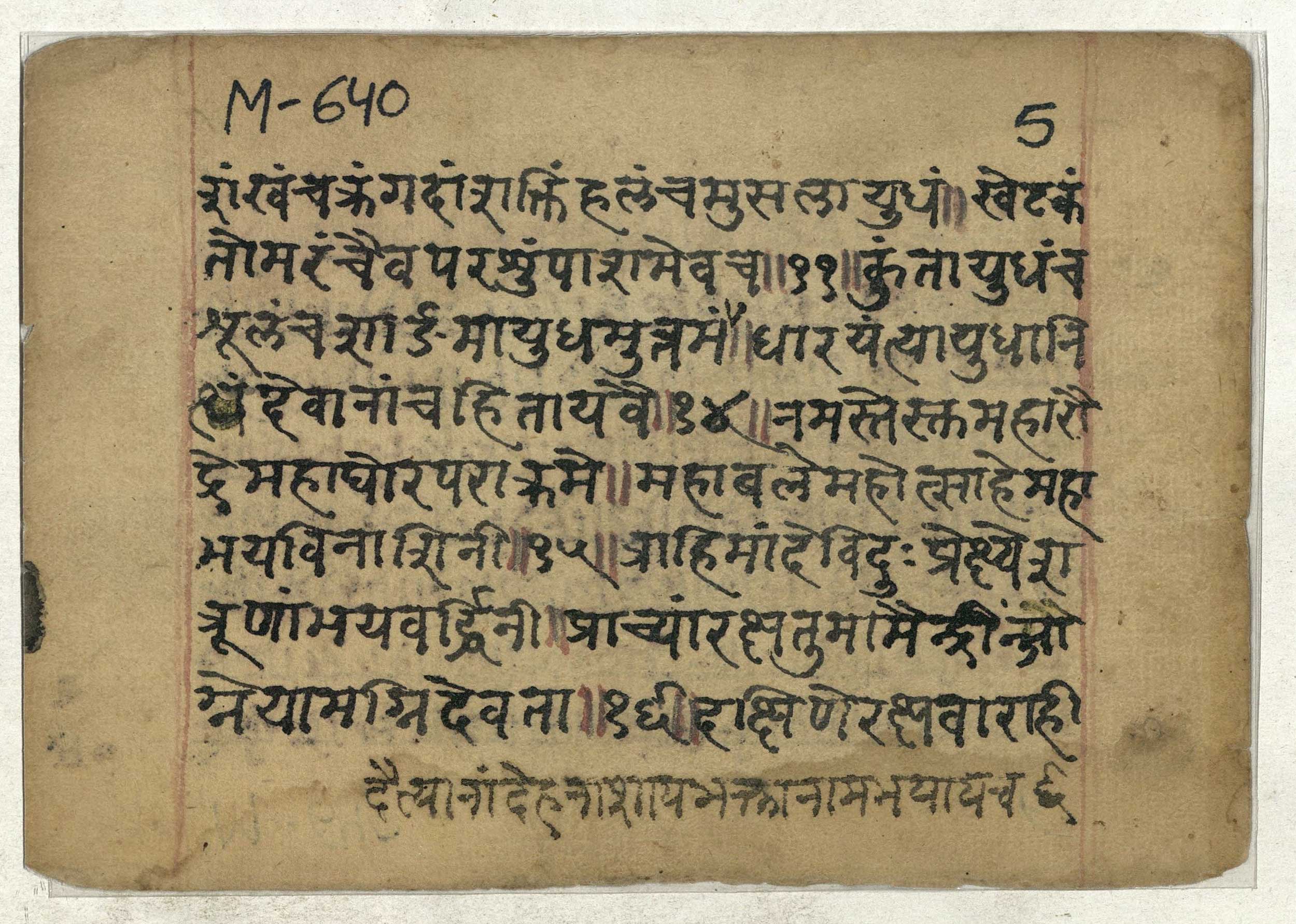
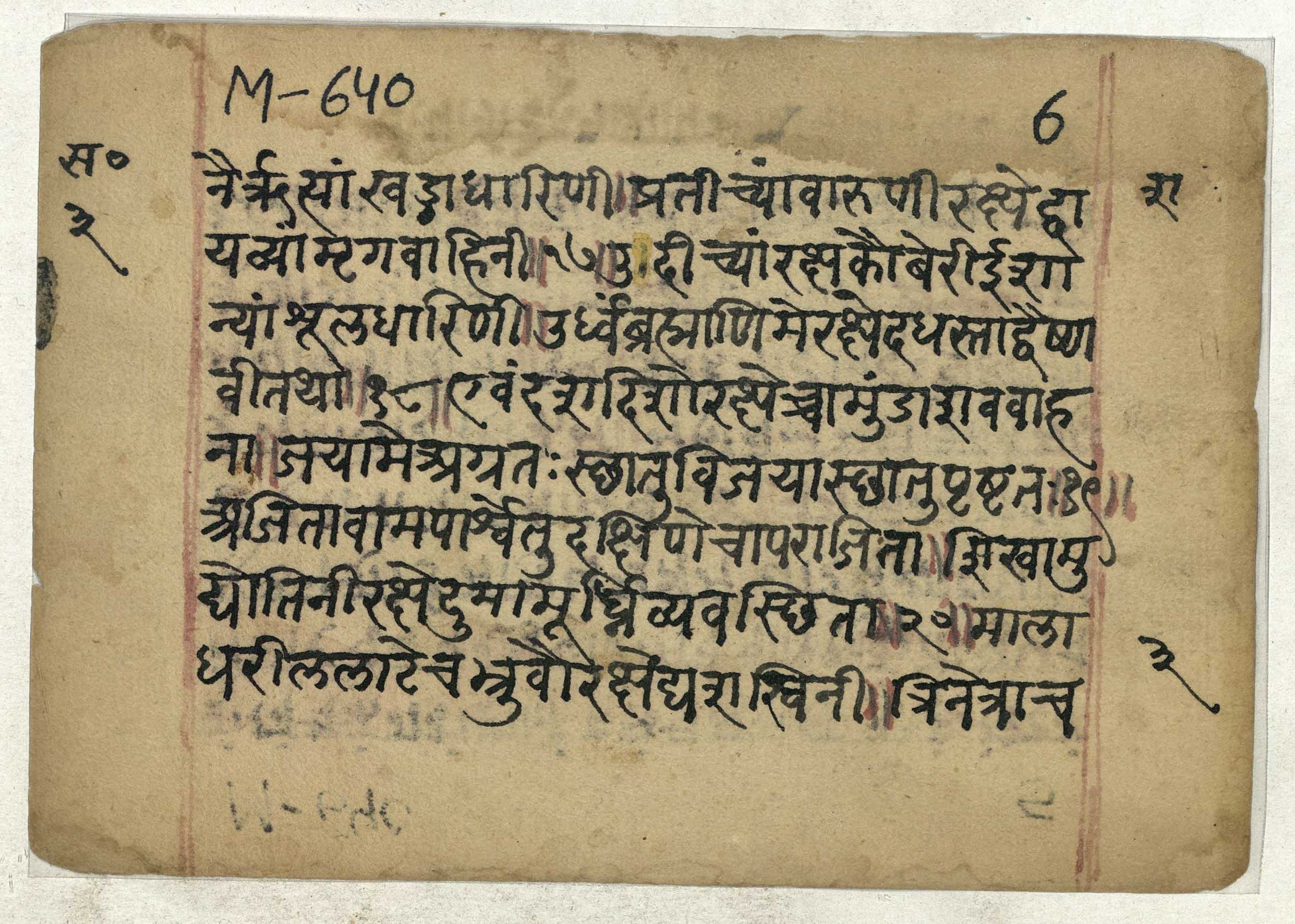
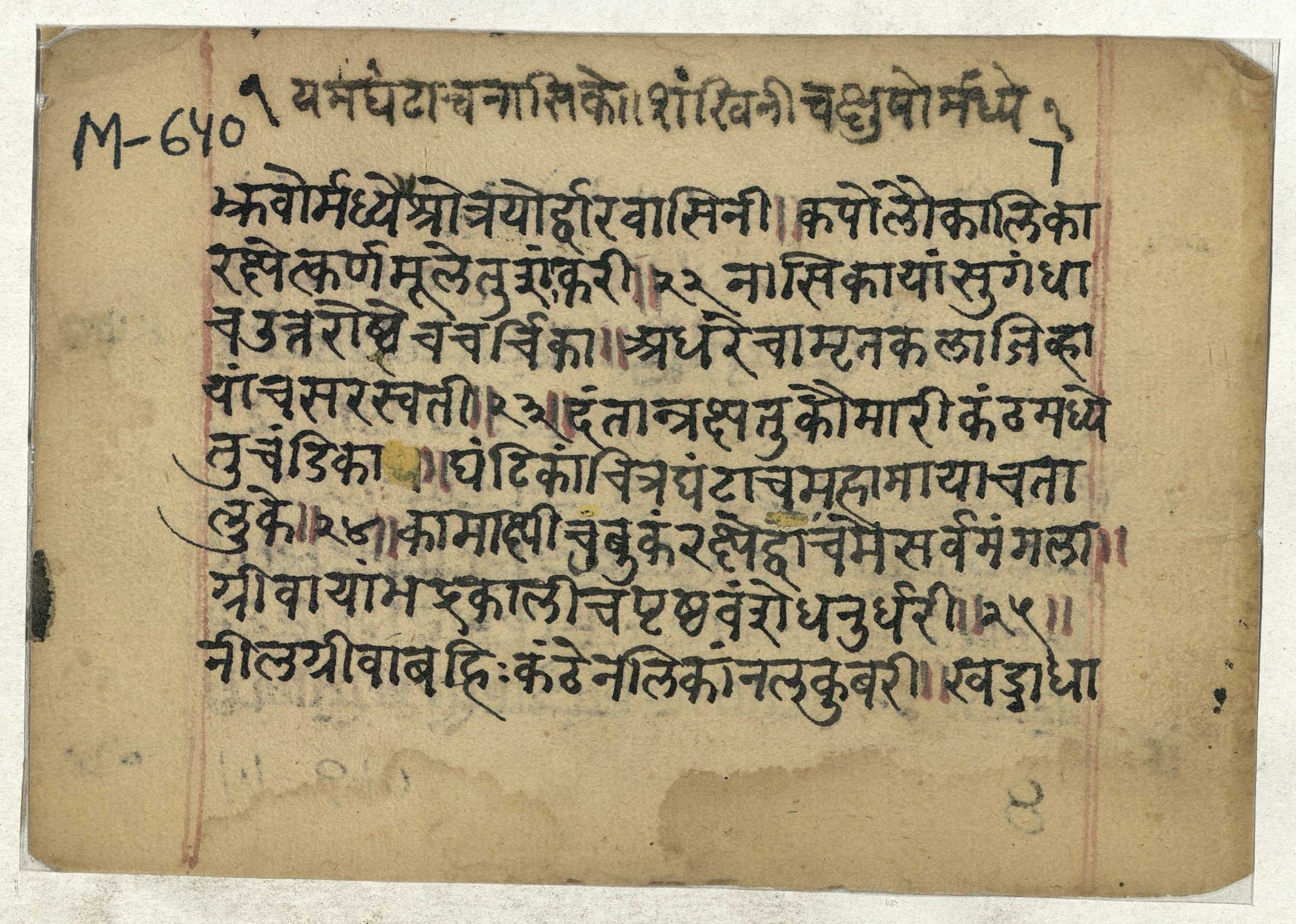
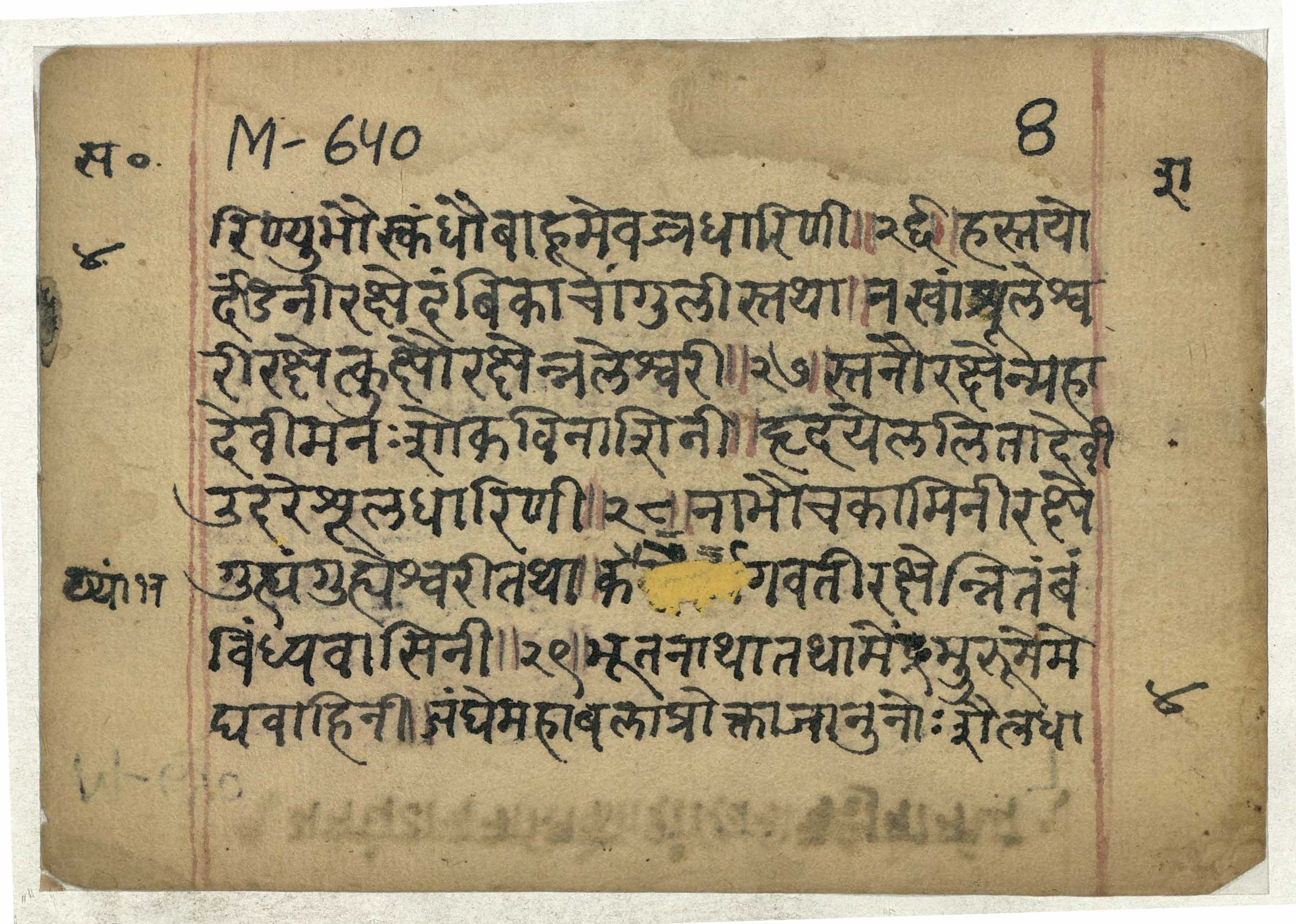
Translation
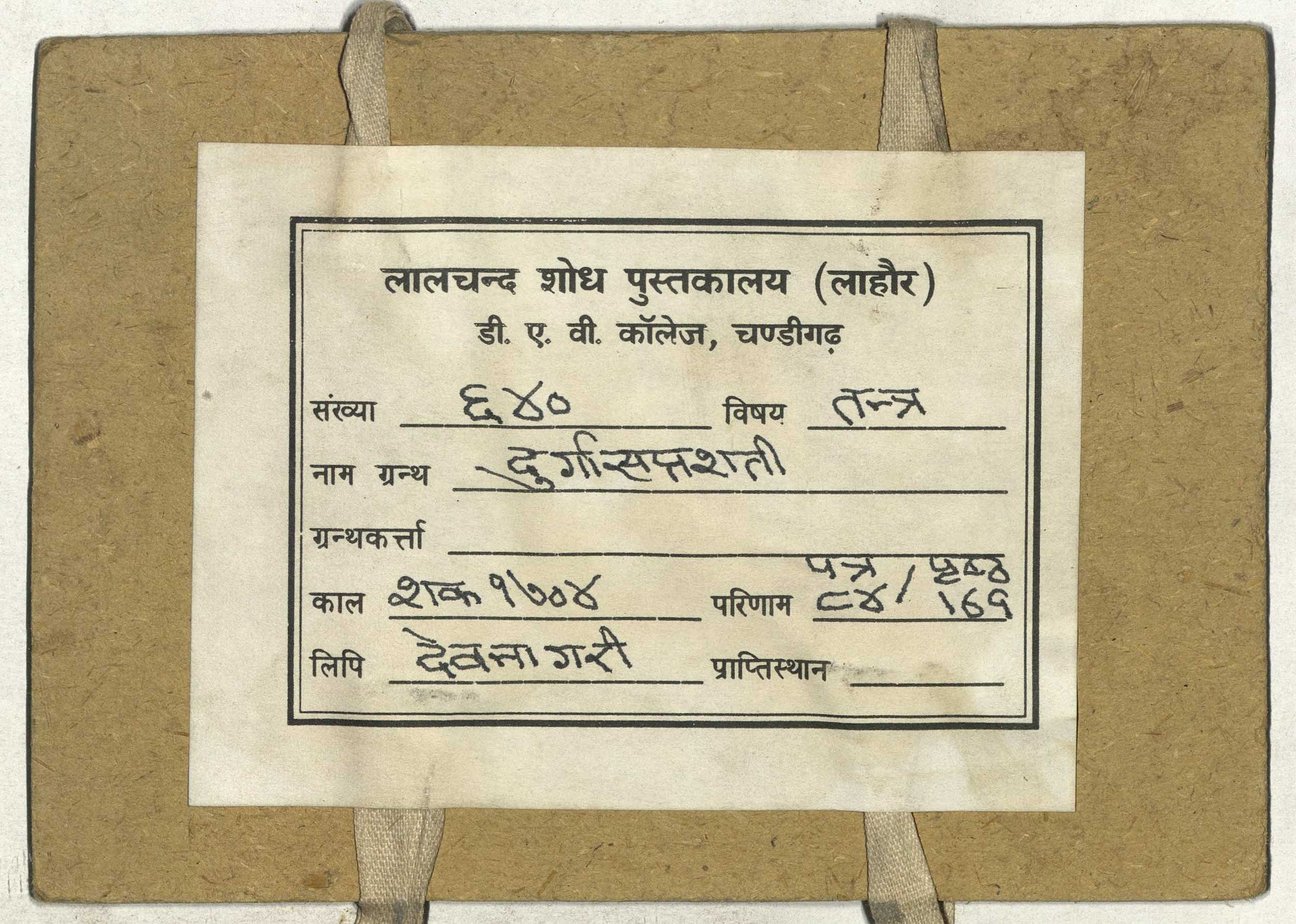
A TEXT OF 700 MANTRAS IN GLORIFICATION OF GODDESS DURGA, THE DIVINE MOTHER
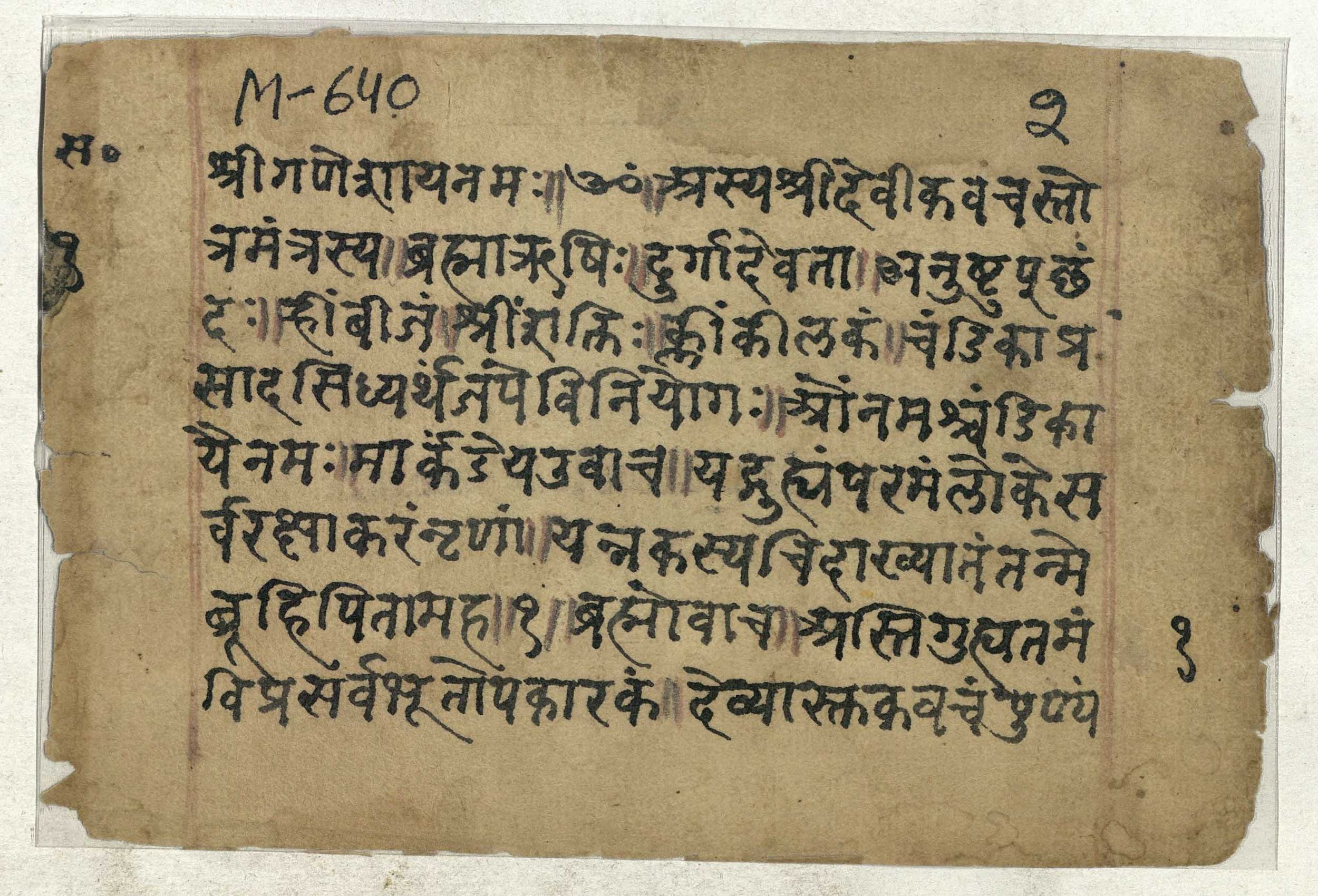
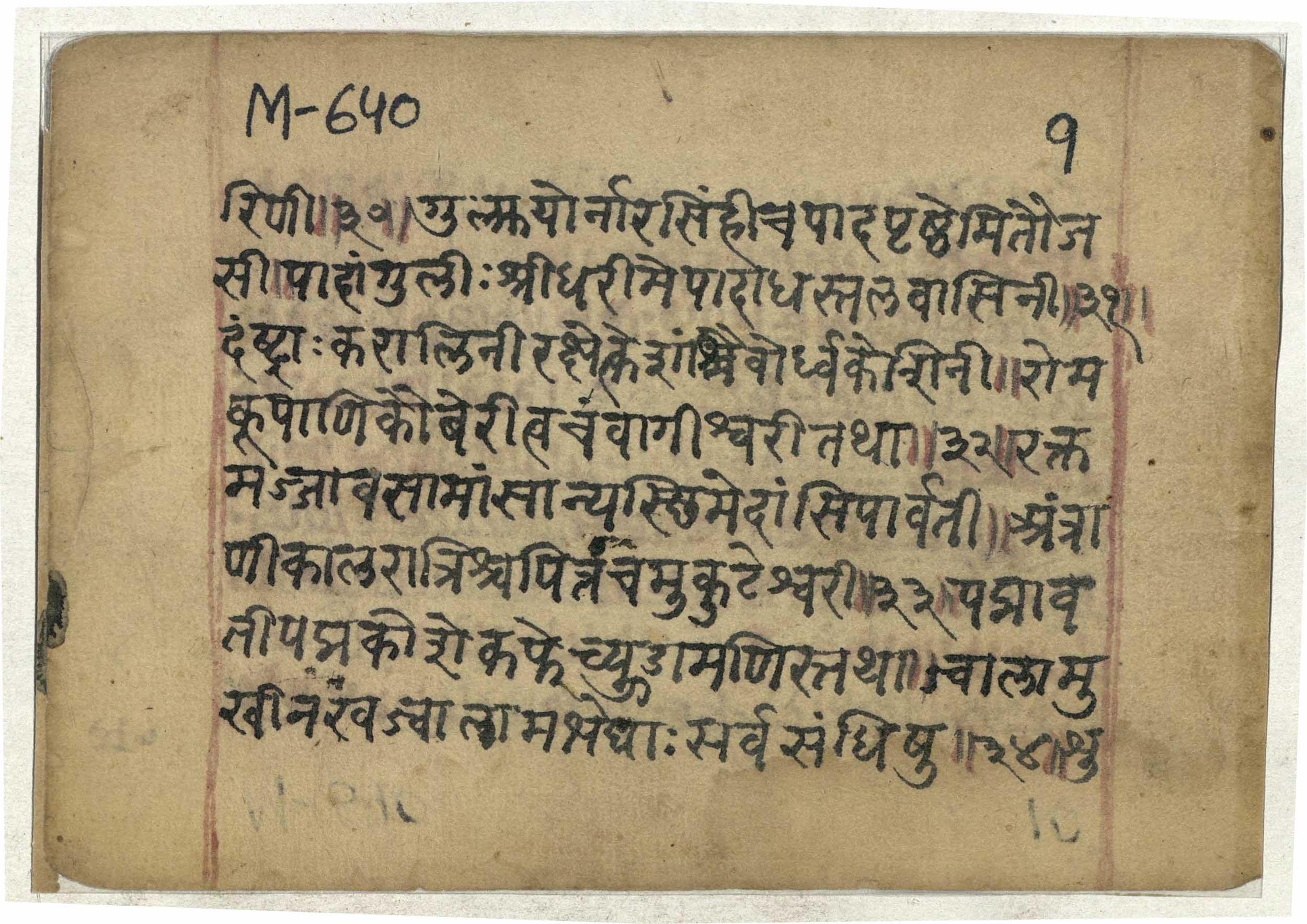
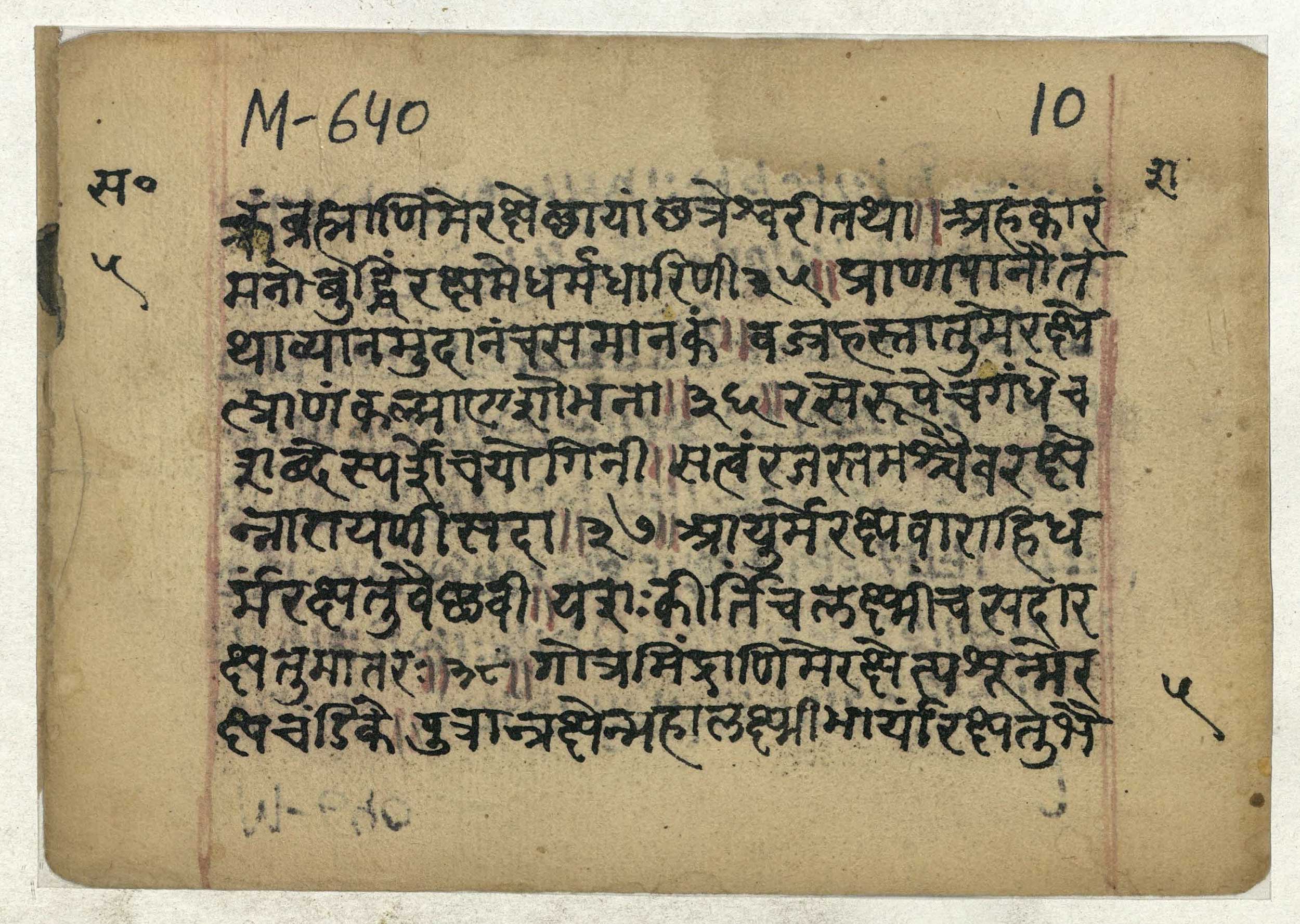
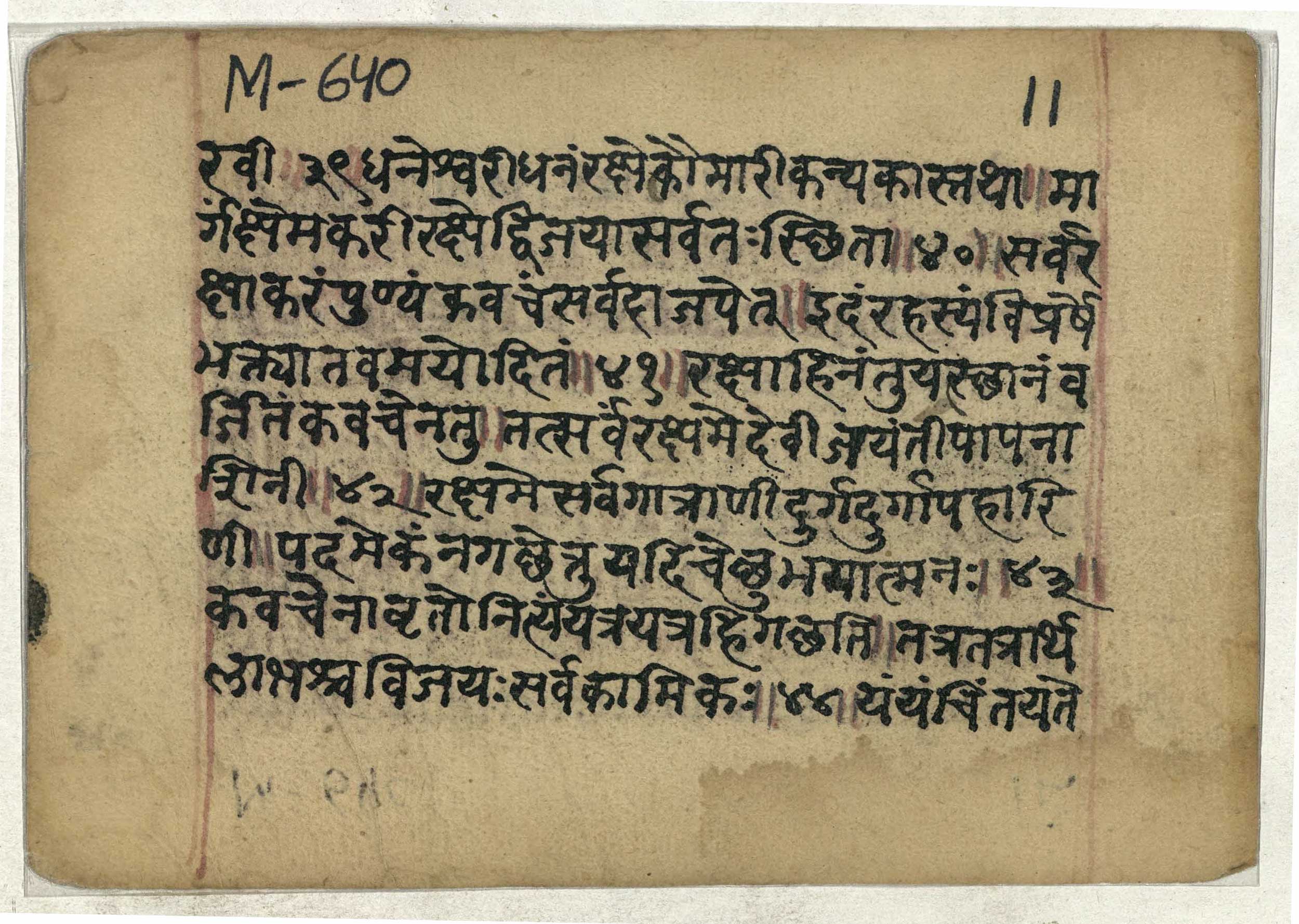
Salutations to Lord Gaṇeśa. (Om asya śrī devīkavacastotramantrasya brahmā ṛṣiḥ durgā devatā anuṣṭup chandaḥ Hriṁ bījaṁ śrīṁ śaktiḥ Klīṁ kīlakaṁ Caṇḍikāprasadasidhyarthaṁ jape viniyogaḥ // Om Namaścaṇḍikāyai Namaḥ)//Markandeya Told: O’ Pitāmaha! Tell me please the highest secret in this world, that protects the persons from all angles & which is also not spoken to anyone else before (1). Brahmā Told: O’ the purified one! There is the highest secret which is beneficiary to everyone. Therefore, O’ Mahāmuni! Listen carefully the Devī Kavaca, such a sacred one (2).
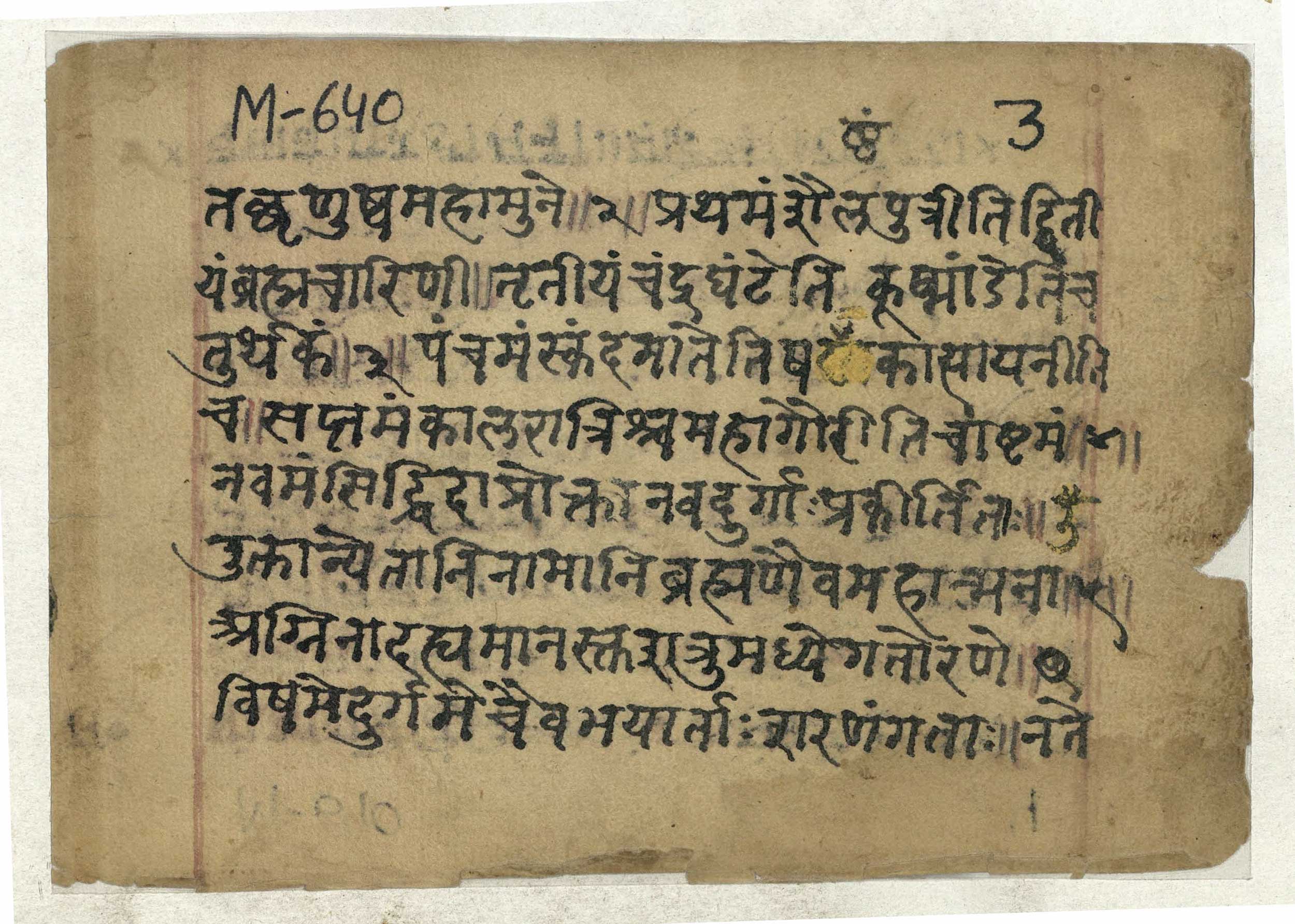
At first (she is called) Śailaputrī, secondly, Brahmacāriṇī, in third (she is) Candraghaṇṭā, in fourth Kuṣmāṇḍā, in fifth Skandamātā and sixth Katyāyanī, seventh Kālarātrī and eighth Mahāgaurī, ninth (she is known as) Siddhidā; thus, she is known with her nine forms, as Navadurgā. These forms have been stated by his greatness Lord Brahmā (only) (3-5). Those are burning by fire or are in the midst of all dangers amongst the enemies in war, if devotedly remember her will get released from all sort of mifortunes. I don’t see any danger, woos or fear for them who are afraid but come to the rescue of her at the time difficulties & impassable path (of their life), They will have no inauspicious happenings at the difficult time of fighting war & also will get all sort of prosperities (in their life) (6-7) She is in the form of Cāmuṇḍā at one time at the involvement of Preta-s and in other time she is Vārāhī & known as Mahiṣāsanā (Mahiṣa as her carrier).
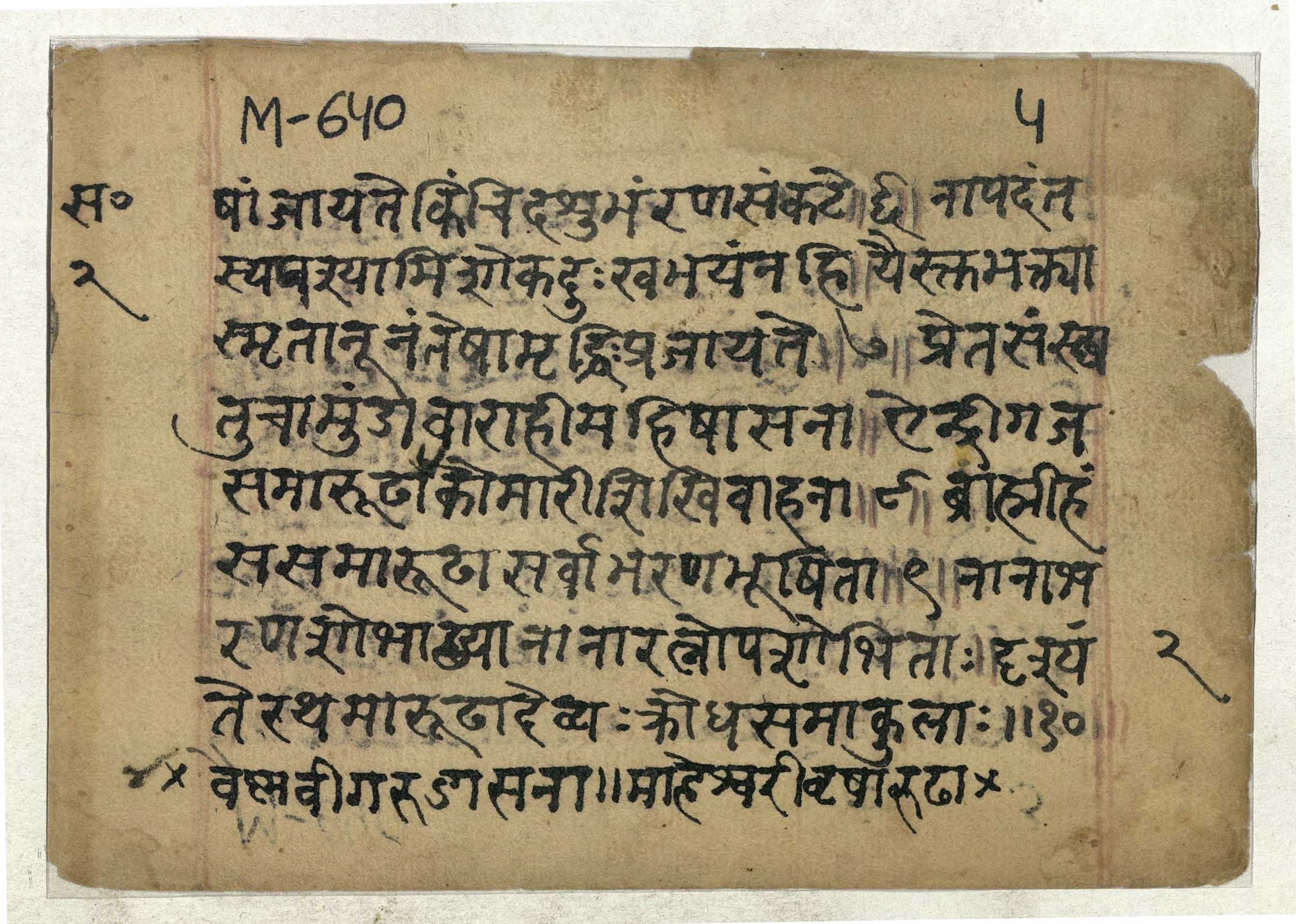
She becomes Aindrī while riding an elephant & Vaiṣṇavī at other time while climbing on Garuḍa. She is Māheśvarī, Vṛṣāruḍhā, Kaumarī & Śikhivāhanā (8). She is Brāhmī while riding on swan and adorned with all sort of ornaments (9). While she is on a riding on a chariot surrounded/accompanied with the deities with all angers. She is decorated with all types of ornaments & is also shinning with various types of stones & gems (10).
She is holding the weapons like Sankha(Conch), Cakra, Gadā, Śakti, Hala, Musala, Kheṭaka, Tomara, Paraśu, Pāśa, Kunta, Śula & Śārṇga, the best of the weapons for the sake of the destruction of the bodies of the Asuras & for the of the welfare of the devotees. It is also certainly meant for the sake of the benefit of the Devas (11-13/14). (I) Bow down to the most aggressive, most fearful with valour, the strongest, most excited & the remover of the great fear (14/15). O’ Devi! You, who is difficult to visualize, energiser/enhancer of fear in the minds of the enemies, please protect me. Let Aindrī protect me in the east & Agni in the direction of Āgneya (15/16). Let Vārāhī protect me in the south & Khḍgadhāriṇi in the direction of Nair̥ta.
(Similarly) Let Vāruṇī protect me in the west & Mr̥gavāhini in the direction of Vāyavya (16/17). Kauberi may protect me in the North whereas, Shuladharini in the Ishana direction. Brahmāṇī may protect from Upward and Vashnavi from downward (17/18). In this way, Cāmuṇḍā, the rider of dead bodies may protect from the ten directions (18/19). Jayā may stay in front and Vijayā may in back whereas, Ajitā in left & Aparajitā in right. Udyotinī may protect my pigtail while Umā may (protect)sitting down on head (19/20). Mālādharī may protect the forehead whereas, Yaśasvinī may protect my eyebrows. Trinetrā may protect the middle portion of my eyebrows and Yamaghantā may protect both the sides of the nose (20/21).
Śaṅkhinī may protect the inside portion of the eyes whereas, Dvāravāsinī may protect the ears. The cheeks may be protected by Kālikā whereas, the ear roots may be by Śaṅkarī (21/22). Sugandhā may protect the inside of (my) nose and Carcikā may the upper-leap. (Similarly), the lower-leap may be protected by Amṛtakalā and the tongue by Sarasvatī (22/23). Kaumārī may protect the teeth and Caṇḍikā may inside the throat. Citraghaṇṭā may protect the uvula whereas, Mahāmāyā may protect both the palates (23/24). Kāmākṣī may protect chin and Sarvamaṅgalā the speech. Bhadrakālī may protect in the neck and Dhanurdharī the backbone (24/25). Nīlagrīvā may protect the surface part of the neck whereas, the inside the throat may be by Nalakūbarī. Khaḍgadhāriṇī may protect both the shoulders and the arms may be by Vajradhāriṇī (25/26).
Daṇḍinī may protect my hands and Ambikā the fingers. Śūleśvarī may protect the nails & Naleśvarī may the belly (26/27). My breasts may be protected by Mahādevī & mind may be by Śokavināśinī. Thus, the heart may be protected by Lalitādevī & abdomen by Śuladhārinī (27/28). The naval part may be protected by Kāminī whereas, the anus by Guhyeśvarī. The waist may be protected by Bhagavatī and Nitamba (buttocks) by Vindhyavāsinī (28/29). Bhūtanāthā may protect my penis whereas, thighs may be by Meghavāhinī. Thus, thighs may protect by Mahābalā whereas, knees by Śailadhāriṇī (29/30).
Nārasiṁhī may protect the ankles and Mitaujasī the soles. Śrīdharī may protect the fingers of the leg whereas, Talavāsinī the toes (30/31). The jaws may be protected by Karālinī and hairs may be by Ūrdvakeśinī. The holes of the hairs may be protected by Kauberī and the skin by Vāgīśvarī (31/32). Blood, marrow, fat, flesh, bone, meda etc., may be protected by Parvatī; antras (the pyloric end of the stomach) by Kālarātrī & Pitta (bile) by Mukuṭeśvarī (32/33). The padmakośa part may be protected by Padmāvatī & kapha part may be taken care by Cuḍāmamaṇi. Thus, Jvālamukhī may take care of the flame of my nails & all the joints by Abhedyā (33/34).
Brahmāṇī may protect my semen & the shadow may be by Chatreśvarī. So also, Dharmadhāriṇī may protect my Ahaṁkāra, mind & intellect (34/35). (The five airs like) Prāṇa, Apāna, Vyāna, Udāna & Samānaka may be protected by Vajrahastā whereas, the Prāṇa part (alone) may be taken care of by Kalyāṇaśobhanā (35/36). Yoginī may protect the rasa, rūpa, gandha, śabda & sparśa whereas, sattva, raja & tamas may be protected by Nārāyaṇī (36/37). My life span may be protected by Vārāhī and my Dharma may be by Vaiṣṇavī. So also, my Yaśas, Kīrti & Luxmi may be protected by the mothers (37/38). My gotra may be protected by Indrāṇī & the animal wealth may be by Caṇḍikā. My sons may be protected by Mahālaxmī & wife may be by Bhairavī (38/39).
Dhanesvarī may protect my wealth whereas, Kaumarī may protect my daughter. My path may be protected by Kṣemakarī & Vijayā from all sides (39/40). One must always repeat this sacred kavaca which is an all-protective one. O’ Viprarṣi! Becase of your devotion I have told the secret of this to you (40/41). (Devi)Jayantī, the remover of sin may kindly protect all this place which is not a protected one and also without the kavaca (41/42). O’ Durga! the remover of all sort of obstacles! Please protect all my body & even a word should not be redundant if one wishes one’s welfare (42/43). Wherever one goes being protected by this Kavaca, will be a winner & also will have the benefit of wealth (43/44).
Whomsoever he thinks gets him very easily & also gets the incomparable highest wealth in enormous quantity (44/45). A mortal one becomes fearless & remains undefeated in wars. Such a man becomes adorable in these three worlds if covered by the Kavaca (45/46). This Devi Kavaca is accessible with all difficulties even for the deities. The one who reads it with all faiths during the three sandhyās with all sincerity then he gets the quality of divinity & also remains un defeated in these three worlds. He remains alive for hundred of years being away from any sort of untimely death (46/47-47/48). All the deseases like lūtā (Skin Irretaion, scratch etc.), Bisphoṭakas(Boils)etc., and also the poisons incusive of sthāvaras (Poision of immobile origin), jangamas(Poison of mobile origin) & artificial ones will vanish (from him) (48/49).
All those Ābhicārika mantras & Yantras under this earth including the bhūcarars, Khecaras, Kulajas, Upadeśikas, Sahajās, Kuśalīs, Mālās, Śākinīs, Dākinis, Antarīkṣacarās, Gorās, Yakṣiṇis, Mahābalās, Grahas, Bhūtas, Piśācās, Yakṣas, Gandharvas, Rākṣasas, Brahmarākṣasas, Vetālās, Kūṣmāṇḍas, Bhairavas & such others will certainly disappear/perish seeing him wearing kavaca on his heart. There will be a progress of the king with regard to his dignity including the enhancement of his spiritual power (49-52/50-53). O’ Muni! (Not only that) he will also prosper with his fame among those who have set their world records. It is therefore, one must always repeat the kavaca, the wish- fulfilling one with all devotion(53/54).
Prior to repeat(japa) of the Saptaśatī Caṇḍī one must complete the Devī Kavaca first. Then he will have the accomplishment (Siddhi)that is being generated through caṇḍījapa (54/55). His sons & whole of his future generations will survive as long as this earth, mountains, forests & gardens survive (55/56). At the end of his mortal body, at the grace of Mahāmāyā he certainly gets that supreme place which is difficult even for the deities to get (56/57). //Here ends the Devī Kavaca written by Harihara & Brahmā //
Om asya śrī argalāyāḥ śrī bhagavāṅṛṣiḥ anuṣṭup chandaḥ/ hrīṁ durgā devatā/ om aiṁ hrīṁ klīṁ cāmuṇḍāyai viccai namaḥ śaktiḥ/ mantro devatā/ devyaḥ aiṁ hrīṁ klīṁ bījaṁ/ saptaśatī manustatvaṁ/ argalājape viniyogaḥ/om namaścaṇḍikāyai namaḥ/ Mārkaṇḍeya uvāca (Markandeya Told): Salutations to Jayantī (Ever Victorious One), Maṅgalā (Auspicious One), Kālī (Who is in the dark form), Bhadrakālī, Kapālinī (One who wears a garland of skulls), Durgā (Who helps to overcome difficulties), Śivā (the partner of Lord Shiva), Kṣamā (Embodiment of Forbearance), Dhātrī (Supporter of all beings), Svāhā (final receiver of the oblations to gods) & Svadhā (final receiver of the oblations to fore-fathers) (1).
Salutation to the one who has passified/killed the two demons called Madhu & Kaitabha & being so proved as the great boon to Lord Brahmā. Please give me the good health, the victory, the fame & also destroy the enemies (2). I bow down before you. You are the destroyer of Mahiṣāsura, maker of fate & giver of happiness. Please give me the good health, the victory, fame & also destroy my enemies (3). You are reason behind the killing of Raktabija & destroyer of Caṇḍa & Muṇḍa. Please give me the good health, give me the victory, give me fame & also destroy the enemies (3A). You are the destroyer of Shumbha & Nishumbha & also the passifier of Dhūmrākṣa. Please give me the good health, give me the victory, give me fame & also destroy the enemies (4) Devī who is worshipped at two of her feet & who offers all the good fate. (To such I beg) Please give me the good health, give me the victory, give me fame & also destroy the enemies (5).
To such, whose appearance & character cannot be apprehended & who has the capacity to kill the enemy along with his whole lineage, please give him beauty, victory, fame including the destruction of enemy (6) O’ Caṇḍike! Those who always worship you with devotion, (you certainly) give beauty, victory, fame to them & kill their enemy (7). O’ the remover of the difficulties! You always protect them who bow down before you with devotion. May you please provide beauty, victory, fame & kill the(their) enemy (8)! O’ Caṇḍike! You are of the nature of being a destroyer of all sort of deseases. Those who make prayer to you with devotion you may please provide them beauty, victory, fame & destruction of their enemy (9). O’ Devi! May you provide good luck, health & highest pleasure along with beauty, victory, fame & destruction of enemy (10)! You please accomplish the destruction of the enmies & provide the excellent power all along the beauty, vicory, fame & killing of enmies (11). O’ Devi! Accomplish (for us) the welfare & sumptuous wealth all along the beauty, victory, fame & destruction of enemies(12).
O’ Ambike! You are the one whose feet are rubbed against the gems of heads of demons & deities. Please give beauty, victory, fame & kill the enmies (13). Please make me learned, famous & wealthy (so) give me beauty, victory, fame & also kill my enmies (14). O’ Candike! the one who smashes the arrogance of the furious demons & also the one who is the remover of difficulties. Please give me beauty, victory, fame & also kill my enemies (15). O’ Ambike! You were also being continuously worshipped by Lord Krishna with atmost devotion. May you grant beauty, victory, fame & killing of enmies! (16). O’ Paramesvari! You are also being worshipped by the husband of the daughter of Himalaya. May you grant beauty, victory, fame & killing of enmies (17)! O’ Paramesvari! You are also being worshipped by Indrāṇi on account of the development of her relationship with Indra. May you grant beauty, victory, fame & killing of enmies (18)! O’ Parameśvari! You are being prayed by Lord Brahma & Lord Bishnu. May you grant beauty, victory, fame & killing of enmies(19)!
O’ Devi! You are the one who is of the nature of passifying the arrogance of most violent demons. May you grant beauty, victory, fame & killing of enmies (20)! O’ Devi! You are of the nature of manifesting out of the pleasure of the acute devotion of the devotees. May you grant beauty, victory, fame & killing of enmies (21)! May you grant me a pleasurable wife who can proceed according to (my) mindset. She must be able to help me in difficulties of crossing the ocean of this mundane/worldly life & reaching at the shore (22). Having read this one must read the main text. Such a person will get the boon of equal to that of the number of Saptaśatī (23). Here ends the argalāstuti. Om asya śrī kīlaka stotramantrasya/ Iśvara ṛṣiḥ/ cāmuṇḍā devatā/ anuṣṭup chandaḥ/ om aiṁ hrīṁ klīṁ cāmuṇḍāyai viccai namaḥ/ śaktiḥ/ mantro devatāḥ/ devyaḥ aiṁ hrīṁ klīṁ bījaṁ/ mālāmanustvatvaṁ(?)/kīlaka(ṁ) jape viniyogaḥ/
Om Namaścaṇḍikāyai namah (Salutation to Devi Caṇḍī). Rishi Told: It is for the sake of welfare I bow down to that embodiment of pure knowledge having three devine eyes in the forms of three Vedas, & who is also known as Somārdhadhāriṇī (holder of the half-moon) (1). All these are to be known as the Kīlaka of Mantras.The one who does the japa regularly with concentration gets all the welfare (2). All those tantric techniques/matters like Uccāṭana etc. will be accomplished by them those who read even a stotra from this regularly (3). There is no mantra, no medicines and nothing as such including all those uccāṭna etc., which can yield fruits without the japa of this (4). Everything can be accomplished through this was the doubt in the minds of people which was removed by Lord Shiva by making the stotras auspicious (5). In fact, he (Lord Shiva) made the stotras of Devī Caṇḍikā hidden and one can invoke her properly with all austerity (6).
There is no doubt all those will have welfare who maintain themselves with all austerity either in Kṛṣṇāṣṭamī or Kṛṣṇacadurdaśī (7). Those who offer their everything (whatever they have) on these two days to Devi and later on accept those as an offering from Devi, Mahādevī becomes happy with them and there is no other way to make her happy. This is the method(Kīlaka) introduced(Kīlitam) by Mahādeva (8). Those who make the chanting of it by making it niṣkīla and does the chanting with full concentration according to the method prescribed then only he will get the full effect of chanting the mantra(9).Such a person will neither have any fear even while walking alone nor will meet any untimely death and if also dies gets the salvation(10).One must begin this after knowing every thing about it and by not doing so he looses the result (11).
Whatever auspicious qualities in feminities etc., seen in the ladies also come from the grace of her so, one must recite Devīmāhātmya (for the sake one’s welfare) (12). Even if the stotras are recited softly it gives an indication of wealth but with a loud reading one it indicates a wide spectrum of wealth. That is the reason on must do that (loud reading) (13). Why should she not be praised by the people if with the grace of whom they get welfare, health, wealth, end of enmies & liberation (14)? Here ends the Kīlaka of Bhagavatī
OM AIṀ MĀRKAṆḌEYA UVĀCA// Henceforth I will speak in details regarding the birth of Sāvarṇi, the son of Surya who is believed as the eighth Manu (1) You please listen how he, the great Sāvarṇi, the son of Ravi(Sun), by the grace of Mahāmāyā, became the lord of the eighth Manvantara (2). Much before (in ancient times), during the Svārociṣa, there was a king, namely, Suratha born of the Caitra dynasty, was ruling over the whole world (3). While he was ruling over the kingdom and looking after the whole countrymen like that of his own sons/daughters there were some enemies of him who destroyed the Kolas (4). Following the same, there was a serious battle fought with these enemies by the king, Suratha with powerful weapons. However, with a small number of army, the enemy won the war (6).
Thereafter, he came down and started ruling over his own kingdom however, attacked again by the enemy & got defeated by that mighty enemy who was known for destroying the Kolas(7). Thereafter, he, in his own kingdom got all his money/property robbed by his own wicked & mighty ministers (8).Thereafter, in the pretext of mrigaya he, leaving apart his lordship, the king alone riding a horse went to a dense forest(9). While wandering there, he saw an ashrama of a great sage, the atmosphere of which was very much pleasant with the wandering of beasts & the sage surrounded by the disciples (10). He lived there in the forest for some time wandering in the forest surrounding being hosted by the sage (11). In a fine moment, while he was wandering in the ashrama surrounding, started thinking about his kingdom (12). How is about the kingdom that was once guarded by my ancestors and now the situation there in my absence; whether it is being righteously taken care of by my servants of evil nature(13).
I do not know what type of enjoyment my chief elephant who was heroic and always elated is having now under the control of my enemies! (14). Certainly, all those servants under my control who were once enjoing my grace & wealth are following the other kings today (15). All those kings of lavishly spending nature might be spending extravagantly all those treasure deposited once (by me & my fore-fathers) with great difficulties (16). While pondering over these & other related thoughts the king Suratha saw a merchant near the hermitage (17). Thereafter, he was asked by the king: Hello! Who are you? What is the reason of your coming over here? Why are you looking melancholy & depressed? (18).
Thus, having heard this language with great love from the king bowing down he respectfully the merchant replied (19). The merchant said (20). “I am a merchant & my name is Samadhi. I am born of a rich family. Because of greediness of my evil natured sons & wife, I am cast out & devoid of my wealth today (21). Being cast out by my wife, sons & wealth, I have come over here in this forest stricken by grief (22). I do not know now the good or bad of my sons & or for that matter of my own people & my wife (23). It is neither known the things in their home is well or not (24) nor regarding my sons whether they are well-behaved or otherwise now “(25).
The king said (26): How is it that you still have love in those greedy sons & wife by whom you are deprived of your wealth & have been cast out? (27-28) The merchant said (29): You have rightly stated the words of my mind but what shall I do? My mind somehow does not become cruel in this regard (30). As a result, my mind is attached to such who have driven me out & my fatherly affection & the love of a husband for the sake of greed of wealth (31). I do not know the nature of the chitta which, after knowing all the bad conducts of my dear ones, is still emotional towards them (32). I have heavy sighs & also feel dejected due to them (33) but still my mind is not hard enough towards these unloving ones (34).
Markandeya said (35): Thereafter, Samadhi, the merchant & Suratha, the king, both of them together approached the sage (36-37). Having gone through the necessary formalities (& permissions from the sage) both of them decided & negotiated on the topic for the discussion & sat with the sage (38). The king said (39): O’ sir, I would like to ask you a question, if you kindly agree to reply please! (40). My mind is perturbed due to non-control of intellect over it (41). O Best of sages! How is it that even if I have lost my control over the kingdom & all its auxiliaries, I have still an attachment to all of these like that of an ignorant man? (42). Same is the case of this merchant who has been disowned by his children, wife & servants but still has affection towards them! (43).
Thus, we, he & I both are very much disappointed being emotionally attached to the things that are very much defective in nature (44). Sir, how is it that those who are really aware of this (whole situation) also get infatuated by this foolishness like that of a person who has lost his discriminating power? (45). The sage said (46): O lord! Knowledge exists in every being perceivable within his/her range but the subjects become different from person to person (47). Some animals are blind in day time & some are in night. However, for some, there is no difference between day and night; they see equally (whether it is day or night) (48).
Of course, the human beings are knowledgable but they are not the only beings who have knowledge. Even the animals, birds & other beasts are also knowledgeable (49). Thus, the knowledge human beings possess they also have it and what they possess human beings also have that (50). In spite of the knowledge, you look at these birds- how even if they are distressed with hunger, because of this delusion, drop the rice grains in their kids’ beaks (51). O Manujavyaghra (tiger among men)! Are you not seeing the fact how to their attachment towards their kids for a return help! (52)
It is because of the influence/power of this Mahamaya, to sustain the creation, all these creatures fall into the ditch of infatuation in the name of whirlpool of affection (53). Nothing to wonder that this Mahamaya is the Yoganidra of the master of this world and deludes the whole world (42/54). It is the same Mahamaya who is known as Bhagavati who even drags the minds of the wise ones by force to this infatuation (43/55). The whole Universe-movables & immovables have been created by her. Having satisfied, she offers boon that causes someone liberated (44/56). She is Eternal & Supreme Knowledge and altimately the cause of final liberation (45/57).
She, being the sovereign, also is the cause of bondage of transmigrations (46/58). The king said: (47/59) O’ venerable! Who is this Devi (goddess) whom you call Mahamaya? Wherefrom she came & what are her activities? (48/60) O’ the supreme of the knowers of the Absolute! What is her real nature & what are her influences? Also, how did she originate? (49/61) I would like to know all of these from you (50/62) The sage said (51/63): Despite the fact that she is the eternal & supreme embodiment of this Universe, as it is heard, you may please listen from me regarding her manifestations at different times(52-53/64-65). When she originates/manifests herself for the sake of the Devas, despite the fact that she is eternal, it is stated/believed in the world (mundane) that she is born (54/66).
At the end of a Kalpa when all the oceans made/became one & Lord Visnu stretched out (his body) on the Sesanaga resting in his famous Yoganidra then two hostile demons, namely, Madhu & Kaitabha were born out of the dirt of his ears & proceeded towards Brahma to kill him (55-56/67-68) Having seen these two aggressive demons & also the Lord Vishnu in the stage of asleep, Lord Brahma who resides in the lotus sprung from Vishnu’s naval, tried with his atmost concentration to extol the Yoganidra in the eyes of Lord Hari for the sake of awakening him(57-58/69-70). The Yoganidra is the one who is the illumination of the Lord Vishnu, the queen of the Universe who also nourishes it and is the responsible for the sustainability & desolution (of the Universe) (59/71).
Brahmā stated (60/72): You are ‘Svāhā’ also called ‘Svadha’.You are the three-fold mantra. You are also verily called “Vaṣaṭkāra”and the embodiment of the Svara. You are the nectar (61/73). Despite your eternality you are half a matra which cannot be uttered specifically. You are that ‘Sandhyā’ & you are the ‘Sāvitrī’. Moreover, you are the Supreme mother (of the Universe) (62/74). The whole Universe is borne by you & you are the creator of this world. You protect it and also withdraw/swallow it at the end (63/75). When there is no chance/hope for creation you are the force of this creation & while sustenance you are the protector/protective force. At the time of disolution of this Universe, you appear as that destructive power (64/ 76). You are known as Mahāvidyā (Supreme Knowledge), Mahāmāyā (Great Nescience), Mahāmedhā (Great Intellect), Mahāsmṛiti (Great Remembrance), Mahāmoha (Great Delusion), Mahadevī (Great Devi) & Mahāsurī(Supreme Goddess) (65/77).
You are the primodial cause of everything, bringing into force the three qualities (Sattvas, Rajas & Tamas). You are the dark/fearful night & you are also known as that great night. Moreover, you are known as the terrible night of delusion (66/78). You are the prosperity, the Supreme Power, bashfulness, Great intellect characterized by knowledge, Modesty, Nourishment, Contentment, Tranquility & Forbearance (67/79). You are armed terribly with sword, trident, club, discus, conch, bow, arrow, slings and iron mace (68/80) and yet you are pleasing. You are not only pleasing but more pleasing than any of the pleasant things and the beauty par excellence. You are indeed the Supreme Force (Isvari) among all the higher forces (69/81). Whether it is conscient or inconscient one, among all the things (in this Universe), you are the inner force behind every matter. How can I admire you who is such a (pervading) force (70/82)?
Who is really capable of extolling you who brings the creator, sustainer & destroyer of this Universe under sleep (71/83)? Who again will be capable of praising you who has created all even Lord Vishnu, Shiva & myself (72/84)? O Devi, being lauded with thus you may please bewitch these two unaccessible/uncontrollable demons, namely, Madhu & Kaitabha with your superior powers (73/85). Let Vishnu, the lord of this Universe, be awakened quickly & rouse up the idea to slay these two great (furious) demons (74-75/86-87).
The Rishi said (76/88): The Devi of delusion extolled thus by Lord Brahma, drew herself from eyes, nose, arms, heart & chest of Lord Vishnu & stood nearby Lord Brahma for awakening of Viṣṇu to see killing of Madhu & Kaitabha(77-78/89-90). Then Lord Jagannatha, named after Janardana got up from his couch of ocean being released by her and saw these two demons Madhu & Kaitabha full of demonic power and eyes red with anger, attempting to consume Lord Brahma (79-80/91-92). Got up readily, All-pervasive Lord Hari started an arm-fighting fighting with them & it continued for five thousand years (81/93).
During the fighting, these two were frenzied with exceeding power & being deluded by Mahamaya, asked Kesava to choose a boon from them (82-83/94-95). Lord Hari said (84/96): If you are satisfied with me then both of you must be slained by me right now (84/97). I choose this (boon) only & I do not want anything else (85/98). The Rishi said (87/99): Thus, the betrayed duo, seeing the whole world flooded with water, asked the lotus-eyed Visnu to kill them in a place where there is no water (88-89/100-101) The Rishi said (90/102): Having said ‘be it so’, Lord Viṣṇu holder of Śaṇkha (Conch), Cakra (Wheel/Discus) & Gadā (mace) splitted their heads & thighs there (on lotus or possibly within his captivity of no water zone which is not clear here)(91/103).
Thus, the Devi was appeared (for the sake of the protection of Brahma) herself being praised by Lord Brahma about whose glory I will speak further which you may please listen(92/104). (78 shlokas) Thus, in the Mārkaṇḍeya Purāṇa, in the part of sāvarṇika-manvantara, in the context of Devīmāhātmya, namely, the Madhu-Kaitabhavadha chapter completes with this. //Madhya(ma)caritasya viṣṇurṛṣiḥ śirasi uṣṇik chandaḥ mukhe śākaṁbharī śaktiḥ pādayoḥ durgābījam guhye vāyustatvaṁ sarvāṅge mahālakṣmīprītyārthe jape viniyogaḥ// Mahālaxmi Dhyānam (Meditation) I resort to Mahālaxmi, the destroyer of Mahiṣāsura and who seated on lotus of the complexion of a red coral and who holds in her hands a rosary, axe, mace, thunderbolt, arrow, lotus, bow, jar, rod, śakti, sword, shield, conch, bell, wine-bowl, trident, snare and a discuss,namely, sudarśana.
The Rishi said (1): In the remote past there was a fight between deities & demons where Indra & Mahiṣāsura headed respectively from both of their sides and it continued for full one hundred years (2). In this war, the demons with their heroic deeds, defeated the deities and consequently having won this war Mahisasura became the head of deities (3). Then, these defeated deities, Brahma being their representative head, went to Lord Visnu & Mahesvara (for their recue) (4). The deities described there in details of all that really happened in the war with Mahiṣāsura. They also described how he (Mahiṣāsura) himself is occupying with all those jurisdictions/rights of Sun, Indra, Agni, Anila (Air), Indu (Moon), Yama, Varuna & other deities (5-6).
All these deities have been thrown out of the heaven by this evil-natured Mahisa and now they are moving like that of the mortals (7). Whatever has been stated here is an activity of an enemy of all the Devas (means applicable to you also) and we have taken shelter under you. You may please think of his destruction (8). Having heard this, both Lord Viṣṇu & Lord Śambhu were angry & their faces were fierce & eye-sides were frowned (9). Thereafter, a great shining ray came out from the face of Lord Viṣṇu who was heavily angry & subsequently from Lord Śaṅkara & Lord Brahma also (10). Thereafter, great rays also from each separately came out from the bodies of Indra & others & slowly all these rays started becoming one (11).
The deities saw there a concentration of light that looked like a mountain spreading its light to all the quarters with its blaze. Then that unique light, generated from the bodies of all the deities, pervading the three worlds with its lustures, combined into one & took a female shape (12-13). The light generated from Lord Shiva became her face and Yama’s one became her hair. Lord Vishnu’s light became her arms & Candra’s one became two of her breasts. Indra’s light became the waist and Varuna’s one became her shanks & thighs whereas; Earth’s light became her hips (14-15).
With the light of Lord Brahma, her legs were formed and with Sun’s light their fingers. With the lights of Vasus (Aṣṭavasus), her fingers of hands were created whereas her nose was formed with the light of Kubera (16). With the light of Prajapati, her teeth were formed whereas three of her eyes were formed out of the light of Agni. Her eyebrows were formed out of the lights of two Sandhyās (Morning & Evening) & the ears were of Anīla (Air). Similarly, the lights of other deities also contributed in different ways in her formation (17-18). Thereafter, looking at the Devī born out of the combined light of the deities, all of them (Devas) who were being tortured by the demon Mahiṣāsura, felt joy (19).
Thereafter, the deities offered their own weapons (*The original text in the page has been struck out. Reason: Unknown. All other versions have it) Lord Pinākadhṛk (Shiva) brought out a śula from his own śula and offered it to her (20). Lord Vishnu offered the cakra produced from his own cakra. Similarly, Varuṇa offered conch and Agni offered his weapon (Shakti) (21). Māruta gave her a bow along with two quivers full of arrows and Lord Indra, the king of deities presented kuliśa (vajra) produced out of his own kuliśa (22). He (Indra) also offered her the bell taking out from Airavata, the (royal) elephant. Yama offered a Daṇḍa out of his own Kāladaṇḍa & Ambupati presented a Pāśa (noose) (23). Lord Brahmā offered a string of Rudraksha and also a Kamaṇḍalu. Sun offered his rays into the roots of all the hairs of her (24).
Kāla offered her a spotless sword and also a shield. The milk-ocean offered a pure necklace and a pair of undecaying garments (25). He also offered a devine crest-jewel, a pair of ear rings, bracelets, a crustal white half-moon(ornament), armlets to all the arms, a pair of shining anklets, an unique necklace, jewel rings for all the fingers(26-27). Visvakarmā offered her a shining axe, weapons of different types/forms including an invincible weapon (28). The ocean offered her unfading lotus garlands, one for head & another for her chest apart from a very beautiful lotus in her hand (29).
The ice-mountain (The Himalayas), along with a lion as a carrier for her, offered also different types of jewels and the king of wealth (Kubera) offered a vessel of drink full of wine (30). The Śeṣanāga, the king of all the Nāgas who holds the earth offered a garland of Nāgas (31).Thus, the Devi was honored by the Devas with different types of weapons and jewels along with great shouting of joy (32). With this terrible sound the entire sky was filled in and there was also a great reverberation out of it (33). The worlds were shaken with fear & the oceans were also trembled. There was an earthquake and the mountains were also rocked down (34).
Thereafter, the deities with great joy said “jay”to Devi, whose carrier is a lion. The sages, bowing down with great devotion, started praising the Devi (35). Having seen the three worlds agitaed, the enemies of the deities (=demons) got prepared with all of their armies and stood affirmed to fight lifting their weapons (36). Having heard the sound, “Oh, what is this” stated Mahishasura engulfing with anger and being accompanied with enormous number of demons, started running towards that great roar (37). Thereafter, he saw Devi spreading over all the three worlds with her radiance making the earth down with her footstep by scraping the sky with her diadem (38). Devi was standing by agitating the nether worlds with the the twang of her bow-string and pervading all the directions with her thousand arms (39).
Thereafter, the war began between the Devi & the enemies of deities. The directions were full of arms & weapons that were hurled diversely (against each other) (40). The whole armies of Mahiṣāsura grouped into four (Rathārohī, Aśvārohī, Gajārohī & Padātik) started fighting under the great demon-general, namely, Chikshu (41). Udagra, a great demon fought in this war along with his sixty thousand chariots & Mahahanu, another demon, also joined in the war with his ten millions of chariots (42). Similarly, Asiloman joined with fifty-millions & Bāskala with six-hundred millions of chariots (43). Parivarita, another demon fought the war with thousands of elephants & horses along with one crore of chariots (44).
Another demon called Biḍāla fought the war surrounded with five hundred millions of chariots (45). There were other asuras too who also joined the war with the Devi surrounded with millions of elephants, horses & chariots (46). Mahiṣāsura appeared there surrounded with crores of chariots, elephants & horses (47). The war was also fought with Tomara, Bhindipāla, Śakti, Musala, Paraśu & Paṭṭiśa (48).
Some of them have thrown iron maces & some javelines whereas some attacked with spears, clubs, swords, axes & some others with halberds & nooses (49).However, Devi crushed all those weapons very easily while shouring her own weapons on them(50). Without any facial changes & being praised by the sages, Devi started pouring/throwing the weapons heavily on the bodies of asuras (51). Her carrier Lion, Dhūtasaṭa also started stalking among the soldires of asuras like the forest-fire in a jungle (52). The sighs that have been released by Ambika became personified & multiplied into hundreds & thousands in number (53).
These battalions being energised by the Devi started attacking on demonish forces with axes, javelins, swords & halberds (54). In this great martial warfare some of these started beating drums, blowing conches whereas some started playing tabours and other such insruments (55). Thereafter, Devi started killing hundreds of these powerful asuras with the help of Triśula, club, sword & by showering the arrows on them (56). She made some others fell down who were stupefied by the sound of her ringing bell & started crossing some others by capturing them with her noose (57).
Some were splited into two pieces by throwing the sharp swords on them whereas some started falling on grounds because of the falling of clubs on them (58). Some started vomitting blood on ground after they died by on ground with the severe attack of musala. & some were killed on the spot just by the blowing mace on their breasts (59). Some of these enemies of Devas left their lives in the battle-field not being able to come out of the continuous showring of arrows resembling the porcupines (60). Some of these lost their arms and some of them lost their neck whereas; some others were beheaded being crushed in between (61).Some others lossed their thighs & fell down on the battle ground while others being split into two being one-armed, one-eyed & one-footed (62).
Even if some of them were beheaded, their body fell & rose again while some others being beheaded danced according to the tune of war instruments (63). The headless trunks also fought with Devi with the best kinds of weapons in their hands while uttering “stop” “stop” towards Devi (64). The ground where this great battle was being fought became difficult to venture being crowded by fallen chariots, elephants, horses & asuras (65). A river of profuse blood stream started flowing instantly in that area amidst the army of the asuras (66).
Within a moment Devi Ambikā brought that great army of demons to the state of destruction as the fire burns the heaps of dried trees & grasses (67). The lion, with quivering mane & thundering roaring prowled around the battle field as if searching for the living breaths of the enemies of Devas (68). Devi’s battalions fought in a manner that satisfied them to the extent that they (Devas) started showering flowers from the heaven (69). This is all about the II chapter namely, Mahishasurasainyavadha in Devimahatmya of Markandeyayapurana during the time called Savarnikamanvantara.
Rishi Said (1). Having seen his Army being killed the commander of asuras, Cikṣura with great anger went towards Ambika to fight with her (2). He started showering arrows on Devi in such a manner in this war that it appeared like clouds showering rain on the peak of the Meru mountain (3). Devi also responded gently by crushing all those arrows on her and killed his horses with cutting of all their controllers (4). She also split off his bow & lofty flag (of the chariot) and while he was being cut off from his bow, made his body pierced with her powerful arrows (5). Thereafter, he being with a shattered with bow, chariot-lost, horses-killed, charioteer-slain ran towards Devi armed with sword & shield (6).
He swiftly smote on the head of the lion with his sharp-edged sword & then struck on Devi’s left arm (7). O’ king! At the touch of the arm (of Devi) the sword broke into pieces and thereafter his eyes became red with anger and (being so) held a spike (8). Thereafter, that great demon threw that spike, dazzling like that of sunrays from sky (9). Seeing the spike falling on her, Devī also released her own spike that made the demon’s spike into hundred of pieces along the demon (10). Mahiṣāsura’s valiant commander having been killed, Cāmara, the afflictor of the deities, came closer to Devi, mounted on an elephant (11).
He also hurled his spear on Devi but that was suddenly assailed by her with a whoop by making it powerless and falling on ground (12). Seeing this broken spear fallen down Cāmara was with full of anger & flung a spike which was also broken by Devi with her arrows (13). Thereafter, the lion jumped on (the elephant) and being seated on the temple of the elephant started an arm fighting with the enemy of Devas (14). While they were fighting with each other both of them came down to earth. Both of them started blowing on each other very seriously (15). Then the lion suddenly jumped up on the sky & came down on the head of the Cāmara and with his hand made his head pierced (16).
Udagra also was killed in the battle by Devī with the help of stones, trees etc. Karāla was assassinated with her teeth & beneath the fist (17). Devi being angry smashed Uddhata by thrashing gadā on him & also killed Bāṣkala by a Bhindipāla (Dart). Similarly, Tāmra and Andhaka were killed with arrows (18). Trinetrā, the ultimate supreme power killed Ugrāsya, Ugravīrya & Mahāhanu with her Triśūla (19). She split/separated the head of Biḍāla from his body & likewise both Durdhara & Durmukha were also killed with the arrows (20). Thus, as the no. of army personnels started decaying in the field Mahisasura started troubling the troops of Devi in his buffalo form (21).
To some he started terrifying by dashing his face, some with his steps of hoofs and frightened some with the beating of his tail and scratched some with his horns (22) (He) Frightened some with his speed (of running) and some others with his bellowing & others through his movement whereas, some were made to fall on the ground by his blasting breath(23). Having killed the army of Devi, he started running towards the lion and then (only) it made Ambika very angry (24). He also with great anger started scratching the earth with his hooves and threw up the high mountains on her with terrible bellowing (25).
With the speed of his movement the area on the earth was crushed & lashed with his tail the ocean started overflowing all around (26). Pierced with his horns the clouds went into fragmentations and with the velocity of his breathing air the mountains fell down from sky (27). Seeing the great asura advancing towards her enflamed with temper Devi also did appropriately that was required to assassinate him (28). She hurled her Pāśa (noose) over him and then he left his buffalo form but was caught with it (29).Thereafter, he took the form of a lion but as Devi tried to cut his head he changed his form and appeared as a man with sword in his hand(30).
Then Devi immediately with her arrows severed the man along with his sword & shield but then he became a great elephant (31). Tugged at her great lion with his trunk, he roared heavily but Devi cut off his trunk while dragging (the lion) (32).Then he again appeared in his buffalo form and started frightening the three worlds with their movable & immovable objects (33). Then the Mother of the world became angry and started drinking the best (divine) drinks again & again while laughing with reddish eyes (34). The demon also roared heavily being aggressive with his power & valour and with his horns tossed mountains against her (35).
She also with a shower of arrows thrashed those mountains hurled at her & told him with flustered words while the colour of her face was accentuated with the intoxication of the drink (36). Devi Told (37): ‘Roar, roar a while as long as I drink wine and once you are killed by me the whole deities will soon roar here in this very place (38). Rishi Told (39): Having exclaimed so she jumped up and landed on that great asura by attacking (him) on his neck with her foot and struck him with spear (40). Thereupon, he also appeared in his own form in a half-perceivable appearance coming out of his buffalo face but controlled by Devi with her great valour (41).
Fighting with his half-revealed form the great asura was laid down by Devi with her great sword by making his head chopped off (42). Then all those armies of asura were also vanished and all the hosts of deities became pleasant (43). Along with the great sages of heaven, all the Devas praised Devi & the chiefs of the Gandharvas sang & groups of Apsaras danced (44). This is all about the III chapter namely, Mahishasuravadha in Devimahatmya of Markandeyayapurana during the time called Savarnikamanvantara.
Rishi Told (1). When that valiant & evil-natured foe of Devas was killed by Devī, Indra & other hosting deities praised her with great words reverently bending necks & shoulders & horripilation in their body with overwhelmingly joy, looked charming (2). To that Ambikā who is worthy to be worshipped by all the deities & sages and the one who pervades this world with her power of being the embodiment of the entire power of all the deities, we bow down before her with all our devotion. May she grant us all the auspicious happenings (3)! May Caṇḍikā whose incomparable power cannot be explained by Lord Brahmā, Viṣṇu & Maheśvara, bestow upon her mind to protect this entire Universe by destroying all the fears of inauspicious/evils (4)!
O’ Devi! We bow down before thyself who are (in the form of or none other than ) prosperity in the houses of virtuous people (but), alaxmi (ill-fate) in those vicious people, intellect in the heart of learned, faith in righteous people, modesty among high-born. May you protect this Universe (5)! O’ Devi! How can we describe you since your appearance is unconceivable that is so powerful that it abundantly sufficient to make the asuras perishable that is so much established through the war itself among the Devas, Asuras & others(6). You are the cause of this entire Universe & even if you are possessed with the three guṇas (i.e Sattva, Rajas & Tamas) but not affected by their attributes. You are also inconceivable to Lord Vishnu, Shiva & others. You are the abode to all & the whole Universe is composed of a tiny version of yourself & you are the supreme primodial Prakriti being untransformed (7).
O’ Devi! You are that Svāhā at the utterance of which the whole of the deities attains satisfaction in all the sacrifices. You are (also) that Svadhā which is uttered for the satisfaction of the fore-fathers. Therefore, you are chanted as Svāhā & Svadhā by the people (8). O’ Devi, You are Bhagavati, the Supreme Knowledge (Paramā Vidyā) - the cause of liberation, (but being) inconceivable meditated upon by the great seers who have great control over their sense organs & have dedicated for the cause of Reality being detached from all the spots (9). You are the essence of Śabda & (also) container/repository of the pure form of the hymns of R̥K, Yajus & Sāman with the the beautiful recital (padapāṭha) of the later one along with Udgītha (sound).You are Bhagavati, the embodiment of three Vedas (R̥k, Yajuṣ & Sāman) & a message of sustenance of life & also the ultimate destroyer of sufferings of all the worlds (10).
O’ Devi! You are the Medhā (Intellect) by which the essence of all the scriptures is comprehensively understood. You are Durgā, who takes away men from this difficult ocean of worldly travels being detached from its attachments. You are Śrī who has taken abode ever in the heart of Lord Viṣṇu. You are also Gaurī who has established herself with Lord Shiva (11). With a gently pure smile, resembling like that of a full moon’s disc/orbit and as brilliant as of pure gold the face was of yours. However, it was strange enough that the demon Mahiṣa, being in anger struck your face suddenly after seeing it (12). Seeing your enraged face that was terribly frowned & red in hue like the rising moon, it was strange enough that the demon Mahiṣa did not straightaway give up his life otherwise, who can live witnessing (his/their) infuriated destroyer (13)?
O’ Devi! Please be compassionate. You are the Supreme (force). At the stage of annoying you can destroy the families of the asuras for the sake of welfare of the world & it has been evident now from this incident of bringing Mahiṣāsura’s forces to their end (14). It is observed that you are so generous towards them with whom you are wel-pleased. Such persons are found riches & they are the people of high-esteem in the society. They have the glories & their righteousness is never declined. They are indeed blessed & found gifted with devoted children, servants & wives (15). O’ Devi! By the grace of yours the blessed one maintains a virtuous daily life so that at the end (of the day) he attains heaven. Therefore, O’ Devi! You are known as the bestower of reward in the three worlds (16).
O’ Devi! If remembered in difficult times you totally remove the fears of every creature & if recalled in joyous moments then you bestow all the auspiciousness in mind. Who is other one except you, being a dispeller of poverty, sufferings & fears, is so kind enough to do all the welfare to the men (17)! (No doubt)The whole world attains the peace of mind(today) due to their killings; even if these asuras have committed enough sins to go to hell for long periods of time, you have provided them a chance to go to heaven being their killer(It proves that you are compassionate to everyone even to your foes)(18). Are you not able to reduce these asuras to mere ashes just by your sights? Knowing that also you fight with them by applying your weapons against them to let them attain a higher world being purified with the missiles.This is the higher intention behind your activity even for these foes (19).
If the eyes of these asuras had not been put out by the flood of terrible flashes sparkled from the swords or from the heaps of lusture from your spearpoints then it is certainly by looking at your face resembling a piece of moonlight (20). O’ Devi! Your nature is to mollify the conduct of wicked; this of your beauty is also inconceivable & incomparable for others. Your energy spoils them who deprive Devas from their valour. Your compassion is such that it even works at the level of enmies (21). With what can we copmpare your valour? Where can we find this most charming beauty that creates fear in the minds of foes? Compassion in mind but merciless in the battlefield, O’ Devi! O’ bestower of boon! Where can we really find all these in the whole three worlds except in you (22)?
All these three worlds have been saved by you through the killing of enemies at the very war ground itself. All those hosts of enemies also are sent to heaven and the fear in our mind also has been ousted from those hostile enemies of Devas. We salute you (on account of this) (23). O’ Devi, please protect us with your spear. O’ Ambikā, please protect us with your sword. Please protect us by the sound of your bell & also please protect us by the resonance of your bowstring (24). O’ Caṇḍikā, you please protect us in the east & also in the west. You also please protect us in the south & in north too. O’ Īśvari ! by the exhibiting (through the movements) of your Śūla (spear) (25). You please protect us with all your charming forms/epithets moving around the three worlds; also with all those extremely terrible (forms) for the protection of this world too (26).
O’ Ambikā! Please protect us with sword, spear, club & many other such weapons those have come in contact with your delicate sprout-like hands (27). Rishi Told (28). Thus, the protector of this world (Devi Herself) was praised by the Devas and also worshipped with the flowers from “Nandana” garden along with offering of the fragrant perfumes & cosmetics (divinely prepared ones) (29). With all devotion, all of these deities offered the divine incense to her; and being incentified/benevolent she benignly started speaking to the humbled deities (30). Devi Told (31). Choose all of you, O’ Devas! Whatever has been expected from me (32). Devas Told (33). Everything has been accomplished (for us) by goddess Bhagavatī (you) and nothing is left by now that you have killed this very our enemy Mahiṣāsura (34).
O’ Mahesvari, If at all a boon is to be granted by you to us then please (do the favour) destroy our all immediate misfortunes/calamities at the remembrace of you (35). O’ the spotless countenance mother! The other thing is whenever a motal being will praise you in coming times with these hymns of ours then being gracious towards us, may you please gratify him also with wealth, wife and other kinds of prosperties (36-37)! Rishi Told (38): O king! Thus these things were requested by the Devas for themselves & for the world too. Then having said “tathā” (Yes/be it so) Devi disappeared from there (39). O’ King! This has been narrated as it happened in the past in relation to Devi who sprang from the bodies of the Devas, being desirous of the welfare of the three worlds (40).
Once again, Devi appeared in the form of Gaurī for the sake of killing the wicked asuras along with Śumbha & Niśumbha (41). You may listen what happened after the appearance of Devi for the sake of this world and for the benefit of Devas as I tell you systematically as it happened (42).(Ślokas : 36) This is all about the IIII chapter namely, Śakrādikr̥tadevyāḥ Stuti in Devīmāhātmya of Mārkaṇḍeyapurāṇa during the time called Sāvarṇikamanvantara. Rudra R̥ṣiḥ in Uttamracarita. Anuṣṭup Chandaḥ. Sarasvatī Devatā. Bhimā Śaktiḥ.
Bhrāmarī Bija. Sūryaḥ Tattva. Sāmavedaḥ Svarūpa. Mahāsarasvatīprītyarthe jape viniyogah. Dhyānam: Here, I worship to the Mahasarasvati, who holds bell, trident, plough, conch, mace, discuss, bow & arrow in her (eight) lotus-like hands; who is as bright as the white moonlight shining from the fringe of cloud & who is the destroyer of Śumbha & other demons, who is very much unique & like that of the substratum of these three worlds sparkled from Devi Gaurī. Rishi Told (1). In remote past, there were two asuras, who with the help of their pride & physical strength taken away the sovereignity of Indra over three worlds along with remnants (purodasa) of his sacrifice (2). The duo, took away the power from Sun, Moon, Kubera, Yama & Varuṇa too (3).The two also snatched the authority of Vāyu & made the Agni deprived of his duty. Thereafter, the deities being deprived their rights and defeated, lost their kingdoms (4). Being deprived of their rights along with with the expulsion by these two great asuras, they started remembering Devi Aparājitā (5).
She had granted us the benediction, “At the time of mishappenings/misfortune if I am remembered then I will instantly destroy all your great tragedies” (6). Thinking thus, all the deities went to the Lord of mountains and thereafter, extolled Devi Viṣṇumāyā there (7). Devas Told (8) Salutation to Devi, the Mahādevī, to her who is always auspicious. Salutation to her who is the primodial cause & sustaining power of this Universe). We always bow down to her with all humbleness (9). Salutation to the terrible one who is also eternal & in the form of Gauri- a protecting force. Salutation to her who is the moonlight & in the form of moon itself & eternal happiness (10).
We bow down to yourself who is auspicious. We bow down you all in the form of Riddhi (prosperity) & Success (Siddhi). Salutation is also due to her who is the consort of Lord Shiva & who herself is good (Laxmi) & bad (Alaxmi) fortune of kings (11). Salutation always to Durgā who helps us to overcome the difficulties, the one who is the essence (of the world) & reason behind everything. Salutation to her who is the discriminatory knowledge and also has black (as a special form of Mahākālī) & smoky-like appearance (12). We bow down before her & salute her again & again who is most gracious at times and most terrible at other times. We salute to her who is the support of this world. Salutation also to her who is in the form of self-evolving effort (13). Salutations again & again to her who is in all being and known as Viṣṇumāyā (14-16).
Salutation again & again to the Devi who resides in every being as consciousness (17-19). Salutation again & again to the Devi who resides in every being as intellect (20-22). Salutation again & again to the Devi who resides in every being in the form of ‘Sleep’ (23-25) Salutation again & again to the Devi who resides in every being in the form of ‘hunger’ (26-28). Salutation again & again to the Devi who resides in every being in the form of ‘shadow’ (29-31). Salutation again & again to the Devi who resides in every being in the form of ‘power’ (32-34). Salutation again & again to the Devi who resides in every being in the form of ‘Thirst’ (35-37). Salutation again & again to the Devi who resides in every being in the form of ‘Forbearance’ (38-40). Salutation again & again to the Devi who resides in every being in the form of ‘Class’ (41-43). Salutation again & again to the Devi who resides in every being in the form of ‘Modesty’ (44-46).
Salutation again & again to the Devi who resides in every being in the form of ‘Peace’ (47-49). Salutation again & again to the Devi who resides in every being in the form of ‘Faith’ (50-52). Salutation again & again to the Devi who resides in every being in the form of ‘Radiance’ (53-55). Salutation again & again to the Devi who resides in every being in the form of ‘Prosperity’ (56-58). Salutation again & again to the Devi who resides in every being in the form of ‘Behaviour’ (59-61). Salutation again & again to the Devi who resides in every being in the form of ‘Memory’ (62-64). Salutation again & again to the Devi who resides in every being in the form of ‘Compassion’ (65-67). Salutation again & again to the Devi who resides in every being in the form of ‘Satisfaction’ (68-70). Salutation again & again to the Devi who resides in every being in the form of ‘Mother’ (71-73). Salutation again & again to the Devi who resides in every being in the form of ‘Confusion’ (74-76). Salutations to the Devi who presides over the sense organs including the governance on all the elements in this world (77-79). Salutation to her again & again who has established herself by pervading the entire Universe as consciousness (80-82).
May she, the Īśvarī, the source of all auspiciousness who is Invoked by the Devas before for the sake of their desired object and also worshipped by them in their day today life, do all the needful do destroy the misfortunes from our life (81)? Being tormented by the asuras, you are the only goddess at our resque being reverenced by us. The one who, being remembered once with humble devotion, instantly destroys all the calamities (82). Rishi Told (83) O’ the Prince! Thereafter, Devi, having praised thus, arrived at Ganga for taking bath in her water (84).
She, the beautiful eyed, told those deities, ‘’ Who is praised here by you all? Then ‘Śivā’ (an auspicious Devi) sprung from the body covering of her & replied. Those praising me here are rejected by the demon Shumbha and also have been defeated by Nishumbha (85-86). Since she (Ambikā) came out of the physical sheath of Pārvatī, she is venerated as the Kauśikī in all the worlds (87). The same Parvati in course of time became black and known as Kālikā who was stationed at the Himalayas (88).
Thereafter, Caṇḍa & Muṇḍa, the two servants of Shumbha & Nishumbha saw Caṇḍika bloomed with supreme beauty (89). Both of them informed Shumbha: O’ king! There is a woman excessively beautiful dwelling in the Himalayas making it shine(90). Such a beauty is never seen by anybody anywhere. (So Sir)It is necessary to be known “who that goddess is” and to take a possession of her. O’ the king of Demons (91)! She is just like a gem among women, with extremely beautiful limbs, illuminating the directions with her light. She is there and you must see her (92). O’ Lord! All the varieties of gems, stones, elephants, horses etc., available in the three worlds are all present with you (93).
‘Airāvata’, the gem among elephants has been brought from Indra and so also (brought are) this Pārijāta tree along with the horse, namely, ‘Uccaiśravas’ (94). The aeroplane adorned with swans is a wonderful one and is like a gem shining in your courtyard, is brought here from Brahmā (95). The treasure called Mahāpadma is brought away from the Lord of wealth (Kubera). Similarly the Ocean also gave away the Kiñjalkinī (a garland) made of unfading lotuses (96).The gold- showering umbrella that (once) belonged to Varuṇa exists (now) in your house & so also the best chariot that once upon a time belonged to Prajāpati(97).
O’ Lord! The Utkrāntidā, the power of Death (Yama) has been abducted by you. (Similarly) Pāśa (Noose) of Water-king (Varuṇa) is at the possession of your brother (98). Nishumbha has all sorts of ocean-product gems & their varieties in his house. (Moreover) Agni also gave you two cloths that are purified by fire itself (99). Thus, O’ lord of Demons! You have acquired all sorts of gems. Then why don’t you acquire this auspicious gem of lady (100)? Rishi Told (101): Thereafter, having heard this language from Caṇḍa & Muṇḍa, Shumbha sent his messenger, Sugrīva, a great demon to Devi (102). He said: “Do a small thing. Having gone to her you must tell as I tell you (in my language) in a way she will love to come to me (103).
Having gone there to that beautiful place in the mountain where Devi was staying, he (the messenger) spoke to her with refined & sweet words (104). The Messanger Told (105): O’ Devi, I am the messenger of Shumbha, the demon-king known as the supreme lord of these three worlds. I have been sent by him to you (106). Please listen to what has been stated by him(Shumbha) who has defeated all the foes of the asuras & whose order has never been disobeyed/dishonoured by the divinities (107). (He stated thus): “I am the owner of these three worlds & all the deities are my followers. I also enjoy the remnants of all the sacrifices separately” (108).
All the best gems in these three worlds are under my control. So also, the gem of elephants, Airāvata, the carrier of Indra that was snatched away from him (109). The gem of horse namely, Uccaiśravas that came out from the churning of the milk-ocean, was offered to me by the devas themselves with salutations (110). All other best gems that were with Devas, Gandharvas & Uragas are shining with me now, O’ beautiful woman (111)! O Devi! We consider you as the gem of woman in this world. So, why don’t you accept us since we are the enjoyer of all the best gems (112)! Therefore, O’ the throbbing-eyed lady! since you are the best gem (of ladies) in fact, you either should accept me or my brother Nishumbha, who is also a great fighter (113).
With the acceptance of me, you will enjoy the highest unparalleled prosperity in life. Keeping this in mind you must consider to accept my proposal of becoming my wife (114). Rishi Told (115). Thus, told, Devi Durgā, the Bhagavatī, the adorable one who is the substratum of this Universe became grave & introvert (116) Devi Told (117). You have told the truth here & there is nothing untruth about it. Shumbha is the master of all of these three worlds & Nishumbha is also equal to him (118). However, how can I make my promise be made false! Please listen what promise I have made due to my low intelligence/calibre (119).
The one who can win me in the battle, the one who can drive away my arrogance & the one who matches with me (in all respects) will be my husband (120). Then, let Shumbha or Nishumbha, the mighty one come here & conquere me (in the war) without a delay to receive my hand (121). The messenger Told (122). O’ Devi! Don’t be haughty. How can you say all these before me! Which man in these worlds can stand before Shumbha & Nishumbha (123)? O’ Devī! All these Devas could not stand even before the other (inferior to Shumbha & Nishumbha)) demons in the battle? (In that case) How can you alone will stand (before them) (124).
Where all the deities like Indra & others could not stand before them in the war, how do you expect a lady can face them (alone) (125)? Let you go to Shumbha & Nishumbha based on my words & otherwise it should not happen that you will be harassed & lose your prestige by the way of splitting of your hairs (126). Devī Told (127). ‘So is the mighty Shumbha & exceedingly heroic Nishumbha; what can I do? This is my vow since I could not consider it properly (128) ‘Go back & tell the lord of asuras with my words sincerely to take the decision whatever he thinks proper’ (129). Iti mārkaṇḍeyapurāṇe sāvarṇike manvantare devīmahātmye devyā dūtasamvādaḥ pañcamo’dhyāyaḥ (Here ends the 5th Chapter comprising of the dialogue between Devī & Dūta in Devīmāhātmya of mārkaṇḍeyapurāṇa during the time called Sāvarṇikamanvantara).
Rishi Told (1). Thereafter, having heard the language of Devī, he, the messanger filled with anger, spoke elaborately to the king of demons, having arrived there (2) Then, having heard the sentences from the messanger the king of asuras being angry told Dhūmralocana, the commander of the demons’ army (3). O’ Dhūmralocana! You being surrounded by your army fetch here that wicked woman by force dragging her hair in a distressed manner (4). If raised there any protector of her, must be assassinated, irespective of he being a Deva, Rākṣasa or Gandharva (5).
Rishi Told (6): Thereafter, the demon Dhūmralocana, being ordered quickly by him (Shumbha) proceeded first accompanied by a band of sixty thousand demons (7). Seeing Devī stationed on the snowy mountain, he (Dhūmralocana) loudly shouted, “Come forward to the presence of Shumbha & Nishumbha” (8). If you do not approach my lord today with love then I will take you by force making harassed with dragging of your hair (9). Devī Told (10): “You are sent by the lord of demons & you yourself are a mighty one along with a company of force. If you take me by force then what can I do to you? (11).
Rishi Told (12): Being told so, the demon Dhūmralocana ran towards her but then Ambikā made him into ashes with just a sound of ‘hum’ (13). Thereafter, the great angry army of asuras started showering sharp weapons like arrows, javelins & axes on Ambikā (14). Thereafter, Dhūtasaṭa, the carrier of Devī by making terrible roaring with anger started falling on the army of asuras (15). He killed some of the asuras by way of blows of his fore paw, some by his facial attack and killed some others by way of his back legs (16) The lion, with his claws tore out the hearts of some whereas, the heads of some were severed through his paws (17).
Heads & hands were severed in case of others and the blood from the hearts of others was drunk by Dhūtakeśara (18). Just within moments that entire force has been destroyed by the greatly spirited & highly enraged lion, the carrier of Devī (19). Having heard that the demon Dhūmralocan is killed along with the entire force being destroyed by the lion of Devī, the demon-king Shumbha with trembling lips, was very much angry and ordered Chaṇḍa & Muṇḍa, the two demons duo. (20-21). O’ Chaṇḍa! O’ Muṇḍa! both of you, go there being accompanied by a great deal of forces, and having gone there, she must be brought quickly (22).
She must be brought dragged by her hair or may be brought bound but, in case of your doubts in dealing with the way then kill her with the help of the demons & all the weapons (23). When she, the wicked one is being killed & the lion is also slain then making her seized & bound bring that Ambika here quickly (24). Iti mārkaṇḍeyapurāṇe sāvarṇike manvantare devīmahātmye śumbhavadho nama sastho’dhyāyaḥ. Here ends the 6th Chapter comprising of the killing of Shumbha in the Devīmāhātmya of mārkaṇḍeyapurāṇa during the time called Sāvarṇikamanvantara.
Rishi Told (1): Thus, being ordered so, these demons with the entire army four wings headed by Chaṇḍa & Muṇḍa, marched (towards her) with the erected/raised weapons (2). Thereafter, they saw Devī with a gentle smile seated upon her lion on the top of the great mountain on a shinning gold peak (3). Having seen her some of them tried to catch her whereas others tried to approach her holding their bows bent & swords drawn (4). Thereafter, Devī became furiously angry towards these foes and as a consequence of the anger her face became ink-like black then (5). Because of her fierce frown, Kālī with furious face, came out from her forhead, holding sword & noose (6). She is holding the Khaṭvānga (club with a skull staff on top)
decorated with the garland of human skulls, wearing elephant’s skin & fearful due to the emaciated flesh (7). She is with an expanded mouth, fearful lolling out tongue, sunken reddish eyes & filling the directions with her roarings (8). She immediately fell on the army of asuras and slaughtered the great ones and consumed these foes of the Devas (9). Snatching the elephants in one hand she hurled them inside her mouth with the rear men, drivers(mohout), rider-warriors and the bells on them (10). Similarly, she also threw the chariots inside her mouth along with their horses, warriors and chariators; and started grinding them dreadfully with her teeth (11).
She caught, one with hair and another with his neck while attacking the other demons with her feet, crushed another by his chest.(12). With her mouth, she caught hold of the furious weapons released by the asuras and with all angers crushed them with her teeth (13). All those demonic hostile forces have been crushed by her whereas some were swallowed and some others were seriously beaten to death (14). Some were demolished with her sword and some with the beating of her skull staff whileas others were grounded upon by the edge of her teeth (15). Just within moments, the demonic forces were smashed. Having seen the situation that all the forces have been killed by Kālī with her furious appearance Chaṇḍa rushed towards her (16).
The great demon Chaṇḍa then showered his powerful arrows on Bhīmākṣi. So also, Muṇḍa tried to encircle her with the thousands of discusses (17). While those discusses in numerous numbers were entering into the mouth of Devī, it looked like the solar orbits disappearing in the midst of a cloud (18). Thereafter, Kālī, the furious-faced laughed terribly with her luminous teeth inside the dreadful mouth (19). Thereafter, Devī mounting upon the great lion, rushed towards Chaṇḍa and holding his hairs, chopped off his head with the sword (20). Having seen Chaṇḍa fall down on earth, Muṇḍa rushed towards her but, she with a great anger made him down to earth by striking down his head with her skull staff (21).
Thereafter, seeing these valiant Caṇḍa & Muṇḍa laid down, the remaining army ran away towards different directions (22). Holding the heads of Chaṇḍa & Muṇḍa Kālī approached to Caṇḍikā with a saying of something with an intermingling of an aṭṭahāsa she made with it (23). “Here have been brought by me the two great animal offerings for the sacrifice of battle in which you yourself will kill Shumbha & Nishumbha” stated Kālī (24). Rishi Told (25): Having seen these two asuras(heads) brought before her, the benevolent Caṇḍikā Devī said to Kālī: “Since you brought these two- Chaṇḍa & Muṇḍa. O’ Devi! you will be famous in the name of Cāmuṇḍā in this world hereafter (26-27). Iti mārkaṇḍeyapurāṇe sāvarṇike manvantare devīmahātmye canda-munda…. nama saptamo’dhyāyaḥ (Here ends the 7th Chapter comprising of the killing of Caṇḍa & Muṇḍa in the Devīmāhātmya of mārkaṇḍeyapurāṇa during the time called Sāvarṇikamanvantara.
Rishi Told (1): After the assassination of Caṇḍa & falling down of Muṇḍa; as well as the heavily destructed army troops and the king of demons Shumbha, the valiant one, became controlled from anger and instructed/commanded to all his hosts for a mobilization/deployment ((2-3) Let the demons be united with all our forces comprising of eighty-six uprised arm chiefs with their troops & eighty-four kambus (special categories/types of traditional asura wariors) proceed forward with their troops & weapons (4).
Let the fifty families of asuras known as Kotivīryas & hundred families of Dhaumras proceed forward with my order (5) Let Kālakas, Dauhridas, Mauryas & Kālikeyas be prepared for war & proceed forward at once by my command (6). After this order, the demon king Shumbha, the fierce ruler proceeded forward being surrounded by thousands of demon-soldires (7). Caṇḍikā, having seen this terrifying army of Shumbha coming towards her, filled the space between earth & sky with the twang sounds of her bow-string (8).
O’ king! Thereafter, the lion (of Devī) made an exceedingly terrible roaring and Devī made that sound magnified/multiplied with the clanging sound of her bell (9). With the sounds of the string of bow, roaring of the lion & of the bell, the quarters of earth & sky were filled in with terrific sound and Kālī with her expanding face astounded (10). Having heard the sound, the infuriated army of demons spreading over the four directions surrounded the lion, Devī & Kālī (11). In the mean while, O’ king! To kill the enemies of demons and for the wel-being of the Devas, there were the exceedingly overpowering spirits issued forth from Lord Brahmā, Shiva, Guha(Kārtikeya), Vishnu & Indra went to Devī Caṇḍikā with the similar forms of those devas (12-13).
Whatever was the form of deity & whatever was the ornament & the carrier/vehicle in case of each deity, the same were followed up by their simulated powers and proceeded to fight with the demons (14). The spirit of Brahmā carrying a rosary & a kamaṇḍalu sitting in chariot drawn by swans came forward who is known as Brahmāṇī (15). Māheśvarī came seated on a bull, holding a beautiful trident, garlanded with the kings of serpents & marked with the crest of moon (16). Kaumārī, in the form of Guha, sitting on a beautiful peacock, holding a spear in her hand came forward to fight with the demons (17). Similarly, the power of Viṣṇu, known as Vaiṣṇavī, came forward riding on Garuḍa, holding conch, cakra, gadā, bow & sword in her hand (18).
Vārāhī, holding an incomparable Yajñavarāha form of Hari, proceeded there also with a boar-like form (19). Nārasiṁhī, similar to that of the form of Nṛsiṁha reached there bringing down the constellations of stars by the toss of her mane (20). Aindrī, the thousand-eyed one, reached the spot seated on the elephant-king & holding vajra in her hand, looking alike Indra (21). Then surrounded by the personifications of these divine powers, Lord shiva appeared there and told Caṇḍikā “Let the asuras be killed quickly for the sake of my gratification” (22).
Thereafter, an aggressive & very much ferocious power was issued forth from the body of Caṇḍikā, making the bellowing sound that is comparable with hundreds of jackals (23). That invincible power told Lord Shiva, the dark coloured & matted haired, O’ my Lord! You please go as a messenger to the closer vicinity of Shumbha & Nishumbha & tell these two arrogant ones along with other demons present there who have come to fight (with Devas) that let Indra get the three worlds and Devas enjoy the offerings in the sacrifices, if at all these people(asuras) would like to live may go to pātāla (the underground). However, if by chance due to their over confidence they would like to go for war then let my jackals be satisfied with their flesh(24-27).
Since Lord Shiva himself was appointed by her as the messanger(Dūta), she was renowned as Śivadūtī in this world thereafter (28). On hearing the words of Devī being communicated by Lord Shiva, these great asuras were filled with anger and went to the place where Kātyāyanī stood/stayed (29). Then at the beginning the angered foes of the Devas started showering arrows, spears & swords in front of her (30). However, very casually, she crushed those weapons like, arrows, darts, spears & axes flung by them with her arrows shot from her full-drawn bow (31).
Then, Kālī, in front of him(Shumbha) started aggravation by the way of tearing the enemies pierced into pieces with her spear & further making them crushed with her skull-topped staff (32). Brahmāṇī wherever she travelled made the enemies devoid of their potency & bereft of valour by sprinkling water from her Kamaṇḍalu (33). Similarly, Māheśvarī, Vaiṣṇavī & Kaumārī very angrily started slaughtering the enemies with their weapons namely, trident, discuss & lance respectively (34). Aindrī torn down hundreds of demons by throwing her axe on them and made them also fallen down to earth with the streams of blood coming out of them (35).
Crushed by the boar-formed Devī Vārāhī with the blows of her facial attack, wounded in their chests with the points of her tusk and torn by her discuss these asuras fell down. (36). Nārasiṁhī scratched the other great demons with her claws & swallowed them by wandering on the war ground filling up the sky & the directions with big roaring (37). Thus, being harassed by Śivadūtī alongwith great aṭṭahāsa (violent laughter) the asuras started falling down on earth but those were swallowed by her (38). Seeing this incident of devastation of asuras in various ways by these enraged band of mothers, the remaining troops started moving, seeing them tetreating with fear, the angered Raktabīja, the great demon came forward to fight (39-40).
(He was such) Whenever, a drop of blood falls to the earth from his body, an asura , equal to him, arises on the earth (the other meaning of Pramāṇa here is equal to his stature in the sense of strength). (41). He, fought with Indraśakti with a gadā(club) in his hand but then Aindrī struck up Raktabīja with her thunderbolt (42). Being wounded by thunderbolt a lot of blood was oozed out from him immediately and the fighters equal to his form & strength stood up (43). As long as drops of blood fell from his body, until then many of the male forms equal to his valour & strength were born (44). Those born out of blood also started fighting with the mother equally in the same violent manner hurling with formidable weapons (45).
When his head was hit again with the thunderbolt, blood started flowing from it and from that the males in thousands were born (46). In the war, Vaiṣṇavī hit him with her chakra (Discus) and Aindrī beat that king of demons with her Gadā (Club) (47). Produced out of the blood oozed out due to hit of Vaiṣṇavī’s chakra, thousands of such asuras equal to him came out pervading the whole world (48). Kaumārī killed the great demon Raktavīrya with her lance and Vārāhī with her sword. At the same time Māheśvarī also hit him with her trident (49).
Raktabīja, the great demon also being overpowered with anger hit all the mothers separately with his club(gadā) (50). His blood stream which fell on earth, due to being hit by different types of weapons like spears, darts & other weapons gave rise to hundreds (meaning thereby enormous numbers) of demons (51). The whole world was pervaded by demons that were generated from the blood of the asura and the deities were very much afraid due to this (52). Having seen the deities very much distressed, Caṇḍikā asked Kālī immediately to make her mouth expanded (53). She told: “With your mouth please quickly take all the drops of blood generated by the blows of my weapons which are turned into great asuras” (54).
Swallowing the blood sprouted of great demons you may please roam around in the battle field so that with this sort of decay continuously he will be short of blood (55). As you go on swallowing them, no other fearful entities will be born. Having said so to her, she struck him with Śūla (56). Kālī drank the blood of Raktabīja (57). He then hit Caṇḍikā with his club. There was not even the slightest pain from the hit of the gadā(club)(58). However, there was a heavy flow of blood from his woonded body but then and there Cāmuṇḍā swallowed that blood(59).
She also swallowed those demons who came out/sprang up at her mouth out of that blood (by the time she swallowed that) along with his blood (60). Raktabīja, the one whose blood was swallowed by Cāmuṇḍā was killed by Devī with śūla, vajra, arrows, swords & ṛṣṭis (one sided swords), (61). O’ King! That Raktabīja fell down on earth being bloodless & wounded by multiple weapons (62). Thereafter, O’ King! The deities were filled with enormous joy & the assemblaze of mothers who sprang from them also danced with joy being intoxicated with the drink of blood (63). Iti mārkaṇḍeyapurāṇe sāvarṇike manvantare devīmahātmye raktabijavadho nana aṣṭamodhyāyah (Here ends the 8th Chapter comprising of the assassination of Raktaīja in the Devīmāhātmya of mārkaṇḍeyapurāṇa during the time called Sāvarṇikamanvantara).
The King Told (1): O’ sage/great! You have stated/shared something very unique/wonderful with regard to the glorification of Devī based on/in the context of the assassination of Raktabīja (2). Now I would like to listen to what happened after the assassination of Raktabīja. What Śumbhāsura did and also Nishumbha, the extremely angry one (3). Rishi Told (4): Śumbhāsura & also Niśumbha got extremely angry at the assassination of Raktabīja along with others in the war (5).
Thereafter, seeing these great army being killed in the war, Nishumbha was consumed with anger and came rushing with the main demon-army (6). Devī was surrounded from her front, back & both the sides with these great demons enraged with anger with pressed lips together to slay her (7). Shumbha, the mighty one, also came forward along with his forces, being angry, to kill Caṇḍikā, fighting the cluster of the mothers (8) Thereafter, there was a great fight of Devī in one side & Śumbha & Niśumbha at the other. The shower of arrows was so high from the two demons was so that it looked like two clouds are raining (9).
Caṇḍikā, with the cluster of her arrows, cut down all those arrows released by these two demons. She also struck down the limbs of these kings of the demons by applying diiferent types of weapons on him (10). Then Niśumbha along with his sharpened sword and dazzling shield, struck down on the head of the lion, the best carrier of Devī (11). When Devī’s carrier lion was struck with (demon’s) sharpen sword, she cut down it(sword) immediately along with the shield that was marked with the aṣṭacandras (12). When the sword and shield were cut down, the demon threw his spear against Devī but she again cut down that into two pieces (the spear)which came towards her discuss (13). Puffed of with anger Niśumbha, the demon now grabbed a śūla but Devī seeing that coming pounded/powdered it with her fist only (14).
Brandishing his gadā(club), he (Niśumbha) threw it towards Caṇḍikā, but that too turned into ashes coming in contact with her trident (15). Thereafter, seeing the demon-hero coming with an axe in his hand, Devī made him fall down on earth by a stream of arrows (16). After falling down of Nishumbha, the furious & valiant one on earth, his brother was very much angry and stepped forward to kill Ambikā (17). Even though he was on chariot, holding with the finest weapons in his eight raised incomparable hands he pervaded the infinite sky (18). Seeing him coming Devī blew the conch and started creating high level unbearable sound of twang from her bows/string (19).
She filled in all the directions with the sound from her bell that was meant for the quick killing of the demons’ army (20). Thereafter, the lion with his terrible roaring sound by way of making the elephants leaving apart his rut, filled in the sky, earth & the ten quarters (21). Thereafter, springing upward Kālī struck both sky & earth with both hands and with her sounds all the previous noises were stopped (22). Śivadūti (Kālī) made an aṭṭahāsa (a kind of furious laughter) that was very much inauspicious that created fear in the minds of the demons thereby generating a great anger in Śumbha (23).
When Ambikā said: “O’ evil-doing one! “stop”, “stop”, then deities in the sky (encouraged her with the words) declared ‘be victorious’(‘Jay’) (24). The kind of terrible shining that released from the spear of Śumbha was like a mass of fire that was put out by the great fire brand sparkled from Devī (25). The lion-like roar by Shumbha pervaded the entire interspace of the three worlds but the thunder-like terrible sound neutralized that, O’ king! (26). Devī split the weapons hurled by Śumbha with her sharp arrows so also Śumbha splited the arrows released by Devī. Thus, the splitting was carried out for hundreds & thousands (27). Thereafter, Devī being very much angry struck him with her trident. Being stricken & fainted he then fell down on earth (28).
Then Niśumbha, regaining his consciousness, reached there grasping a bow & struck down Devī, Kālī & also the lion (29). Again, that progeny of Danu (demon king) created a million hands and through the weapon of chakra(Discuss) the offspring of Diti covered Caṇḍikā (30). Bhagavatī Durgā, the destroyer of difficulties & remover of afflictions then became angry and cut down his discusses & bows with her arrows (31). Thereafter, Nishumbha, carrying a club(gadā) in his hand & accompanied by the demon army, quickly, ran towards Caṇḍikā to slay her (32). As he was approaching towards Devī she cut down his club with her fine edged sword but he then immediately caught hold of a spear (33).
While Niśumbha, the troublemaker of the deities, was coming to her with a spear in hand, Caṇḍikā pierced his chest immediately with a swiftly dart (34). As she pierced his heart came out from there a male with enormous strength & valour screaming “Stop” sound (35). Then Devī, laughing aloud, severed his head with the sword and thereafter he fell down on earth (36). Thereafter, the lion consumed those whose necks were crushed by him with his sharpened teeth & jaws & others by Kālī & remaining by ‘Śivadūtī’ (37). Some of the asuras were perished being splitted with the spear of Kaumārī and remaining others were vanished by Brahmāṇī’s mantrapūta (purified with mantra) water (38). Some were died being splitted with trident of Māheśvarī & some were powdered by the snout of Vārāhī’s facial snout on the earth (39).
The demons were cut into pieces by Vaiṣṇavī with her discus and some others met the same fate with the thunderbolt released from the palm/fingers of Aindrī (40). Some of the asuras died in the war & some others fled away (hence not seen in the war) whereas others were swallowed by Kālī, Śivadūtī & the lion (41). Iti śrī mārkaṇḍeyapurāṇe sāvarṇike manvantare devīmāhātmye niśumbhavadho nāma navamo’dhyayaḥ (Here ends the 9th chapter comprising of the assassination of Niśumbha in the Devīmāhātmya (of mārkaṇḍeyapurāṇa) dated back to the time called Sāvarṇikamanvantara. Rishi Told (1): Having seen Niśumbha, the dearly lored brother assassinated in the war & the forces being slaughtered, Śumbha told with anger (2). O’ Durgā! The Naughty One! Don’t take pride on you. Although you are fighting with the help of the forces of others yet you are an arrogant one (3).
Devī Told (4): “I am alone in this world, who else is there other than me? O’ vile one! See all these are my offsprings and how entering into me only” (5). Thereafter, all these deities, starting with Devī Brahmāṇī went into the breasts of Devī (and were absorbed there in Devī) and Ambikā was alone then (6). Devī Told (7): All those manifestations whatever I had of me are withdrawn now by me & I stand alone in this war & you also be steady (8). Rishi Told (9). Then a dreadful war begun between two, the Devī & Śumbha witnessing all the deities & demons (10). With showers of arrows, with sharp & dreadful/fierce weapons the war continued that terrified all the worlds (11).
Hundreds of those divine weapons, released by Devī Ambikā were shattered by the demon-king with the counter responsive weapons (12). He also released some divine weapons but that were easily broken by Parameśvarī with the utterance of sounds like ‘Hum’ etc. (13). Then that demon covered up Devī with hundreds of his arrows but the Devī being enraged with anger broke down his bow itself with her arrows (14). When the bow was broken, the demon-king caught hold of the spear. Devī, with her discuss cut that one also which was in his hand (15). Then that king of demons, taking a sword, the light of whose dazzles like that of hundreds of moons, ran towards the Devī (16).
As he was about to rush that sword forward, quickly, Devī Caṇḍikā split that sword, as also his shield that was as shinning as sun rays, by releasing sharpen arrows from her bow (17). With horses being slain, with the bow being cut off, with the absence of a charioteer he caught hold of a terrible mace and prepared himself to kill Ambikā (18). His mace was fell down, being cut with the sharp arrows but still he rushed fast towards her with raised fist (19). He, the lord of demons then placed his fist down on the chest of the Devī but she also with her palm thrashed him on his chest (20).
With the slap of her palm, he fell down on earth. However, the king of demons rose up again at once (21). Grabbing Devī, he jumped up to the sky & Devī Caṇḍikā without any support fought with him there too(22). Thereafter, the demon & Devī fought with each other in the sky, a kind of fight that happened never before, which stunned the hermits & siddhas even (23). The fight continued for a long time closely between the two and in that Ambikā lifted him up & whirled him around and (finally) thrown him on earth (24). Having reached earth being thrown out, the evil one, again rushed towards Devī in haste with his raised fist, with the wish to kill Caṇḍikā (25-26).
Seeing the lord of entire demon tribe coming towards her, Devī, piercing his heart/chest with her spear and threw him on the earth (27). Having been pierced with the spear of Devī he left his last breath and fell down on earth making the entire earth shake along with the oceans, islands & mountains (28). After the killing of that evil one, there was a happiness everywhere; the entire atmosphere was peaceful & the sky also got cleared (29). After the assasination of Śumbha the furious clouds along with the flaming items came to tranquility and the rivers also came within their courses (30). Following the slaying of the asura, all the band of deities also became joyful & the Gandharvas started singing sweetly (31).
Similarly, others started playing instruments & the bands of nymphs danced. The pure air started blowing & the sun-shine became radiant (32). The fire started blazing peacefully & the strange sounds (produced from) different quarters of all the directions also came to tranquility (33). Iti śrī mārkaṇḍeyapurāṇe sāvarṇike manvantare devīmāhātmye śumbhavadho nāma daśamo’dhyayaḥ (Here ends the 10th chapter comprising of the assassination of Śumbha in the Devīmāhātmya (of mārkaṇḍeyapurāṇa) dated back to the time called Sāvarṇikamanvantara.
Prasīda viśveśvari pāhi viśvaṁ tvamīśvarī devi carācarasya//3// Ādhārabhūtā jagatastvamekā mahīsvarūpeṇa yata sthitāsi/ apāṁ svarūpasthitayā tvayaitadāpyāyate kṛtsnamalaṅghyavīrye//4// Tvaṁ vaiṣṇavī śaktiranantavīryā viśvasya bījaṁ paramāsi māyā/ sammohitaṁ devī samastametattvaṁ vai prasannā bhuvi muktihetuḥ//5// Vidyāḥ samastāstava devī bhedāḥ striyaḥ samastāḥ sakalā jagatsu/tvayaikayā pūritamambayaitatkāte stutiḥ stavyaparā paroktiḥ//6// Sarvabhūtā yadā devī svargamukti pradāyinī/
Tvaṁ stutā stutaye kā vā bhavantu paramoktayaḥ//7// Sarvasya buddhirūpeṇa janasya hṛdi sansthite/ svargāpavargade devī nārāyaṇi namo’stute//8// Kalākāṣṭhādirupeṇa pariṇāmapradāyinī/ viśvasyoparatau śakte nārāyaṇi namo’stu te//9// Sarvamaṅgalamāṅgalye śive sarvārthasādhike/ śaraṇye tryambake gauri nārāyaṇi namo’stu te//10// Sṛṣṭisthitivināśānāṁ śaktibhūte sanātani/ guṇāśraye guṇamaye nārāyaṇi namo’stu te//11// Śaraṇāgatadīnārtaparitrāṇaparāyaṇe/ viśvasyārtihare devī nārāyaṇi namo’stu te//12//
Haṅsayuktāvimānasthe brahmāṇīrupadhāriṇi/ kauśāṁbhaḥ kṣarike devī nārāyaṇi namo’stu te//13// Triśūlacandrāhidhare mahāvṛṣabhavāhini/ māheśvarīsvarūpeṇa nārāyaṇi namo’stu te//14// Mayūrakukkuṭavṛte mahāśaktidhare’naghe/ kaumārīrūpasaṅsthāne nārāyaṇi namo’stu te//15// Śaṅkhacakragadāśārṅgagṛhīta paramāyudhe/ prasīda vaiṣṇavīrūpe nārāyaṇi namo’stu te//16// Gṛhītogramahācakre daṅṣṭroddhṛta vasundhare/ varāharūpiṇi śive nārāyaṇi namo’stu te//17// Nṛsiṁharūpeṇogreṇa hantuṃ daityānkṛtodyame/ trailokyatrāṇasahite nārāyaṇi namo’stu te//18//
Kirīṭini mahāvajre sahasranayanojjvale/vṛtraprāṇahare caindri nārāyaṇi namo’stu te//19// Śivadūtīsvarūpeṇa hatadaityamahābale/ ghorarūpe mahārāve nārāyaṇi namo’stu te//20// Daṅṣṭrākarālavadane śiromālāvibhūṣaṇe/ cāmuṇḍe muṇḍamathane nārāyaṇi namo’stu te//21// Lakṣmi lajje mahāvidye śraddhe puṣṭi svadhe dhruve/ mahārātri mahāmāye nārāyaṇi namo’stu te//22// Medhe Sarasvati vare bhūti bābhravi tāmasi/ niyate tvaṁ prasīdeśe nārāyaṇi namo’stu te//23// Sarvasvarūpe sarveśe sarvaśaktisamanvite/ bhayebhyastrāhi no devi durge devī namo’stu te//24// Etatte vadanaṁ saumyaṁ locanatrayabhūṣitam/
pātu naḥ sarvabhūtebhyaḥ kātyāyani namo’stu te//25// Jvālākarālamatyugra maśeṣāsurasūdanaṁ/ triśūlaṁ pātu no bhīte bhadrakālī namo’stu te//26// Hinasti daityatejāṁsi svanenāpūrya yā jagat/ sā ghaṇṭā pātu no devi pāpebhyo naḥ sutāniva//27// Asurāsṛgvasāpaṅkacarcitaste karojvalaḥ/ śubhāya khaḍgo bhavatu caṇḍike tvāṁ natā vayam//28// Rogānaśeṣānapahaṁsi tuṣṭā ruṣṭā tu kāmān sakalānabhīṣṭān/ tvāmāśritānāṁ na vipannarāṇāṁ tvāmāśritā hyāśrayatāṁ prayānti//29//
Etatkṛtaṁ yatkadanaṁ tvayādya dharmadviṣāṁ devī mahāsurāṇām/ rupairanekairbahudhātmamūrtiṁ kṛtvāmbike tatprakaroti kānyā//30// Vidyāsu śāstreṣu vivekadīpeṣvādyeṣu vākyeṣu ca kā tvadanyā/ mamatvagarte’timahāndhakāre vibhrāmayasyetadatīva viśvam//31// Rakṣāṁsi yatrograviṣāśca nāgā yatrārayo dasyubalāni yatra/ dāvānalo yatra tathābdhimadhye tatra sthitā tvaṁ paripāsi viśvam//32// Viśveśvari tvaṁ paripāsi viśvaṁ viśvātmikā dhārayasī ca viśvam/ viśveśavandyā bhavati bhavanti viśvāśrayā ye tvayi bhaktinamrāḥ//33//
Devi prasīda paripālaya no’ribhīternityaṁ yathāsuravadhādadhunaiva sadyaḥ/ pāpāni sarvajagatāṁ praśamaṁ nayāśu utpātapākajanitāṁśca mahopasargān//34// Praṇitānāṁ prasīda tvaṁ devi viśvārtihāriṇi/ trailokyavāsināmīḍye lokānāṁ varadā bhava//35// Devyuvāca//36// Varadāhaṁ suragaṇā varaṁ yanmanasecchatha/ taṁ vṛṇudhvaṁ prayacchāmi jagatāmupakārakam//37// Devā ucuḥ//38// Sarvabādhāpraśamanaṁ trailokyasyākhileśvari/ evametattvayākārya masmadvairivināśanam//39// Devyuvāca//40//
Vaivasvate’ntare prapte aṣṭāviṁśatime yuge/ śumbho niśumbhaścaivānyāvutpatsyete mahāsurau//41// Nandagopagṛhe jātā yaśodāgarbhasambhavā/ tatastau nāśayiṣyāmi vindhyācalanivāsinī//42// Punarapyatiraudreṇa rūpeṇa pṛthivītale/ avatīrya haniṣyāmi vaipracittāstu dānavān//43// Bhakṣayantyāśca tānugrān vaipracittānmahāsurān/ raktā dantā bhaviṣyanti dāḍimīkusumopamāḥ//44// Tato māṁ devataḥ svarge martyaloke ca mānavāḥ/ stuvanto vyāhariṣyanti satataṁ raktadantikām//45//
Bhūyaśca śatavārṣikyāmanāvṛṣṭyāmanambhasi/ munibhiḥ saṅstutā bhūmau sambhaviṣyāmya yonijā//46// Tataḥ śatena netrāṇāṁ nirīkṣiṣyāmi yanmunīn/ kīrtayiṣyanti manujāḥ śatākṣīmiti māṁ tataḥ//47// Tato’hamakhilaṁ lokamātmadehasamudbhavaiḥ/ bhariṣyāmi surāḥ śākairāvṛṣṭeḥ prāṇadhārakaiḥ//48// Śākambharīti vikhyātiṁ tadā yāsyāmyahaṁ bhuvi/ tatraiva ca vadhiṣyāmi durgamākhyaṁ mahāsuram//49// durgā devīti vikhyātaṁ tanme nāma bhaviṣyati/
Punaścāhaṁ yadā bhīmaṁ rūpaṁ kṛtvā himācale//50// rakṣāṁsi bhakṣayiṣyāmi munīnāṁ trāṇakāraṇāt/ Tadā māṁ munayaḥ sarve stoṣyantyānamramūrtayaḥ//51// Bhīmā devīti vikhyātaṁ tanme nāma bhaviṣyati/ yadāruṇākhyastrailokye mahābādhāṁ kariṣyati//52// Tadāhaṁ bhrāmaraṁ rūpaṁ kṛtvāsaṅkheyaṣaṭpadam/ trailokyasya hitārthāya vadhiṣyāmi mahāsuram//53// Bhrāmarīti ca māṁ lokāstadā stoṣyanti sarvataḥ/ itthaṁ yadā yadā bādhā dānavotthā bhaviṣyati//54// Tadā tadāvatīryāhaṁ kariṣyāmyarisaṅkṣayam//55//
Devī Told (1) With these prayers(hymns), if someone with proper concentration, tries to satsify me then no doubt, I will remove all of his difficulties/obstacles (2). And also, those who will praise/glorify the ‘killing of Madhu & Kaiṭabha’, (the part of) killing of Mahiṣāsura, and similarly the killing of Śumbha & Niśumbha. Also, those listen to these great hymns of mine on Aṣṭamī, Caturdaṣī & Navamī with single-minded devotion & concentrated mind, nothing wrong will happen to them nor any misfortunes/dangers/calamities arisen out of wrong doings (of previous ones). Neither will be any poverty there nor any separation of their desired people/beloved ones (3-5).
He will have no fear from enemies, robbers or from a king. No fear will be arisen at any point of time from weapon, fire or from the stream of river (6). Therefore, the glory of mine should be read with a focus. It must be listened devoutedly and it is the ultimate discourse of wellbeing (7). Let my glory pacify all the epidemic calamities like Mahāmārī etc., and the three-fold natural calamities (8). Where there is a regular chanting of my glory continues with austerity I do not leave such place and my presence is always near there (9). When sacrifice is offered, during worship, in fire-oblation and in festivals, all of my glorification be pronounced/chanted and heard (10).
I will wait to accept with love the sacrifice done through worshipping that is done and the fire-oblation that is made with due knowledge or without proper knowledge (11). During the important annual worship that in being observed in autumn, the glorification of mine be heard in it with devotion. No doubt, having heard it, with my blessings, a person will be free from all sort of difficulties along with the blessing of being wealthy in all respects (12-13). Having heard this glorification of mine and the auspicious appearances, and also the adroitness in war a man will certainly be fearless (14). Having heard the glorification of mine, the enemies perish, welfare amasses and the family also delights (15).
The glorification of mine may be listened to everywhere (by a person) in propitiatory rites, in case of viewing a bad dream and in case of bad influences of planets (16). (With this) Obstacles and also the painful influences of planets subside/disappear. A bad dream visualized by a person turns into a good dream (17). Those kids under the evil influences become peaceful & the people with broken relationships reunite again with better relationships (18). It diminishes the power/influence of all types wicked people. All those spirits like demons, ghosts, goblins etc., will be destroyed only with the reading of this (19).
All of these glorifications of mine are meant to come closer to me (20). (One can also satisfy me) with offerings of animals, flowers, arghas, fragrant sticks, gandhas/perfumes & with beautiful lamps, feeding brāhmaṇas, through oblations day and night (21). Whatsoever, with many other things as prasāda & their offerings, my pleasure is in the listening of my glorification once (22). Just by listening, it removes sins & offers good health. The singing of the glory of my births protects from evil spirits (23). My valour on war with regard to killing of wicked demons if heard then there will be no fear from the enemies (24). Whatever hymns in praise uttered by you or those by Brahmarṣis or by Brahmā may bestow upon an auspicious mind (25).
Whether one is in a jungle or in a field or surrounded by jungle-fire or by robbers in a deserted place or captured by enemies; or, if one is chased by a lion, a tiger or by forest elephant; or, if some one is ordered to be killed under the sentence of a wrathful king, or, if imprisoned; or, if some one’s boat is stirred by the typhoon while he is in travelling in the deepest ocean; or, while weapons are falling without any gap on some one in a terrible war (26-28). In all sorts of intense difficulties, even if it is too painful, a person can be relieved from the danger/misfortune (29). Due to my influence, lions & other terrible animals, robbers & enemies turn away from from a distance provided, my glorification is remembered (30).
Rishi Told (31) Having told this, she, the Bhagavatī, the Caṇḍikā, the ferocious one, disappeared instantly then & there while all the deities were watching (32). Then the deities fearlessly, as it was the case earlier, being the devoid of enemies started enjoying their rights of participation in their shares of sacrifices (33). After the killing of that Śumbha, the enemy of Devas, the incomparably valorous & the most aggressive one; and the one who was the destroyer of the world, along with Niśumbha, who was also excessively powerful, the rest went to pātāla’ under ground’ (34-35). O’ King! This way Goddess Bhagavatī, even if she is eternal appears again & again to nourish this world (36).
The whole world is deluded by her & she is the one who delivers/creates this Universe. When entreated, she bestowes upon the higher knowledge and if satisfied offers prosperity (37). O’ King! She, the Mahādevī is pervading the entire world in the form of Mahākālī & Mahāmārī (38). She, at a time is known as the Mahāmārī & she is the one who is not born but manifests. She also helps the creatures in sustenance & she is the one who is eternal (39). At the time of prosperity of people, she bestows wealth in the home but at the time of misfortune she brings ruin there (40). Being praised & worshipped with flower, incense & perfume etc., she bestows wealth & sons; also introduces his mind in well-being & goodness (41). Iti śrī mārkaṇḍeyapurāṇe sāvarṇike manvantare devyāścaritamāhātmye bhagavatīvākyaṁ nāma dvādaśo’dhyayaḥ (Here ends the 12th chapter containing the importance of the glorification of Nārāyaṇī in the chapter of bhagavatīvākyam by name (of mārkaṇḍeyapurāṇa) dated back to the time called Sāvarṇikamanvantara).
Rishi Told (1): O’ King! This very beautiful glorification of Devī has been narrated to you (2). The one who holds this Universe is such an influential. She is the Viṣṇumāyā, the one who deliberates the highest knowledge (3). By her only, you, the Vaiśya & others who have even discriminating power, are being deluded & were deluded (in past) & all others also will be deluded (in future) (4). You please go to the refuge of that Supreme power. She is the one who is adorned by the kings as the bestower of all whether it is worldly pleasure, heaven or the status of liberation (5).
Mārkaṇḍeya Told (6): O’ the great sage (respectfully addressing to his own desciple Bhāgurī here)! Then having heard his words, the king Suratha, who was very much depressed due to too much of attachment & deprivation of his kingdom bowed down to the great Rishi of exemplary penance and went for penance. The Vaiśya also did the same (7-8) He, along the Vaiśya went to visit Goddess Ambā and stationed at the shore of the river there. The Vaiśya also started penancing repeating the devīsūkta meditatively (9). Both of them built an earthen image of Devī there on the sands started worshipping with flower, incense, fire oblation & water offerings (10). Both of them abstained from food, followed self-restraint, with concentrating mind & with all purifications offered sacrifices sprinkled with their own blood (11).
In this manner of self-restraint, they went on worshipping Devī for three years (at the end) the Jagaddhātrī (sustainer of the world) was satisfied & appeared before them & spoke (12). Devī Told (13) O’ King! Whatever you desire, O’ the dignified son of your dynasty, you may get all those from me and I can all offer all that since I have been satisfied (14). Mārkaṇḍeya Told (15) The king chose his own kingdom to get it in return after winning over it from the enemies and even to retain it for his next life (16). The wise merchant also chose to have the knowledge where that is subservient for a detached life wherein there will be no ‘I’ or ‘mine’ (17). Devī Told (18). O’ king! Within some days you will get you kingdom (19). It will be unperishably with you after killing your enemies (20).
After your death, you will get your next birth from the god Vivasvat (Sun God) (21). You will be famous in the world then in the name of Sāvarṇika Manu (22). O’ the honorable merchant! For the boon, you desired to get from me (23) I will offer it for your knowledge that leads to liberation (24). Mārkaṇḍeya Told (25). With the offering of the boon desired by both, Devī instantly disappeared while both of them praying her (26). (The verse gets repeated) (27). This way after receiving the boon from Devī, Suratha, the foremost kṣatriya will become the Sāvarṇimanu (28). (The verse gets repeated) (29). Iti śrī mārkaṇḍeyapurāṇe sāvarṇike manvantare devīmāhātmye suratha-vaiśyaor varapradānaṁ nāma trayodaśo’dhyayaḥ (Here ends the 13th chapter comprising of the matter of offering boon to Suratha & Vaśya in the Devīmāhātmya (of mārkaṇḍeyapurāṇa) dated back to the time called Sāvarṇikamanvantara.(By thirteen chapters 700 mantras with 577 ślokas have been enumerated)
King Told. O’ Bhagavan! You have stated/narrated to me all the incarnations of Caṇḍikā. O’ Brahman! You may tell me the important nature of them (1). O’ Dvija! The nature of Devī, as I have to worship may please be stated in complete with all technicality, to me who is in humble waiting (2). Rishi Told. O’ the king! The secret of this is not to be told. However, since you are my disciple nothing remains to be unspeakable to you (3). Among all Mahālaxmī is the foremost. She is the triguṇā ‘of three qualities’ & queen of goddesses. She is of the nature of our final aim & otherwise also, spreading over all (4). O’ king! She holds mātuliṅga ‘a fruit’, gadā, kheṭa, pānapātra, nāga, liṅga & Yoni as her signs (5). The colour of her can be compared with the hottish gold wearing the ornaments of hot gold. The whole vacum of this Universe has been filled in by her with her own shining (6).
Looking at the vaccum in the Universe, the Parameśvarī assumed a different form with the darkness only (7). She assumed the form of a woman in a differently with a colour similar to that of collyrium, a beautiful face marked with teeth, with expanded eyes having the thin waist (8). The four arms of her (Devī) are adorned with a sword, a pot, a human head and a shield. She is also wearing a garland of kabandha-s (head-hand-legless human bodies) and a head-weared garland with the serpents (9). She told Mahālaxmī, O’ Mother! I bow down before you. You are the excellent among the ladies and are in the tāmasī form. The names & my works may please be assigned accordingly (10). Mahālaxmī then told that tāmasī & devine-eyed one. I will assign you the names according to the work (11).
The names are: Mahāmāyā, Mahākālī, Mahāmārī, Kṣudhā, Tṛṣā, Nidrā, Tṛṣṇā, Ekavīrā, Kālarātrī, Duratyayā (12). These names of yours have been enumerated here according to your deeds. Those, having known these of your deeds treat you accordingly; they are supposed to get happiness (in their life) (13). O’ King! Having said so, Mahālakṣmī with her extremely pure quality called sattvaguṇa she assumed a different form having the colour similarity to that of moon light (14). She, a woman par excellence was with a garland of rudrākṣa on the neck & holding an aṅkuśa along with violin & books on hands. The names of her were also offered by her (15). The names are: Mahāvidyā, Mahāvāṇī, Bhāratī, Vāk, Sarasvatī, Āryā, Brāhmī, Mahādhenu, Vedagarbhā, Dhīśvarī (16).
Thereafter, Mahālakṣmī stated to Mahākālī & Sarasvatī. Both of you should produce two according to your own form/image (17). Having said so, to both of them, Mahālaxmī, herself produced a couple. They were hiraṇyagarbhas, beautiful couple, one male & one female seated on the lotuses (18). People invoked that male as- Brahman! Viriñcya! Dhātṛ! & the female one as Śrīḥ! Padme! Kamale! Laxmī! the motherly one (19). Mahākālī & Bhāratī (Sarasvatī) produced two couples together. I wiil also speak up their names & forms (20). She generarted the male who was famous in the name of Nilakaṇṭha, Raktabāhu, Śvetāṅga, Candraśekhara; also, a female namely, Mahākālī, the beautiful one (21).
That male was Rudra, Śaṅkara, Sthāṇu, Kaparda, Trilocana and the female is known as Trayīvidyā, Kāmadhenu & Bhāṣāsvarākṣarā (22). O’ King! Accordingly, Sarasvatī produced a female namely, Gaurī & a male called Kṛṣṇa and I will speak to you the names of these two (23). (The names of the male are): Viṣṇu, Kṛṣṇa, Hṛṣikeśa, Vāsudeva, Janārdana & (the names of the female are): Umā, Gaurī, Satī, Caṇḍi, Sundarī, Subhagā, Sukhā (24). All these young women got the strength instantly. Those having eyes and having insights only can see, not others (25). O’ King! She gave ‘Trayī’ to Brahmā, Gaurī to Rudra & boon giving Śriḥ to Vāsudeva (26).
Along with Svarā, Virañcya produced an egg and the Bhagavān Rudra, the mighty one split it along with Gaurī (27). O’ king! All that primary necessities for the Universal creation were accomplished there. All the five basic elements of nature & the movables & immovables like flora & fauna were created there (28). Keśava along with Lakṣmī started taking care along with their nourishment. O’ king! Mahālakṣmī is the one who is never born (means eternal) & the supreme queen (of this Universe) (29). Being formless she is with form and designated differently. She is to be described & ascertained/inferred with her names only and not by any other means (30). Iti śrī mārkaṇḍeyapurāṇe sāvarṇike manvantare devīmāhātmye prādhānikarahasyaṁ nāma caturdaśo’dhyayaḥ (Here ends the 14th chapter comprising of the secrecy of Prādhānika in the Devīmāhātmya (of mārkaṇḍeyapurāṇa) dated back to the time called Sāvarṇikamanvantara.
Rishi Told. The triguṇā devī is a Tāmasī one. The Sāttvikā one that is told by you is the wife of Shiva known as Caṇḍikā, Durgā, Bhadrā & Bhagavatī (1). She is known as the Yoganidrā of Hari, the one who is the Mahākālī & of the nature of Tamas. She was also the one whom Viṣṇu prayed to kill Madhu & Kaiṭabha (the two great demons) (2). She is having ten faces, ten-armed, having ten legs as black as that of collyrium, dazzling with big-sized garland-like thirty eyes (3). O’ king! In spite of a fearful look she is shining with her sparkling teeth. She has established the tradition in form, aesthetics & beauty among the great records of beauty (4) She is holding with sword, arrow, gadā, śula, conch, discus, parigha, bow and a dangerous arm called bhuśuṇḍi including an oozed out bloody human head(5) This is that illusion of Vaiṣṇavī known as Mahākalī who is hard to surpass and being worshipped gets the world of movables & immovables conquered for the worshipper(6).
She is that Mahālaxmi with unlimited radiance who manifested out of the bodies of all the deities. She is having the three qualities & is Mahiṣamardinī herself (7). She has a face of fair complexion, bluish hands, extreme fairness in breast areas, reddish middle portion, reddish feet, reddish shank & thigh with extreme activeness (8). She has artistic thighs, wearing artistic cloths & garland, with picturesque body-paste and with auspicious form & lustre (9). She must be worshipped as the eighteen-handed one even though she is thousand-handed. Her weapons will be stated here respectively starting from right hand side down hand (10). She, the one sitting on lotus, is adorned with the following weapons: There is a string of rudrākṣa beads, lotus, bow, thunder-bolt, mace, discus, trident, axe, conch, bell, noose, spear, sceptre, shield, bow, goblet & pitcher water-jar (11-12).
O’ king! The one who worships this all- pervading highest goddess Mahālaxmi, will be the master of all the worlds and of deities (13) The one who is sprung from the body of Gaurī and is of the nature of sattvaguṇa is told to be the Sarasvatī herself who was the reason behind destruction of demon Shumbha (14). O’ king! The eight-handed one holds arrow, club, lance/spike, discus, conch, bell, plough & bow in her hands (15). Worshipped with devotion she gives the boon of omniscience. She is the Devī who destroyed the demons namely, Niśumbha & Śumbha (16). O’ king! These are the characteristics of different images of Devī. The night time worship of the different forms of this mother of the Universe will be stated separately (17). Whenever Mahālaxmi is to be worshipped, it is mandatory that at the sides of her south & north Mahākalī & Mahāsarasvatī are to be worshipped & behind her the three couples (18).
Viriñci along with Svaradevī should be placed in the middle and Rudra & Gauri must be placed at the right. Lakṣmī & Hṛṣikeśa must occupy the left side; and in front of them the three deities will be there (19). Accordingly, the eighteen-handed Durgādevī must be placed in the middle and at the left & right sides of her ten-faced & eight-handed are to be placed respectively (20). O’ king! When eighteen-handed only is to be worshipped then ten-faced one & eight-handed one, are to be put at the south & north respectively (21). Whenever there is a worship of eight-handed(forms) Devī, the extinguisher of the demon Śumbha, the Kāla & Mṛtyu are to be worshipped for the sake of peaceful sort out of all mishappenings (22). Neither her śaktis nor the Rudra & Vināyaka are to be worshipped in that case and rather ‘namo devyā’ is to be uttered while worshipping Mahālaxmi (23).
In the worship of three (of these) incarnations, this eighteen-handed one, the one who crushed the Mahiṣāsura is to be worshipped linking her with the relevant hymns & prayers (24). She is the one who is considered as the combination of these three: Mahālaxmi, Mahākalī & Sarasvatī. She is the one who is the supreme divinity of (to decide on) merit & demerit & the supreme goddess of this entire Universe (25). Thus, Caṇḍikā, the one who is compassionate towards her devoutees, the upholder of this Universe is to be worshipped (26). O’ king! With the offerings, ornaments & best kinds of fragrences, flowers, insences, lamps, naivedyas along with various kinds of eatables(fruits); and with the bloody offerings like meat along with wine one must devotedly follow the performances like praṇāmas & ācamanīyas in pujā along with using sandal paste & camphors & bittle(pan). In front of Devī towards left side there must be a head of a buffallo-demon cut by Devī. This is for the one who wants to get liberated. In front of Devī there must an idol of a lion, the symbol of Dharma in totality and the carrier of Devī
who holds this movable & immovables, to be kept at the right to be worshipped. Then one must pray with these caritas(mantras) with folding hands (27-31). One must pray Devi either with the first three charitas or only madhyama-charita or all the four charitas but never with half of anything and that will be considered as the japacchidra(destruction of japa)(32). If one praises Jagadambikā with stotras & mantras along with pradakṣiṇās & namaskāras by bowing down before her, apologizes for mistakes again & again without any slipiness makes oblation in fire every śloka with pāyasa, tilas & ghee & other purified offerings as per the prescribed mantras & stotras for Devī, worships with the words of ‘namo namah’ with all sanctity, with all carefulness puts her prāṇas in his soul and becomes engrossed in the thought of caṇḍikā for a longer duration. Thus, such a person the one who worships the supreme Goddess everyday with devotion regularly enjoys the desired life and becomes able to receive the bliss of Devī(33-37).
The one who does not worship Caṇḍikā, the lover of devotees, the Parameśvarī impounds all his merits and punishes him(38).Therefore, O’ King! Worship the Goddess of the Universe with the system prescribed and then you will get all the happiness(in your life). Iti śrī mārkaṇḍeyapurāṇe sāvarṇike manvantare devīmāhātmye vaikṛtikarahasyaṁ nāma pañcadaśo’dhyayaḥ. (Here ends the 15th chapter comprising of the secrecy of Vaikṛtika in the Devīmāhātmya of mārkaṇḍeyapurāṇa dated back to the time called Sāvarṇikamanvantara.
Rishi Told (1): Bhagavatī Nandā(Nandādevī) who will be born as the daughter of Nanda in later times, if worshipped & meditated with devotion upon then one can have control over the three worlds(1). She is as good-looking as gold with the golden colour & also looks beautiful with golden saree, as radiant as gold with the gold ornaments(2). Her four hands are adorned with lotus, spear, noose & abja*. Being seated on a golden lotus she is known as Indirā, Kamalā, Lakṣmi & Śrī (3). O’ Sinless/Unblemished one! Now, I am going to tell about the Devī whom I called in the name of Raktadantikā. I will describe her characteristics/nature which have the power of removing all the fears from the mind (4). She is with red cloth & apart she being of red colour. All of her ornaments are red and her weapons are red; her eyes are red as well & also her hairs are red. Thus she is very much fearful (5). *The meaning of abja is also lotus. The commentary ‘Guptavati’ mentions about the tradition of Devi’s holding two lotuses in two hands. Secondly, abja also means ‘conch’. In that sense there is no problem.
She has sharpened red nails, red teeth & red jaws. She accepts her devotees as affectionately/lovely as a wife to her husband*(6). She is as big/expanded as the earth having a pair of breasts like that of (a pair of) Sumeru mountain.These are long, pendant & excessively lofty but very beautiful(7). These are hard but versatile & pleasurable to all as these are the store houses of milk as such. She nourishes/feeds with her breasts to all of her devotees(with this) and all the desires can be fulfilled with these two(8). She is known as Raktacāmuṇḍā also as Yogeśvarī holding a sword-cover, a musala and a plough (9). She is pervading all over the movables and immovables in the whole world.The one worships her devotedly surpasses all of them(10).The one who reads the vapuḥstava(special hymn) of of the Raktadantī, the Devī, follows him as a woman follows her husband(11). • The comparison is restricted to her affection only as it has been interpreted by the commentary ‘Guptavati’.
Being the energiser of foods & crops she is having the bluish colour with blue lotus like eyes. She is also having a slim body adorned with a deep navel part with three foldings (on the lower belly)(12). She is having the breasts with thickness and of equal height, hardness along with robust circumferential area. The fist of the Devī, the lotus resident one, is full of arrows(13). The Devī is rich with the collection of flower, leafs, roots & fruits having ample multiple types of juices for the removal of hunger & thirst including the power of overcoming death & oldage. The Parameśvarī is holding a bow which is blazing brilliantly. She is the one who is known as Śākambharī, Śātākṣī and moreover she is Durgā(14-15). She is known as Umā, Gaurī, Satī, Caṇḍī, Kālikā & Pārvatī. By praising, meditating, chanting & bowing down before Śākambharī, one instantly gets all time unperishable foods & beverages.
Even if looks furious but she is a bluish coloured one and looks beautiful with shining teeth(16-17). She is having expanded eyes & rounded shaped robust lofty breasts. She holds a sword, a ḍamaru, a pot and a human head in her hands(18). She is referred to as Ekavirā & Kālarātri. She is also praised as Kāmadā. She has a circular shinning aura of multi-coloured hue one which is difficult to be ventured(19). She is has shining ornaments in her hands and sung as Mahāmarī. O’ King! These are the idols/images of Devī explained/ enumerated(20). These(images of Devī) are to be considered as the Kāmadhenus of Caṇḍikā, the Mother of the world. These are not to be disclosed by you to any one(21).
These explainations of the divine idols are to be studied & understood for oneself. The great meditation of Devī which I have taught you is the most secret of secrets. Iti mārkaṇḍeyapurāṇe sāvarṇike manvantare devīmahātmye mūrtirahasyaṁ nāma ṣoḍaśo’dhyāyaḥ// 16// (Here ends the 16th chapter consisting of ‘secret of idols’ in Devimāhātmya of Mārkaṇḍeya Purana during the period of sāvarṇikamanvantara). Thus, altogether in three rahasyas(secrets) Shlokas : 91, Uvāca: 4. Thus 96. The total shlokas in Kavca-Argalā & Kīlaka: 89. Uvāca 3. Thus, altogether 92. The Shlokas in the original 13 chapers: 577. All the Āhutis (offerings)834. In this case there is no offering in case of Kavacahoma. This is a welknown fact what is stated in the Guptavatī (commentary). However, in case of this text the offering homa is prescribed for kavaca so also the oblations. In that case the Āhutis are : 887.
(Thus, it becomes Eight hundred Eighty-Seven). Whatever mantras & their divisions/applications are stated here are as per the Guptavatī by Bhāskarāchārya belonging to Kātyāyanī Tantra. One who wants to know in detail must know it from there. No kavaca homa is prescribed there. It is due to the fear of a loss of everything(sarvanāśa). Thus, ends the Saptaśatī text, it is not mu fault. I have written down the text as I saw it. If the text is correct or incorrect. The text is written for the sake of ourselves & for others by Vināyaka, son of Sadāshiva belonging to Kauśika family tradition, on the day of Bahula pakṣa, Daśamī tithi & Guruvasara in the month of Āśvina(Śakābda 1704).