Translation
A TEXT ON LORD SHIVA’S TEACHING ON YOGIC PRACTICES
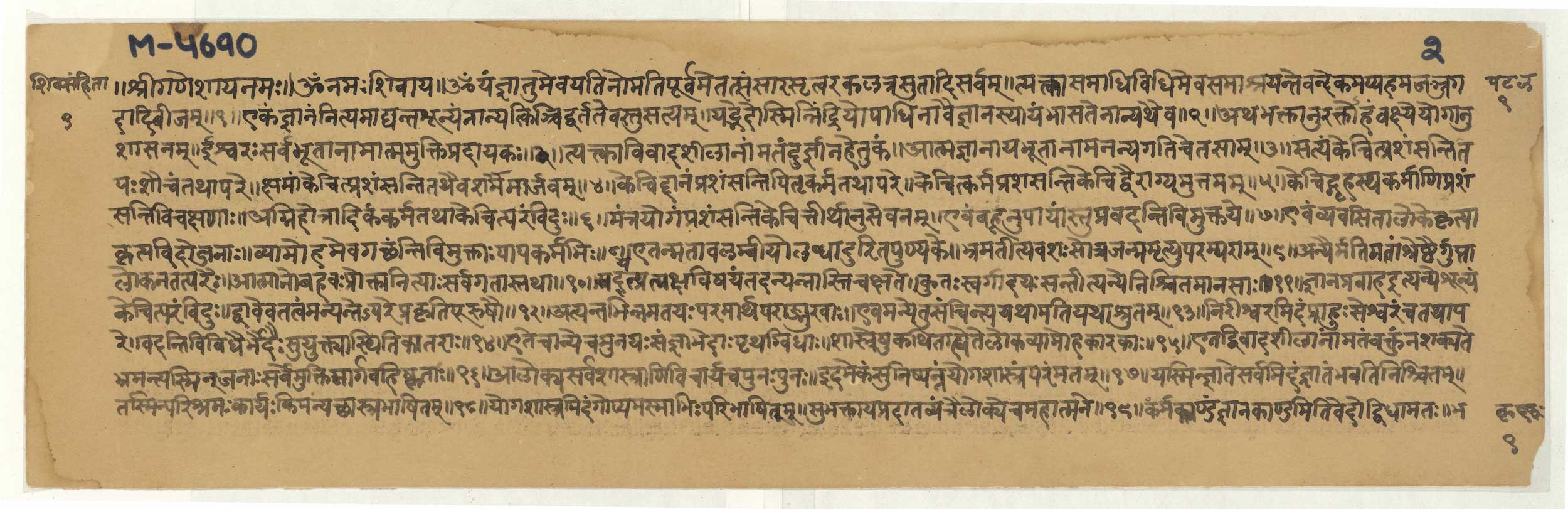
I pray to that Lord who is birthless and the root/seed of this world & for whom the hermits leave their wife, children and others to maintain an ascetic life through meditation just to understand him I1I. The cognition is nityam (perpetual); it is without commencing and end and there is no exsistence of other existent consistentcy. The Bheda (multifariousness) which we see, that is due to the result of sense-observation. When the later cease, then cognition alone (exist) and nothing else persists.//1A// I, Iśvara, the fan of my devotees and bestower of liberation to all the creatures shall explain the Yoga anusashana. //2// (In this scince of Yoga) All the doctrines of controversialist which leads to fake knowledge is discarded and it is for the persons, who are closely associated for spiritual emancipation and whose consciousness is completely attached with me. //3//Some praise Satyam (veracity), some tapas (austerity) and Saucham (purification); some praise Kshama (pardon) and otheres Śama (equality/tranquility) and Arjava (earnestness). //4// Some praise charity and others (praise) rituals in honor of one’s ascendants; some praise action, (while) others regard Vairagya (dispassionateness) is the best.//5// Some learned persons praise the execution of the Grihakarma (responsibilities of the householder); others (praise the) Agnihotradi Karma (ritualistic performances). //6// Some praise the Mantrayoga (Yoga of the Science of the Mantras), others Tirthanusevan (staying at the places of pilgrimage). These are the diverse paths leading to liberation. //7// Being thus diversely determined in this Loka (world), those persons who know the Kritya (beneficial action) and Akritya (evil action), though free from Papa (sin), become subject to delusion. //8// Those persons who follow these (philosophical) doctrines, engrossed in auspicious and inauspicious actions, invariably roam bound by in the cycle of Janma (births) and Mrityu (deaths) in this world. //9// Others, learned among many and passionately devoted in searching the mystery proclaim that thee atmanah (souls) are many, nitya (eternal) and omnipresent. //10// The other firm-minded men proclaim that only those things can be said to exist which are comprehended by the senses nothing else, where is heaven or hell? //11// Some consider the world as a current of consciousness and some consider as void, while others believe in two essences, i.e. Prakriti (matter) and Purusha (spirit). //12// Those who have completely different doctrines and (those who have) turned their faces from the ultimate reality think according to their apprehension and training. //13// Some say that this creation is without God (nirishvara) and others consider that there is a God (seshvara). They based on their belief by different incontrovertible arguments try to establish their existence of God. //14// By these and many other seers with diverse appellations have been established in the Shastras which led the human consciousness into hallucination. //15// It is not possible to completely describe the doctrines of those persons who are fond of quarrel and contention. Being dispelled from the path of salvation, they wander in the universe. //16// Analyzing the scriptures and meditating over them again and again, it has been found that the Yoga Shastra is the only true and firm doctrine. //17// certainly, by Yoga all this is verily known. All the effort should be made to achieve it. What is the need of the other doctrines? //18// This Yoga Shastra is being announced by us as a very secret doctrine. This should be revealed to a pious devotee with a broad vision throughout the three worlds. //19// The Vedas declare about two systems, i.e. Karmakanda and Jnanakanda.
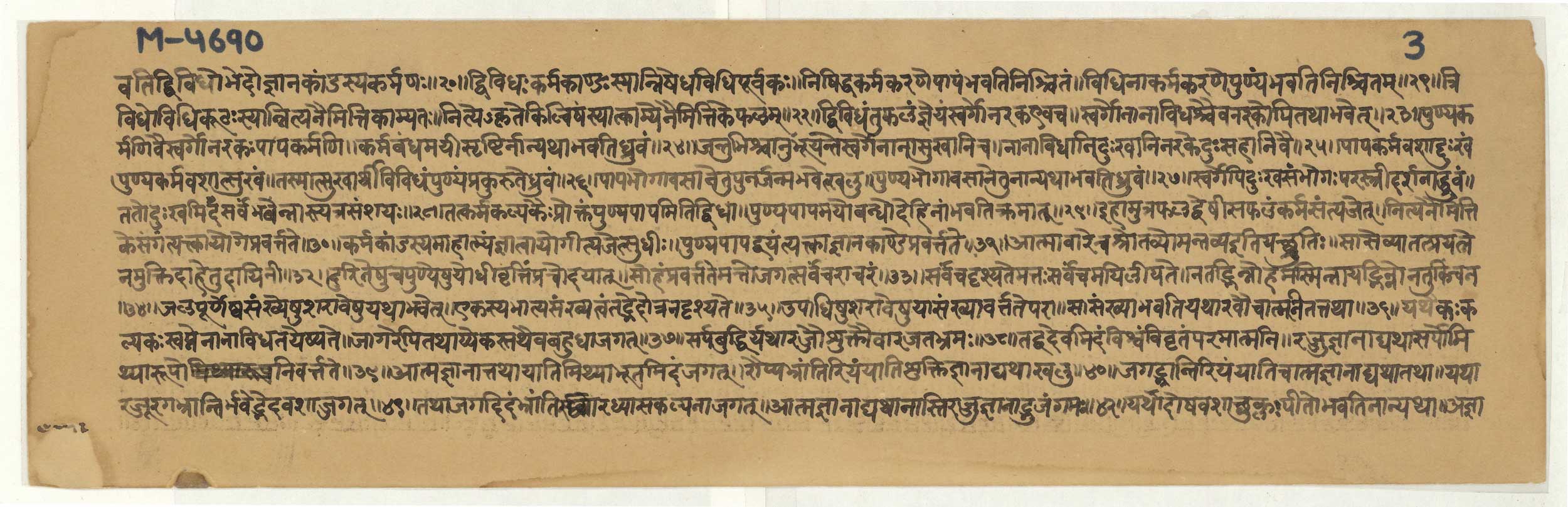
the Jnanakanda and Karmakanda again is divided into two systems. //20// The Karmakanda is two-fold, i.e. injunctions and prohibitions. If prohibited acts done, then certainly arises sin, while execution of the enjoined acts certainly results punyam (merit). // 21// The Vidhis are threefold, i.e. Nitya, Naimittika and Kamya. If the Nityakarmas are not performed then arises sin, on the other hand if the Naimittika and Kamya duties are done or left undone, produce merit or demerit. //22// The results of the accomplishments are twofold, i.e. heaven or hell. The heavens are diverse kinds so also hells are different. //23// The (result of) auspicious deeds is certainly heaven and inauspicious deeds is certainly hell. This creation is the consequence of Karma and nothing else. // 24// The creatures relish many pleasures in the heaven, while many unendurable pains are abided in hell. //25//From the accomplishment of unholy acts pain and from holy acts happiness arises. For the sake of pleasure, one (who desire for pleasure) should invariably perform auspicious deeds. //26// When the sufferings for inauspicious deeds end, then, certainly, rebirth takes place. When the results of auspicious actions are consumed, then also, certainly, result is same. //27// Even in heaven there is undergoing of sorrow by seeing the enjoyment of others. So certainly, everything is full of sorrow; there is no doubt about it. //28//The Karmakalpakas (classifiers of Karma) have distinguished Karma into two parts, auspicious and inauspicious. They are unquestionable in its turn for the bondage of souls(creatures). //29//One should detach from all the actions, who is not desirous of enjoying the results of their actions. Similarly, discarded from the attachments of the nitya and naimittika actions, one is able to engage himself in the practice of Yoga. //30//The Yogi after experiencing the reality of Karmakanda, should renounce them, also detaching from Punya (vice) and Papa (vice), he must concentrate in Jnanakanda. // 31//As per Vedas the Atman (soul) ought to be seen and must be heared .This knowledge is cause of ultimate freedom. That must be practiced with great attention. //32//That intelligence, which is instigated into the paths of Punya (virute) or Papa (vice), is instigated by me. This universe, cara (transferrable) and acara (untransferable), is from me.//33// All things are seen through me and all are absorbed into me, because there subsists nothing but only I. There exists nothing else. // 34// As many reflections of the sun are seen in the cups full of water but the essence is the same. Similarly, individuals, as like the cups are multitudinous, but the reanimating spirit, as like the sun, is one. //35-36//As in dreaming, one soul appears as many objects by mere bequeathing; but on awakening everything disappears, but the soul is one; the same is the universe.//37// As through conjuration a Rajju (rope) appears like a Sarpa (snake), or a (Shukti) pearl like a Rajata (Silver). //38// Similarly, the universe is reflected in the Paramatman. // 39// When the knowledge of the rope is experienced, the incorrect notion of the snake does not persist. Similarly, through self-knowledge the illusion about the universe disappears. When the cognition of the Shukti (Pearl) is experienced, the wrong notion of Rajata (Silver) does not persist. // 40//Similarly, through self-knowledge; the universe always seems a delusion. // As a rope appears like a snake, so the notion about the universe. So, the universe appears as a delusive pigment of adhyasa (misperception) and kalpana (imagination). As through the experience of the rope the serpent appears like a delusion. //42// As through diseased eyes white appears yellow;
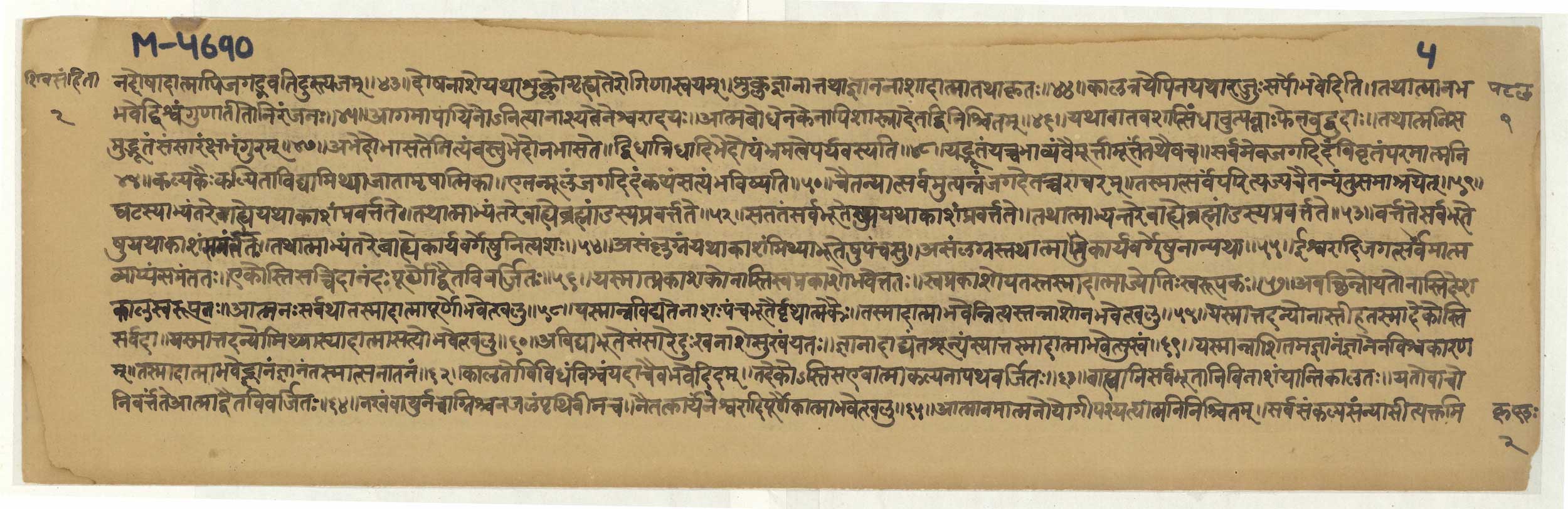
Similarly, due to the defect of ignorance this universe exists in the spirit and very difficult to be eradicated. // 43// As when the disease of the eye is eradicated the patient observes the colour as it is, so when the illusion is removed the real existence of the spirit is perceived. //44//As the rope cannot become a snake during the Kalatrayas (past, present and future), so the spirit which is Gunatita (beyond all the gunas) and Niranjana (pure), never becomes the universe.//45//The learned, who are well-versed in the Shastras and have received the wisdom of the spirt, have proclaimed that even the Gods are non-eternal and liable to end.// 46//As the bubbles in the sea are originated through the fermentation of the Vata (wind), this ephemeral universe originates from the soul.// 47// The abheda (unity) remains always; and the bheda (diversity) does not remain always. During the transition of time, it seems two-fold, three-fold and manifold and is only the illusion. //48// Whatsoever was, is or will be, either Murta (formed) or amurta (formless), the entire universe is overlying on the Paramatman (Supreme Soul). //49//The Kalpakas have advised that (this cognition) comes out of Avidya, which is Mithya (untruth) and Mrishatmika (unreal in nature). How can this universe originating from this be real? //50// The entire universe, transferable and nontransferable has come out from Chaitanya (consciousness). Therefore, relinquishing everything else, take refuge in Chaitanya (consciousness). //51// As Akasha (space) permeates a Ghata (Jar) both inside and out; similarly within and beyond this universe, only one Universal Spirit exists.// 52// As Akasha (space) permeates in all the creatures, similarly within and beyond this universe, only one Universal Spirit exists.// 53//As the Akasha (space) permeates in all the creatures; similarly within and beyond all the effects, only one Universal Spirit exists.// 54//Likewise the space penetrating the five false elements of matters does not combine with them, so the Spirit does not combine with the universe.// 55//From the Almighty Lord to this universe, all are penetrated by one Spirit. There is one Saccidānanda, Purna (all-penetrating) and Dvaitavarjita (second-less). //56//As it is not enlightened by another, hence, it is self-illuminated. From that self- luminance, the identical nature of the Atman (Spirit) is Jyotih (Light). //57//As the Spirit in its real existence is not fixed by time or space, hence it is all- penetrating and exclusively itself. // 58//As the Spirit is dissimilar with this universe, which is based on the five elements, which are considered as false, and subject to devastation, hence it is interminable and it is never demolished. Likewise, there is no other consistency, hence, it is one; without it everything else is pretended; Therefore, it is the real existence. //60//Likewise the universe originated by ignorance and the end of sorrowfulness leads to happiness, hence the Spirit is intuition exempted from the sorrow. Therefore, the Spirit is the (Ultimate) bliss. //61// Likewise by intuition is demolished the ignorance, which is the cause of the universe. Therefore, the spirit is intuition and intuition is endless. //62// Likewise in Kala (time) this universe assumes its origin, but there is one Self which is stable, only one and not subject to imagination // 63//All these extraneous consistencies perish during the course of time, wherever the Spirit, which is undestroyable will subsist without a second and it cannot be subject to speech. // 64//Neither sky, air, fire, water, earth, nor their compounding, nor the Gods, are Purna. The Spirit exclusively is so. //65//
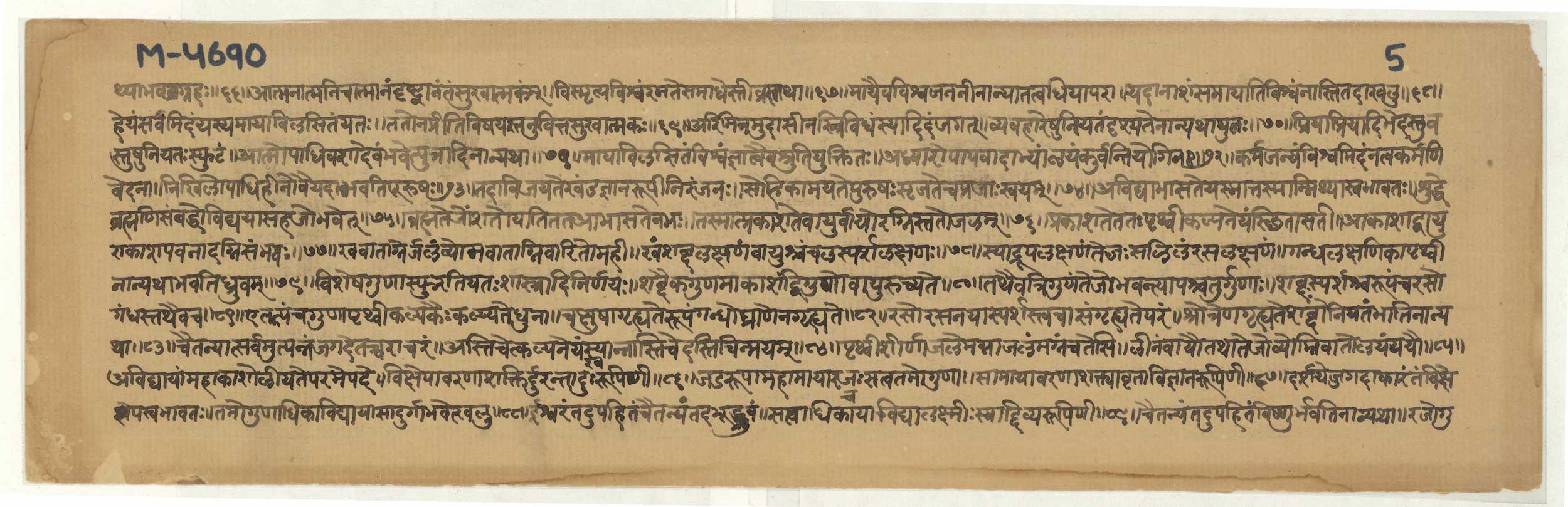
Certainly, the Yogi observes in his own spirit the Universal Spirit by the Self by renouncing all false wants and desolated all the false worldly attachments. //66//Experiencing the Spirit that bestows happiness, in his own spirit by the help of the self, he (the Yogi) forgets this universe and relishes the state of Samadhi. // 67//Maya is the mother of the universe and not from any other principle the universe has been originated. When the Maya is demolished, certainly, the universe does not exist. //68// One for whom the universe (is nothing but) is the amusement ground of Maya, hence worthless, cannot find any happiness in wealth, body etc. nor in delight. //69// This universe seems in three distinct aspects, i.e. either friendly, inimical. This is also found in all the worldly dealings and not otherwise. //70// There is differentiation also in objects, as they are pleasant. Certainly, that Spirit, through distinction becomes a son, a father etc. //71|The doctrines of the Shruti have described the universe to be play of Maya and the Yogi destructs this universe by experiencing that it is but the outcome of adhyaropa and apavada. //72// The universe is full with actions and can be experienced through the doctrine of Karma. When the individual is free from the multitudinous differentiations and existences, //73// Then he can experience that he is inseparable intelligence and Pure (Nikhila Upadhihina).// The Almighty Lord wishes and creates his creatures. //74//From his will comes out ignorance, which is by nature is false and there takes place the continuative between the Pure Brahman and Avidya. // 75//From which rises the Brahmas; from which comes out the Nabha (sky); from the sky rises the air; from the air came the fire; from the fire, water. //76//From water came the earth. This is the order of the elusive procession. From the sky, air; from the sky and air came fire;//77//From the sky, air and fire came water; from the conjunction of sky, air, fire and water the earth was produced. The character of sky is sound; of air is motion and touch. //78//The character of fire is form; taste is quality of water and smell is the quality of earth. There is no disputing about this. //79// The scripture declared the qualities of the elements, i.e. Sky has one quality of sound air two. //80// Fire three, water four and earth has five qualities, i.e. shabda (sound), sparsha (touch), rupa (form), rasa (taste) and gandha (smell). //81// The wise have thus declared the qualities of the elements, i.e. Rupa (form) is comprehended through the eyes; smell through the nose. //82// Taste through the tongue, touch through the skin and sound through the ear. These are certainly the organs of perception. //83// From the Chaitanya (intelligence) the universe both mobile and immobile has come out. The intelligence only does exist. // 84// The earth melted in the water; water is dissolved into fire; similarly, fire unifies in air; air gets dissolved in ether. //85// The ether gets dissolved in Avidya, which unifies into the Paramapada. Vikshepa and Avarana are the two forces, which are of great capability and power and whose form is sorrow. //86// The Mahamaya is Jadarupa has three qualities, Sattva, Raja and Tamas. The non-intelligent form of Maya is encompassed by the avarana force. //87// (The avarana force) demonstrates itself as the universe owing to the existence of the Vikshepa force. When the Avidya has an excessiveness of Tamas then it demonstrates itself as Durga. //88// The intelligence with her is called Ishvara. When the Avidya has an excessiveness of Sattva then it demonstrates itself as Lakshmi. //89// The intelligence with her is called Vishnu.
When the Avidya has an excessiveness of Rajas then it demonstrates itself as Sarasvati. //90// The intelligence with her is called Brahma. All the Gods, like Isa etc. are seen in the Paramatan. Bodies and all substantial objects are the different products of avidya. // 91// The learned have thus described the existence of the universe, i.e. Tattvas and Atattvas are developed, not differently. All things are observed as exhaustible etc. Therefore, the things do not subsist, the magnificent one that demonstrates them, exists alone. // 92//Things appear real due to the reflection of the real. There originate various differences simply due to different names// 93// The One Entity, blissful, entire and all-pervading, alone exists, and nothing else; he who constantly realizesthis knowledge is freed from death and the sorrow of the world-wheel. When by aropa and apavada, this universe dissolved into the one, then, there subsists that one and nothing else is comprehended by the mind. //94-96// From the Physical body of the father and the past actions, the human soul is re-incarnated. The learned deliberate this splendid material body as a penalty for the experience of the results of the past Karma. // 97//This Bhogamandira (temple of excruciation and enjoyment) made up of flesh, bones, nerves, marrow, blood and crossed with Nadisetc., is only for the interest of bearing of ruefulness. //98//This body, created by the Brahma and framed of Pañcabhuta (five elements) is called Brahmanda and has been made for the delectation or sufferings of pain. // 99// The self-assimilation of the Spirit which is Shiva and the Matter which is called Shakti, through their integral combination all the creatures like dreams are born. // 100// From the fivefold intensifying of subtle elements, in this universe, countless objects are developed. The intelligence that is circumscribed in them, through action, is called the jiva. // 101// The universe is derived from the five elements. The Jiva is the enjoyer of the fruits of action. //102// In accordance with the results of past actions, I control all the destinies. Jiva is impertinent and is in all things. It enters the material body to enjoy the fruits of karma. //103// The Jivas obtain different names bound by the actions. In this world (the Jivas), come again and again to enjoy the efffects of their action. The Jiva is dissolved in the Parabrahman when the fruits of Karma have been enjoyed. //104// Thus ends the First Patala on Layaprakarana in the Haragaurisamvada of Shiva Samhita// Now starts the second patala//In this body, mount meru is encircled by seven islands, rivers, seas, mountains, fields and lords of the fields subsist.//1// (In this body), there are seers, sages, stars, planets, sacred pilgrimages, shrines and presiding deities of the shrines as well. //2// The sun and moon, agents of creation and destruction also move in it. Sky, air, fire, water and earth are also there. //3//All the Bhutas (beings) those subsist in the three worlds are also to be found in the body; encompassing the Meru they are enlisted in their respective procedures. //4//He who experiences all these is a Yogi, there is no confusion about it. In the body, which is called the Brahmanda, nectar-rayed moon is established on its proper place, i.e. on top of the Meru (spinal cord) with eight Kalas. This has rains ambrosia day and night with its face downwards. //6// The nectar is divided into two Sukshma (Subtle) parts. (The first one is) the channel Ida goes over the body to nourish it as like the water of the Mandakini. //7// Verily, the nectar nutrifies the complete body through the channel of Ida,
This nectar-rayed (moon) is on the left side. The Another ray is just as magnificent as the purest milk and source of great joy enters through the middle path into the spinal cord to create this body. //9//The Sun, situated at the bottom of the Meru is having twelve Kalas. In the right position path, the Prajapati extends is rays upwards. //10// certainly, it swallows the vital secernments, and ray- transuded ambrosia. The Sun roams through the entire body together with the air. //11//Another form of the sun flows in the right-side path and is the giver of salvation. The God of creation and destruction proceeds in this path through rising zodiac signs. //12//In the body of man there are 3,500,00 (three hundred thousand and a half in number) Nadis and there is principal fourteen nadis out of these namely Sushumṇa, Iḍa, Piṅgala, Gandhari, Hastijihvika, Kuhu, Sarasvati, Pusa, Sankhini, Payaswini Varuna, Alumbusa, Vishvodari, and Yasasvini. Out of these, Ida, Pingala and Sushumna are the main (nadis). //13-15//Amongst these three (nadis) Sushumṇa is the main (nadi) and beloved by the Yogis. Other (nadis) are the subsidiary to it in the body. // 16//All these principal nadis (Ida, Pingala and Sushumna) are adhomukha (mouths downward) and Padmatantunibha (like threads of the lotus). They are corroborated with the Prishthavamsa(spinal cord) and symbolize the sun, moon and fire. //17//The inmost of these three (nadis) is chitra. It is my beloved and in that there is a very subtle hole called Brahmarandhra. //18//Magnificent with five (different) colors, pure and moving in the middle of Sushumna, this (chitra) is the main part of the body and centre of Sushumna. // 19//This has been proclaimed as the celestial way and this is the bestower of happiness and immortality. By meditating on it, the Yogindra eradicates all the sins. //20//The two dactyls higher up the rectum and two dactyls below the penis is the adhara, which is having the proportion of four digits. // 21//In the seed vessel of the adhara lotus there is a beautiful yoni, which is triangular, beautiful and maintained confidential in all the Tantras. // 22//In it is the sovereign goddess Kundalini in the form of coil electricity. It has three coils and a half (like a serpent), and is in the way of sushumna. //23//It exemplifies the originative power of the world, and engaged constantly in creation. It is the Vagdevi, to whom speech cannot manifest and who is being worshipped by all gods. // 24//Ida nadi (is the nadi, which) flows on the left side coiling round the sushumna, it goes to the right nostril. //25//Pingala nadi (is the nadi, which) flows on the right-side coiling round the central path, it goes to the left nostril. //26// Certainly, the nadi which flows in between Ida and Pingala is called Sushumna. It has six stages, six forces, six lotuses and experienced by the Yogis. //27//The five primary stages of Shushumna are experienced under different names. Being essential, they have been explained in this scripture. // 28//The other nadis, rising from Muladhar, go to the different parts of the body; i.e. the tongue, penis, eyes, feet, toes, ears, abdomen, the armpit, thumbs of the hands, the ear and the anus. Developed from their proper place, they end at their several destinations as explained above. //30//From all these nadis, there originate branch wise other limbs and sub-limbs and become three hundred thousand and a half in number, and situated in their several places.//31//
These Bhogavaha Nadis ease the movement of air. They spread through the body cross-wise and length-wise. //32//In the stomach there burns the fire, the digester of food. It is situated in the middle of the domain of the Sun having twelve Kalas. //33//This is known as Vaishvanara (fire) and is born from a part of my own energy. Being inside the body, it digests the different foods of the creatures. //34//This fire enhances life and provides durability and nourishment. It makes the body full of energy, destructs all the diseases and provides health. //35// So, the learned Yogi in compliance with the teachings of his Guru should kindle this Vaishvanara fire with proper procedures and sacrifice food into it every day. //36//This body is called Brahmanad and there are many parts of it. I have explained the Most important of them in this scripture and verily they ought to be known. // 37//In the human body, different are their names and their places are also innumerable. All of them cannot be itemized here. //38// As described, in the body, the all-pervading Jiva dwells. It is decorated with garland of limitless desires and enchained with the body by Karma. // 39//The Jiva having distinct qualities works like agent of all the activities and enjoys the result of his different actions of the past life. // 40//Whatever is seen in the men is the result of the actions and all the beings enjoy or suffer according to the outcome of their Karmas. //41//The desires etc. which make pleasure or pain, function accordingly to the past action of the Jiva. //42//The Jiva receives a happy life due to good and virtuous actions and gets the pleasurable and good things to enjoy without any trouble in the external world. //43//Due to the force of his actions, man suffers wretchedness or enjoys pleasure. The Jiva with excess of evil deeds never stays in peace. //44// (The Jiva) is not distinguished from its actions and except the actions, there is nothing in this world. All things have been acquired from the Chaitanya obscured by Maya. //45//As various beings are born to enjoy their Karma in proper seasons, as through ignorance the pearl-shell is considered as silver, so by the result of one’s karma, the Jiva mistakes Brahman for the Universe. //46//The delusions originate due to the desires and can be removed with great difficulty. When the knowledge of salvation of this world arises, then only the desires are ruined. //47//Due to absorption in this world, the illusion arises about the manifestor. There is no other reason about it. Certainly, certainly, I will tell you the truth. //48// The illusion of the evidenced is destroyed when the Maker of the manifest becomes manifest. As long as one thinks “Brahma is not” the illusion does not cease. //49//This false knowledge only vanishes by observing deeply into the matter. It cannot be eradicated otherwise; the illusion of Rajata (silver) remains.//50//As long as knowledge about the Niranjana does not arise, so long as all things appear separate and many.//51//When the body achieved through the action is engaged in achieving salvation, only then the burden of carrying the body becomes successful not otherwise.//52//The master desire clings to and accompanies the Jiva; alike is the illusion which it suffers according to its Krityakritya (deeds and misdeeds).//53//The person descends from the path of Nirvana through illusion of unnecessary talk and sinful deeds and attached to sensual aim and sensual pleasures. //54// According to my opinion when a person does not see anything else here, having seen the Self by the self in renouncing all the actions then there is no sin in renouncing all the actions. // 55//
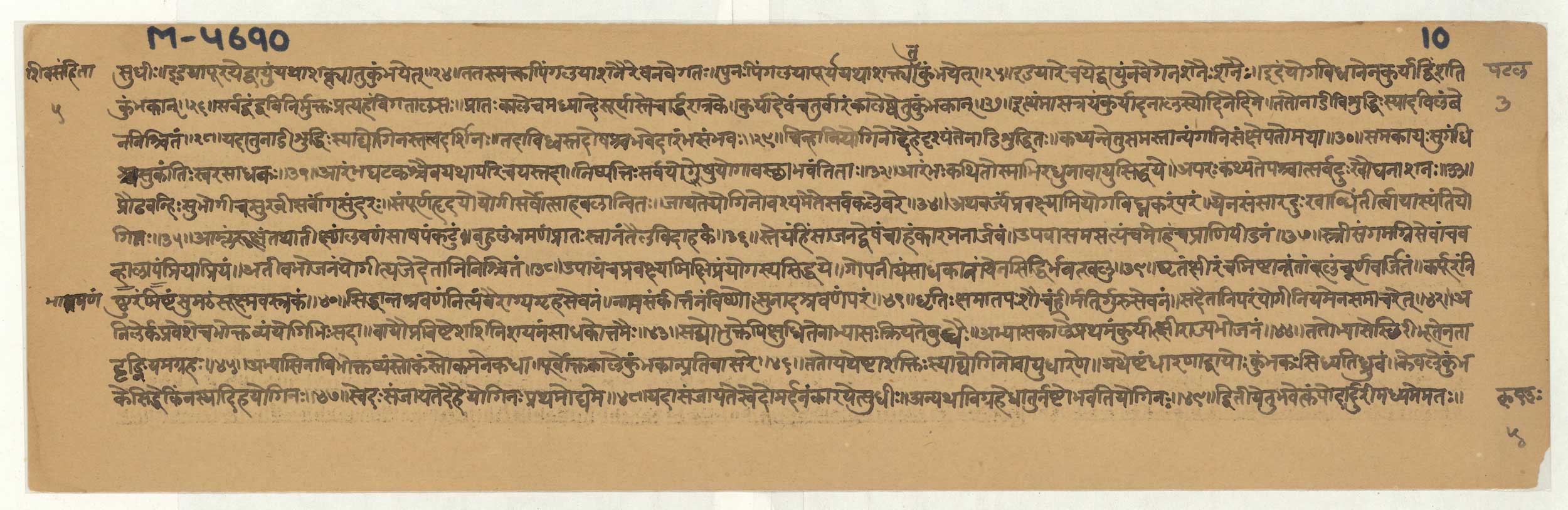
All the desires are dissolved through cognition and not otherwise. In the absence of all Tattvas then tattva of the self becomes manifested. //56// Thus ends the Second Patala on Tattvagyanopadesha in the Haragaurisamvada of Shiva Samhita//There is a magnificent lotus with twelve petals with splendid sign, situated in the heart. It has the twelve beautiful letters from Ka to tha. //1//Embellished with various desires the Prana lives there, attached by its past actions which have no beginning and joined with false ego. //2//From the various alterations of the Prana, it receives different names. All of them cannot be stated here. //4//Prana, Apana, Samana, Udana, Vyana, Naga, Kurma, Krikara, Devadatta, and Dhananjaya. //4//In this scripture, ten principal names of the (Prana) has been described by me. Motivated by their own actions they perform all the functions. //5// According to me, out of the ten (Pranas), the first five are the primary ones. Even among these, the prana and apana are the supreme agents.//6//Prana situated in the heart; apana in the anus; samana in the navel, udana in the throat region and vyana moves all over the body.// 7//The five persisting vayus, Naga etc., execute the functions, i.e. eructation, opening the eyes, hunger and thirst, yawning, and lastly hiccup.//8//He who experiences the structure of the body in this manner, being exculpated from all sins, reaches the ultimate state.//9//Now I will explain the means to attain success in Yoga easily. By experiencing this, Yogis never fail in the practice of Yoga. //10//The knowledge imparted by the Guru through his lips is only powerful; other than it turns fruitless, weak and very painful. //11//By pleasing the teacher with utmost attention, one devoted to this wisdom, readily achieves the result of that knowledge. //12//Guru is father; Guru is mother; Guru is God. There is no doubt about this. He should be served by all with their thought, word and action. //13//Everything is achieved by the blessings of the Guru. Therefore, the Guru should be daily attended and there is nothing auspicious than this. //14//One should salute his Guru with eight limbs after moving three times round him and touching with his right hand his lotus feet. //15//Certainly, the person, who has mastery over himself, attains success through faith, not otherwise. Hence, the Yoga should be performed with faith, care and persistency.// 16//Those who are attached with bad company, who are nonbelievers, who are destitute of respect towards the Guru and who have many assemblies (never achieve success).// 17//Those who are attached with fake and vain discussions, who are brutal in their speech and who do not give satisfaction to their Guru, never achieve success.//18//The first and foremost sign to achieve success is the belief that it will succeed; the second is having faith in it and the third is regard for the teacher.//19//The fourth is the feeling of equality; fifth is the control over sense organs; sixth is the restrained diet. There is no seventh condition. Having obtained a Yogaguru and received the instructions of Yoga, the practitioner should practice Yoga with utmost faith as per the method taught by the Guru. //21// A Yogi should start the practice of air in a Sushobhana Matha (beautiful place) with the Padmasana posture and sitting on the asana. // 22//The wise Yogi should maintain his body firm; his hands joined as if in pranjali (supplication), and salute the wise teacher. He should also salute to Lord Ganesh in right and goddess Ambika and presiding deity the region who are on the left side. //23//Then the Yogi close with his right thumb the pingala (right nostril)
inhale air through the ida (left nostril) and start the procedure of Kumbhaka. //24//Then he keeps the air confined-suspending his breathing slowly and later breathe out slowly, not strongly through the right nostril. //25//Again he should draw breath through the right nostril, then keep the air confined-suspending the air through the ida (left nostril), not strongly, but gently. He should practice twenty Kumbhakas according to this method. //26//The Yogi should perform this practice without any neglect and free from all doubts. The Kumbhaka should be practiced four times during the early morning, midday, sunset and mid-night. //27//In a regular manner, when this has been practiced for three months, then the Nadis will be promptly and verily purified. //28//When the Nadis of the truth-experiencing Yogis are sanctified then his faults are destroyed and he enters in the arambha (first stage) of the Yoga practice. //29//When the Nadis of the Yogi are sanctified special appearances are perceived in the body. I shall explain in brief all the different signs. //30//The body of the Yogi who practice the breath becomes harmoniously increased, emits sweet scent and effulgence. //31// The Yogavasthas (stages of Yoga) are arambha, ghataka, paricaya and nishpatti. //32// Arambha avastha (state of beginning) has been explained and the rest will be described hereafter. They demolish all sins and sorrows. //33//The qualities being invariably found in the bodies of every Yogi are strong appetite, good digestion, blitheness, good figure, strong courage, enthusiasm and full strength. //34//Now I shall explain the obstacles to Yoga which should be avoided. Since their avoidance, the Yogis overcome the sea of worldly sadness.//35//A Yogi should avoid the followings: Amla (acids), Ruksha (rough), Tikshna (pungent), lavana (salt), Sarshapa(mustard), Katu (bitter things), much walking, early bathing and items roasted in oil; stealing, violence, hostility towards any individual, pride, tortuousness, fasting, untruth, desire other than salvation, harshness towards animals; attachment of women, proximity of fire, muck talking, sweetness and unsweetness of speech and much eating.// 36-38//I shall explain the means by which good result in Yoga is rapidly achieved; It should be kept hidden by the Sadhaka so that certainly the success comes.//39// The Paramayogi (great yogi) must observe always the following rules: he should use butter, milk, sweet food, betel without lime, camphor, kind words, enjoyable monastery having a small door, listen the doctrines , household duties with detachment, sing the name of Lord Vishnu, hear sweet internal sound; have patience, stability, forgiveness, austerity, refinements, modesty, devotion and service of the Guru.// 40-42//When the air (anila) enters the sun (arka/piṅgalā), then it is the right time Yogi to take his food and when the air (vayu) enters the moon (sashini/Iḍā) he must go for sleep.// 43//Yoga should not be performed by the wise neither just after the meals, nor when one is very in hungry. Before the practice, some milk and butter must be taken. //44// When one is completely established in (Yoga) practice, then these restrictions should not be observed. //45// The practitioner (Yogi) must consume small amounts many times and must practice Kumbhaka in a routine basis at the stated time. // 46//When the Yogi regulates the air and stops the breath as per his capacity, then verily he gets success in Kumbhaka. When only Kumbhaka is achieved, what things cannot the Yogi command here? //47// In the first stage of pranayama, the body of the Yogi begins to perspire. //48// During the sweat, the Yogi should rub it well. Otherwise the body of the Yogi misses its dhatu. //49// In the second stage, there originates trembling of the body and in the third stage the leaping like a frog. //
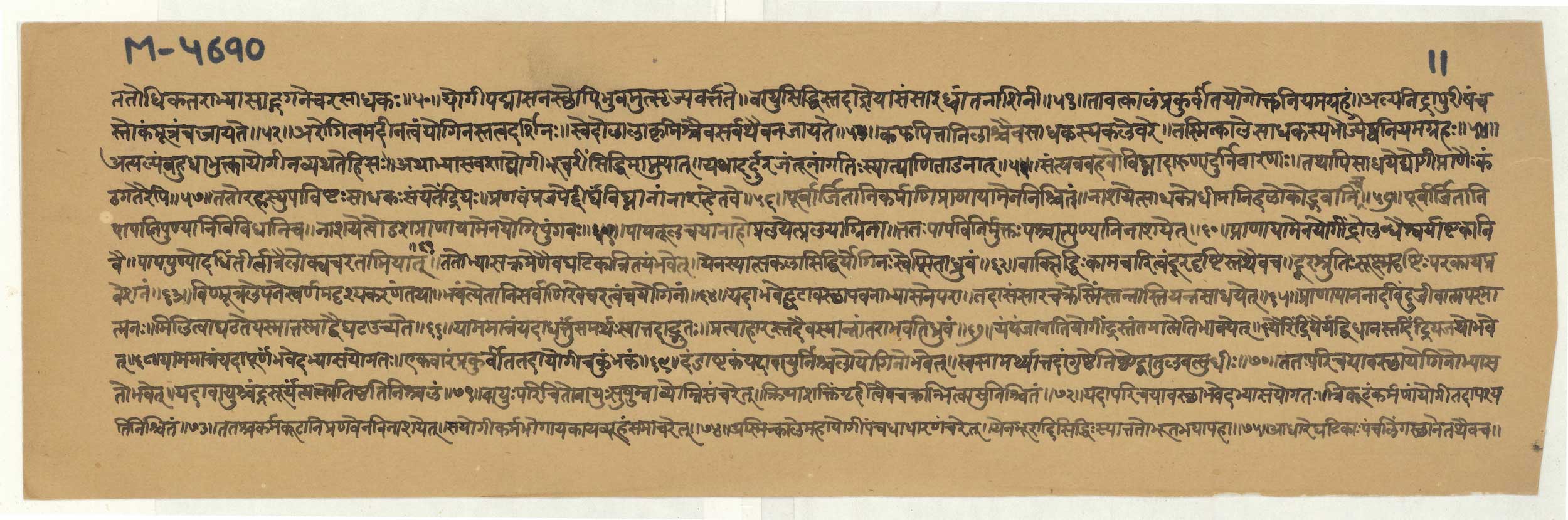
When the practice becomes greater, the Sadhaka moves in the air. //50// When the Yogi through seating in padmasana can leave the ground (and raise in the air), it can be known that the vayusiddhi has been achieved, which removes darkness of the world. //51//The rules and restrictions as mentioned above should be practiced by the Yogi as long he does not achieve it. The perfection in practice follows decrease of sleep, excretions and urine. //52//The Tattvadarshin (truth-perceiving) Yogi becomes free from illness and sorrow. He never gets Sveda (perspiration), Lala (saliva) and Krmi (intestinal worms). //53//When there is neither any development of phlegm, wind, nor bile in the body of the Sadhaka (Yogi); then he may not follow the rules in his food and rest. //54//No hurtful results arise when the Yogi takes a very little quantity of food many times. The Yogi achieves Buucarisiddhi through constant practice. He moves as the frog jumps over the ground, by the clapping of hands. //55// Certainly, there are many insuperable and hard obstructions in Yoga. Still the Yogi must go on his practice (Yoga) at all the difficulties; even when his life is to come to its end.// 56// To remove all the obstacles, the Sadhaka (practitioner) should sit in a peaceful place and controlling his senses he should utter with inaudible repetition, the long Pranava OM.//57//The learned Yogi through the regulation of Prana surely destroys all his karma, whether gained in this life or the past.//58//The (learned) Yogi destroys the different virtues and vices gained in his past life by sixteen pranayamas.// 59//As the fire burns away a heap of cotton, the Pranayama destroys all the sin. It causes the Yogi free from sin; and next it destroys the bonds of all his auspicious actions. //60//The powerful Yogi having achieved the eightfold psychic powers and crossed the ocean of merit and vice through Pranamaya, roams freely through the three lokas (worlds). //61//Certainly, he should make himself capable to hold breath for three ghatikas. The Yogi, by this, doubtlessly, achieves all the desired powers. // 62// The Yogi achieves the powers like- Vaksiddhi, Kamacari, Duradrshti, Sukshmadrishti and parakayapraveshana. //63//Turning base metals to gold by scratching them with his excretions and urine, and the power of becoming unseeable, and lastly, moving in the air. When the Yogi reaches the state of ghata through Pranayama, then there is nothing, which cannot be accomplished in this circle of universe for him. //65//The Ghata Avastha (state of the ghata) is that in which the prana and apana, nada and bindu and the jivatma and paramatma combine and co-operate. // 66//When the Yogi controls the breath for three hours, surely, the auspicious state of pratyaharais accomplished without any fail. //67//Whatsoever object the Yogi comprehends, let him conceive it to be the Atman. When the means of actions of various senses are realized, then they can be subdued. //68// When through practice the Yogi performs one kumbhaka for complete three hours and when for eight dandas the breathing of the Yogi is debarred, then that wise Yogi can balance himself on his toes; but he looks to others as harebrained. //69-70//Afterwards, the Yogi, through practice reaches the Paricaya-avastha (state of knowledge). The Paricaya state is that when the air leaves the sun and moon channels and continues to be unmoved and steady in the ether of sushumna. By practice of Yoga, the Yogi achieves kriya Shakti and he pierces through the six chakras. //71-72//When the Yogi reaches the state of paricaya –avastha through practice, certainly, sees the Trikuta-of karma (three-fold effects of karma).// 73// Afterwards the Yogi destroys the Karmakutas (multitude of Karmas) through the pranava, and achieves kayavyuha ( processing the body) to enjoy the karmabhoga (actions in one life).//74// At this time the wise Yogi exercises the five-fold dharana by which control over the five elements is attained and fear of harms from any one is removed.//75//Let the great Yogi practice dharana in five ghatis in the adhara lotus is in the seat of the penis,
in the region above it, in the heart, in the throat and lastly in the space between the two eye-brows. By doing this practice, the Yogi is free from any harm from the five elements earth etc. // 76-77// The intelligent Yogi, who follows the practices of dharana of all elements never dies through hundreds of cycles of the great Brahma. //78//Afterwards, through exercise, the Yogi attains the Nishpatti-avastha (the final consummation). The Yogi having demolished all the seeds of karma which remained from the unknown time, enjoys the nectar. //79// When the Yogi achieves the state of final consummation of Samadhi, when the jivanmukta calm Yogi has obtained through (constant) practice the culmination of Samadhi and when the culmination of Samadhi is spontaneous, then let the Yogi hold the chetana, along with the air, and with the effect of kriya-shakti conquer all the chakras and assimilate in the jnanashakti. //80-82//Presently, we have to explain the regulation of Vayu(air) to eradicate the obstacles. By this practice all sufferings vanish in this world-cycle.//83// When the expert Yogi drinks the Pranava-vayu by locating the tongue at the root of the palate, then there happens complete dissolution of all diseases .//84//When the expert Yogi drinks the cold air through the concentration of the mouth in the form of a crow-bill, knowing the regulations of action of prana and apana, then he becomes eligible for liberation.//85//The expert Yogi, who daily drinks the nectarous air, according to the proper regulations, eradicates fatigue, burning, old age and diseases.//86//When the Yogi drinks the nectar flowing from the moon by placing the tongue upwards, certainly, he conquers death within a month.//87//When the Yogi drinks the nectar by firmly closing the glottis by proper yogic method and meditating on the goddess Kundalini, he becomes a poet within six months.//88//When the Yogi drinks the air in the morning and the evening through the crow-bill and meditating that it goes to the mouth of the kundalini, then tuberculosis is cured.//89//When the expert Yogi drinks the nectar through the crow-bill during the day and night his diseases are removed and he achieves the powers of duradrshti and durashruti.// 90//When the expert Yogi drinks the air very slowly by closing the teeth and placing the tongue upwards, then within a short period he conquers death.//91//One, who continues daily these exercises for six months, then he is free from all sins and destroys all diseases.//92//If one extends the practice for a Samvatsara then he conquers the death. Therefore, the wise practitioner should follow the practice very carefully. //93//If the Yogi extends this practice for three years, then he becomes a Bhairava and achieves the powers of anima etc. and command all the elements. // 94//The Yogi becomes free from disease, death, and old age by remaining for half a second with his tongue placing upwards. //95//One who meditates by pressing the tongue combined with the Prana, certainly, the person never dies. This has been proclaimed by me. //96//By practicing this exercise and Yoga, he becomes second Kamadeva without rival. He experiences neither hunger nor thirst, nor sleep, nor swoon.//97//Practicing these methods, the expert Yogi becomes in the world perfectly independent and free from all the obstacles and he can move everywhere.//99//By practicing this, he is never reborn, nor is infected by virtue and vices, but delights with the gods.//99//There are eighty-four postures, of various modes.//100//Out of them, four ought to be adopted, which I mention below: Siddhasana; Padmasana; Ugrasana; Svastikasana.//101//The Siddhasana that gives success to the practitioner and by its practice one attains quick accomplishment in Yoga is as follows: pressing the yoni with care by the heel, the another heel to be placed on the lingam(penis); then the Yogi should fix his gaze upwards on the space between the eyebrows; must be steady and hold his senses; his body must be straight and without any bend and the place should be a adjourned one without any noise.// 102-104//The Siddhasana should be practiced through the regulation of the breath and through this posture, the Yogi leaving the world, achieves the ultimate place.//105//
Throughout the world, there is no posture more mystical than this. The Yogi is free from all the sins by contemplating on this posture. //106// The Padmasana which removes all the disease is as follows: having crossed the legs cautiously, position the feet on the opposite thighs; intersect both the hands and place them a like on the thighs; fix the sight on the tip of the nose; pressing the tongue against the root of the teeth then draw the air slowly, raising the chin and the chest and exhale it slowly in an unclogged stream. It cannot be practiced by everybody; only the expert (Yogi) can attain success in it. // 107-110// Undoubtedly, by practicing this posture, the vital air of the Sadhaka becomes fully equable and flows in proper manner through the body. //111// When the Yogi performs the regulation of the breath sitting in the Padmasana and meditating on the function of prana and apana, he is liberated. Verily, verily, I tell you the truth. //112// The Ugrasana is as follows: Stretch out both the legs and keep them apart; steadfastly take hold of the feet by the hands and keep head on the knees. It stimulates the motion of air, eradicates the decay of the body. This is also called paschima-uttana. //113-114//The learned man who daily practices this posture certainly induces the flow of air up through the anus. //115//Those who exercise this (posture) achieve all the siddhis. Therefore, those who are wishful of attaining the success should follow this in a diligent manner. //116//This (knowledge) should be kept mystical with utmost care and should not be given to anybody. Through this the vayu-siddhi is smoothly obtained and it removes a large number of miseries. //117//Place the soles of the feet fully under the thighs, keep the body direct, and sit at ease. This is called the Svastikasana. //118// In this manner, the learned Yogi must exercise the exercise of the air. (By practicing this) no disease can attack his body and he achieves vayu-siddhi. //119// This is also called as Sukhasana. This Svastikasana promotes well-being and should be kept secret by the Yogi. // 120// Thus, ends the Third Patala on Yogabhyasatattvakathana in the Haragaurisamvada of Shiva Samhita// Now stars the fourth patala//In the first stage, fix the mind in the Adhara lotus by means of inhalation. Then contract the Yoni, which is situated between anus and penis. //1//Contemplate on the God of Love as residing in Brahman’s yoni in the shape of a Kanduka flower, which looks like ten million suns and as cool as ten million moons. //2//Above it is the ultimate digit, a flame, whose form is chidrupa (consciousness). The practitioner should envisage himself as having become one with it.// 3//Then the Yogi goes along the Brahmamarga; progressing through the three bodies in their due order, which looks like ten millions suns and as cool as ten millions moons.//4//There is expressed in every chakra the nectar of immortality which is in heaven characterized by ultimate bliss and its colour is pink, abounding with full of energy and pouring forth the immortal fluid.//5//Let the Yogi drink the divine nectar and the once again enter the Kula He should go again to the Kula by the way of Matrayoga, not otherwise.//6//In this Tantra, it has been proclaimed by me as Prana. That which starts with the fire of time and ends as Shiva assimilated in her once more. // 7//Thus has been described the method and application of Yonimudra. Just by implementing it one can do anything. //8//Even those mantras which are deformed, pierced, restrained, burnt out, whose flame has become attenuated, dirty, cursed, slow, young, old, audacious, proud of their youth, deviated, confused, faint for a week on the side of the enemy, impotent, weak, weakened or fragmented into a hundred pieces, shortly becomes powerful in associetion with this practice. All this can give perfections and liberation to the disciple when appropriated by the Guru.//12// The Yogi obtains supremacy or whatever he utters in the form of a mantra, auspicious or inauspicious gets accomplished by applying the Yonimudra.// 13//
After duly initiating with proper rites and embrocating him a thousand times, this mudra is taught in order that the practitioner may deserve and receive the mantras.//14//One, who practices the Yonimudra, does not get tainted by sin even if he kills a thousand Brahmins and destroys the three worlds.//15//By practicing the Yonimudra, one who kills his guru, drink alcohol, steals or violet with the wife of Guru, is not tainted by these sins.//16// Hence, those who wish for liberation should practice this regularly. It is by practice that success is achieved and it is by practice that one gains liberation. // 17//Perfect understanding is acquired through practice. Yoga is acquired through practice. Success in Mudras comes through practice and success in pranayama gained through practice. //18// One deceives time through practice and conquers death. Through practice one gets Vaksiddhi and the power to move everywhere at will. //19//Yonimudra is to be kept in great secrecy and not to be given to all. It should not be revealed to others, even when threatened with death. //20//I shall now describe the best means to achieve success in Yoga. It is the rarest Yoga and the Siddhas should keep it secret.// 21//With the blessings of the Guru when the sleeping Kundalini is active, all the lotuses and knots are pierced.//22//Hence, to awaken the Ishvari (Goddess of Kundalini) who is asleep in the mouth of the Brahmarandhra, the Mudras must be practiced with utmost care.//23// Out of the mudras, the following ten are the most beneficial: Mahamudra, Mahabandha, Mahabheda, Khechari, Jalandhar, Mulabandha, Viparitkarana, Uddana, Vajroli, and Shaktichalana.//24-25////Thus the Mahamudra// O Vallabhe ! now I shall explain the Mahamudra in this Tantra, by whose knowledge the ancient seers Kapila and other achieved success in Yoga.//26//Following the instructions of the Guru, gently press the yoni in the space between the anus and the penis with the heel of the left foot. Stretching the right foot out and hold it with both hands. Having closed the nine doors put the chin on the chest. Then contemplate the vibrations of the mind and start holding the breath. This is called the Mahamudra, it is kept mystical in all the Tantras. //27-29//The concentrated Yogi, after practicing on the left side of the body, should then practice on the right side and should balance his pranayama. //30//In this manner, even an ill-starred yogi can achieve success with this technique. Through this all the Nadis of the body are roused and steadiness of bindu is attaineed. // 31//Increase of life, destruction of sins, heating of kundalini, insertion of the wind into the aperture of Brahman, curing of all diseases, increase of the digestive fire, physical beauty and light eradication of old age and death, achievement of desired goals, happiness and conquering of the senses: all these are achieved through practice for the Yogi in the path of Yoga. //32-34// There should not be hesitation about it. O Surapujite, this mudra is to be kept secret with utmost care. By achieving this, the yogi crosses the ocean of the world. //35//This Mudra, proclaimed by me, is the giver of all the desired results to the practitioner. It must be performed in secrecy and never to be given to anybody. //36//Now the Mahabandha// After the Mahamudra, place the right foot extended up to the thigh; contract the penis and anus and draw the apana vayu upwards and join it with samana-vayu; bend the prana vayu downwards and let the learned yogi bind them in trinity in the navel. This Mahabandha that I have explained to you is the ultimate means to achieve perfection. By this, all the fluids in the vessels of the body of the Yogi are propelled towards the head. This should be practiced with great care, alternately with both feet. By this practice, the wind enters the Sushumna and it nourishes the body, the bones are firmly knitted. //41//The heart of the Yogi becomes full of joy. By the practice of the Bandha, the great Yogi achieves all his desires. //42//O Tribhuvaneshvari, while performing the Mahabandha, when the Yogi unites the prana and apana vayus and fills the belly with air and drives it slowly towards the nates, it is called the Mahavedha. //43//
The best of the yogis, having by means of this vedha used his breath to pierce the knots along the Sushumna, should then pierce the knot of the Brahma//44// One who regularly practices the secret Mahavedha, achieves mastery over the wind and it destroys decay and death.//45// The gods residing in the chakras tremble through the air in pranayama and the Kunadalini Mahamaya is also absorbed in the mount Kailasha.//46//The Mahamudra and Mahabandha are fruitless if they are not combibed with Mahavedha. Hence, the Yogi must practice all these with utmost care. // 47//One, who practices these three, daily four times with great care, undoubtedly conquers death within six months. // 48//Only the Siddhas know glory of these and no one else. By knowing these the Sadhakas, obtain all success. //49//This must be kept with great secrecy by the Sadhakas desirous for obtaining power. Otherwise the powers can never be achieved through the practice of the mudras. //50// Now, the Khecari Mudra// The wise yogi should sit in Vajrasana, in a place free from all the obstacles, should fix his gaze on the spot in the middle of the eyebrows and reversing the tongue backwards, fix in the hollow under the epi-glottis and placing it with utmost care on the mouth of the well of nectar closing up the air. At the request of the Bhaktas, I have explained this Khecari Mudra. It is mother of powers and is dearer to me than life. // 51-53//Through regular practice, the Yogi drinks the ambrosia every day. Through this he obtains Vigrahasiddhi, even as a lion against the elephant of death. // 54//Whatever situation a yogi may be in, pure or impure, if he knows the Khecari he is sure to be purified. //55//One who practices it even for a moment crosses the ocean of sins and after enjoying the Divyabhoga is born into a noble family. //56//One who follows the Khecarimudra with calmness and without laziness counts as seconds the period of hundred Brahmas. //57//One who knows this Khecharimudra in accordance with the teachings of his Guru, achieves the highest end though plunged in great sins. //58//O Surapujite, this mudra, dear as life, must not be given to anyone. It must be kept secret with utmost care. // 59//Having contracted the network of vessels in the neck to place the chin on the chest, is called the Jalandharabandha. It is precious even to the gods. // 60//In the living beings, the fire in the navel region drinks the ambrosia which exudes out of the thousand-petalled lotus. That is why one should practice this bandha. //61//By practicing this Bandha, the learned yogi drinks the ambrosia and becomes immortal and enjoys the three worlds. //62//This Jalandara-bandha grants success to the practitioners. The yogi, who wants perfection, should practice it daily. // 63//By pressing the anus with the heel and draw the apana vayu upwards slowly by practice, this is the Mulabandha- the remover of decay and death. During practice of this mudra, if the Yogi integrates the apana with prana vayu, then it is called as Yoni Mudra. What cannot be achieved in this world by the Yonimudra.? // 64-66//Through the blessings of this Mudra, the yogi sitting in the padmasana posture, free from idleness, leaves the ground and moves through the air. //67//The learned Yogi, who wishes to cross the ocean of the world, should practice this Bandha in a secret and a lonely place. //68// Now the Viparita-karana Mudra// Putting the head on the ground, let him (the yogi) stretch out his legs upwards, moving them round and round. This is called the Viparitakaranamudra, kept secret in all the Tantras. // 69//The (wise) yogi conquers death and is not destroyed even in pralaya, who practices it regularly for three hours. //70// One who performs this Bandha becomes like siddhas and served by the creatures. //71//When the guts up and down the navel region are brought to the back side,
It is called Uddyāna-bandha, the remover of all the sins and sorrows. //72//The internal organ of the abdominal should be contracted above the navel. This is called the Uddyana-bandha- a lion against the elephant of death. // 73// The (wise) yogi who performs this Bandha four times a day, purifies the navel by which the winds are purified. //74// Certainly, by performing for six months, the Yogi conquers death, the abdominal fire is kindled and fluids of the body increase. //75//Accordingly, the Vigrahasiddhi is also achieved through this. Certainly, through this, all the diseases are destroyed. //76//The learned yogi should practice ( this mudra) as per the instruction of the teacher with utmost care. This auspicious mudra must be practiced in a lonely and undisturbed area. // 77// Now the Vajroli Mudra// Motivated by the clemency for my devotees, I shall now describe the Vajroli Mudra, the remover of the ignorance of the world, the most mystical among all mystical. //78//Even adopting all the wants and without adjusting the rules of Yoga, a householder can become liberated if he practices the Vajrolimudra. //79//Practice of the Vajroliyoga gives liberation to one even he is involved in sensuality. Hence, it should be performed by the Yogi with utmost care. //80//Firstly, the learned practitioner acquaints his own body as per the method, the reproductive cell from the female organ enter into own body by sucking up through the tube of the urethra by restraining his own semen, let him follow procreation. If the semen begins to displace, let him control by the practice of the Yonimudra//81-82// Let him place the semen on the left-hand duct and block further copulation. After a while, let him continue it again. //83//As per the instructions of the Guru and by uttering the hum sound, let him draw up forcibly by the compression of the apana vayu the germ-cells from the uterus. //84//In order to attain quick success in Yoga, the Yogi, worshipper of the lotus-feet of his Guru should maintain the diet of cow-milk in this duration. // 85//The vindu should be known as moon-like and the Raja as emblem of the sun. Let the Yogi perform their unification in his own body with great care. // 86// I am the vindu and Shakti is the Raja. The Yogi attains the state of success when both are united and his body becomes divine. //87//Destruction of vindu is death and preservation of it is life. Hence, it should be preserved by the Yogi with utmost care. // 88//Men are born and die through the vindu (semen)//89//When the preservation of the semen is attained, what then cannot be obtained in the world? By the enormousness of its preservation, one turns like me in glory. // 90//In this world, vindu causes the ultimate pleasure and pain for all the creatures, who are ignorant and are subject to death and decay in this world. //91// This Shankarayoga is considered by the Yogis as excellent among all the Yogas//92//Men gets perfection through this practice even immersed in enjoyments. As the result of his practice, he becomes siddha in the world. // 93//Certainly, by this practice, the Yogi obtains all kinds of powers even when relishing all the multitudinous enjoyments of the world. So it should be practiced //94//Vajroli is divided into two types- Sahajoli and Amaroli. By all the methods let the Yogi preserve the Vindu. //95// Amaroli is: during the time of the copulation, if the vindu is emitted and there is the union of sun and moon, then let him assimilate this union through the male organ. // 96// Sahajoli is: the method by which the vindu on the point of the discharge can be recouped by the Yoni-mudra. It is maintained secret in all the Tantras. // 97// Certainly the result of Amaroli and Sahajoli is equal, they are distinguished due to the nomenclature. Let the Yogi perform them with utmost care and perseverance. //98//I have explained this Yoga due to the affection for my Bhaktas. It should be maintained with greatest care and must not be revealed to everybody. // 99//secret of all the secrets that ever was or shall be; hence; by whatever possible means, let the wise Yogi maintain it with utmost secrecy. //100//The Yogi, during the voiding of the urine draws it upwards forcibly by the Apanavayu and keeping it up and then eject it slowly and slowly. According to the instruction of the Guru, when he practice this, he obtains Vindusiddhi which gives the great perfection. // 101-102//
As per the instructions of the Guru, one who practices it for six months, does not lose his semen even if he enjoys a hundred women at a time. //103// What else cannot be achieved when vindusiddhi is obtained? Even the very rare aura of my godhead can be achieved through it.// 104//// Now the Shakti-chalana Mudra// The draw up of the Kundalini forcibly and firmly, by the learned Yogi through the apana-vayu is called Shakti-chalana Mudra, the giver of all powers.//105-106//One who practices the Shaktichalanamudra regularly , achieves increase of life and all the diseases are destroyed.// 107//The serpent i.e. the Kundalini herself goes up leaving sleep by this practice hence let the Yogi wanting for powers, should practice this.//108// One who performs always the excellent Shaktichalanamudra, attains the Vigrahasiddhi and the powers of anima etc.//109//One who practices it as per the instruction of the Guru, there is no fear of death. One who practices it properly for two muhurta with utmost care, becomes very near to success. This Shaktichalana mudra should be performed in a proper posture. // 110-111//The ten Mudras (as explained above), neither whose equal there was, nor ever shall be. Through the practice of any of them, one becomes a Siddha and obtains success. There is no alternative to it. // 112// Thus ends the Fourth Patala on Mudrakathana in the Haragaurisamvada of Shiva Samhita// // Now starts the Fifth Patala// Thus spoke the Goddess Parvati, O dear Shankara! kindly elaborate me the obstacles to Yoga for the sake of those whose minds search for the ultimate end. //1//Thus spoke the Lord // O Devi, I shall explain all the obstacles that are against in the path of Yoga. Bhogas (enjoyments) are the greatest obstacles for the attainment of emancipation. // 2////Now the Bhogarupavighnakathanam// Obstacles to Yoga are women, beds, seats, dresses, and riches. Betels, dishes, vehicles, kingdoms, riches and powers; gold, silver, as well as copper, gems, aloe wood, and kine; debate, studying the Vedas and Shastras; dancing, singing and ornaments; harp, flute and drum; riding on elephants and horses; wives and children, worldly pleasures- all these are so many impediments.//3-5// Now starts the Dharmarupayogavighnakathana // The obstructions which arise from the ritualistic practices are: ablutions, worship, observing the sacred laws, fire sacrifice, desire for moksha, vows and penances, fasts, religious observances, silence, ascetic practices, reflection and the object of reflection, mantras, and alms-giving, fame, excavating and endowing of tanks, wells, ponds, mansions and groves: rituals, vows of starvation, Chandrayana, and pilgrimages.//6-8////Now starts the Gyanarupavighnakathanam// O Varanane, I shall now explain the obstacles originating from knowledge, these are sitting in the gomukha posture and practicing dhauti, knowing the science of nadis, pratyahara, nirodha, moving quickly the belly, entering into the path of the senses and knowledge of the action of the nadis. O Kalyani, now listen the false notion of diet. // 9-11// It is a mistake that Samadhi can be at once induced by navadhaturasa (chemical essences) and eating of dry ginger. Now listen about the mistakes about the influence of company: maintain the companionship of the Sadhus and avoid of the vicious and measuring the heaviness and lightness of the inhaled exhaled air are the mistakes. // Brahman is in the pinda or he is the maker of the form or he has a form or he has no form or he is everything- all these are the obstacles. Such ideas are the obstructions in the form of knowledge. // 12-14//
//Now starts the four kinds of Yoga// The Yoga is of four kinds: Mantrayoga is the first, Hathayoga is the second, Layayoga is the third and Rajayoga is the fourth, which is devoid of duality.//15//The Sadhakas are also divided into four kinds, mild, moderate, ardent and the most ardent- the superior, who can cross the ocean of the world.//16// Now starts the characteristics of Mridusadhaka// Characteristics of a mild sadhaka are: Persons with less enthusiasm, unmindful, unhealthy, finding faults with the teachers, greedy, unholyminded, attached with great desires and helplessly to their wives, gourmand, erratic, timid, diseased, not independent and cruel, characterless and weak.//17-18//Such types of Sadhakas succeed with great effort in twelve years. They should be known by the teachers as fir for mantrayoga.//19//Bountiful/even-minded, merciful, desirous for merit, angelic in their speech; who never goes furthest or highest degree of something- are considered as the middling, these are to be instructed by the teachers in the Layayoga.//20-21//// Now starts the characteristics of Adhimatrasadhaka// Characteristics of the Adhimatrasadhakas are: steady-minded, familiar with the Laya-yoga, independent, full of strength, great-hearted, full of sympathy, excusing, truthful, courageous, youthful, full of faith, worshippers of the lotus-feet of their Gurus and engaged always in the practice of Yoga. Success in the practice of Yoga by the Adhimatrasadhaka is obtained within six years and ought to be instructed in Hathayoga and its branches.// 22-24// // Now starts the characteristics of Adhimatratamasadhaka// The characteristics of the Adhimatratamasadhaka are: having strong energy, enterprising, absorbing, brave, knower of the Shastras, practical, free from the results of emotions, bewilders, at prime of their youth, having moderate diet, controller of their senses, fearless, clean, charitable, helper, smart competent, firm, learned, contented, forgiving, good-natured, religious, secret-minded, having sweet speech, peaceful, faith in scriptures and worshippers of God and Guru, adverse to the companion of the people, free from grievous malady/any terminal disease and who are well acquainted with the responsibilities of the adhimatra and are the practicians of every kind of Yoga. Certainly, they achieve success in Yoga within three years and they are titled to be initiated in all kinds of Yoga, without any obstacles. // 25-29// The conjuration of/meditation on pratika gives the results of seen as well unseen to the devotees. Certainly, by its sight a man becomes holy. //30//In a clear sunstruck sky, the firm gaze of the divine reflection is to be beheld whenever this is observed even for a single second in the sky. Behold the God once in the sky.//31// One who regularly observes his pratika in the sky, increases his years and will never die in accidental death//32// When the pratika is fully reflected in the sky, then one achieves triumph, conquers the vayu and moves everywhere.//33//One who observes always this (pratika upasana) practice and experiences the Paramatma, becomes felicitous by the blessings of his shadow.//34//The conjuration(worship) of pratika is auspicious during the time of starting travel, marriage or auspicious work or when in trouble. The worship of shadow demolishes sins and increases virtue. //35//The Yogi sees the shadow in his heart by practicing it constantly. The steady-minded Yogi achieves liberation. //36//The Yogi observes his own soul in the shape of a light by closing the ears by the thumbs, eyes by the index finger, nostrils with the middle fingers and the upper and lower lip by the remaining fingers. //37-38//One who observes this light even for a moment becomes free from the sins and achieves the ultimate end. //39//The Yogi, who wholly practices this constantly, forgets his physical, subtle and causal bodies and gets united with the soul. //40//
Practice of this in concealment gives the result of assimilation in the Brahman though he had been associated in sinful activities. //41// It must be kept secret; it at once results conviction. This is my dearest Yoga, which gives nirvana to mankind. // 42// The Yogi starts to hear the secret sound (nadas) from practicing it step by step. The first sound is like the hum of the honey-intoxicated bee, next that of a flute, and a harp. //43//Through this practice, which is considered as the remover of darkness of the world, the Yogi hears the sounds of ringing bells and then sounds like the thunder. //44//O my dear ! when the Yogi contemplates on this sound, being free from fearfulness he gets absorption.// 45// The Yogi forgets all the external things and absorbed in this sound when he is completely engaged in this sound.//46// The Yogi conquers the three gunas and being free from all states is absorbed in the ether of intelligence by this practice.// 47//There is no posture like that of Siddhasana, no power like that of kumbha, no mudra like the Khechari, and no absorption like that of nada.//48// O Dear ! now I shall describe the prospect of salvation. By knowing this even the sinful aspirant achieves salvation.//49// Having worshipped properly the Lord and having fully performed the best of the Yogas, being established in a calm and steady state and posture, let the learned Yogi start the Yoga by pleasing his teacher.// 50// Let the wise man receive this practice by giving all his cattle and property to the Guru, who is well versant in Yoga and satisfied, with utmost care.// 51// Let the learned Yogi receive this propitious Yoga in my house with pure heart having satisfied the Brahmans and giving them all kinds of good things.//52//Let the Yogi adopt this Yoga by renouncing by the above mentioned methods, all his past bodies and firmly established in his spiritual body.//53//Let the Yogi agitate the two vessels of consciousness with his two fingers by sitting in the padmasana and renounced from the association of men.//54// By receiving success in this, the Yogi becomes all felicity and stainless. Hence, in order to achieve success, let him focus on it with all his might //55//One who practices this constantly, achieves success within a short time. During the course of time he also gets Vayu-siddhi. //56// Certainly, the Yogi destroys all his sins by doing it once and doubtlessly the Vayus enter his middle channel. //57// The Yogi who follows this with great tenacity is also worshipped even by the gods; he gets the powers, like anima, laghima etc. and can move everywhere across the three worlds with great pleasure. //58// As per the strength of one’s practice in controlling the vayu, one achieves control over his body. The wise in the state of the spirit enjoys the world in the present body. //59// This Yoga is a great secret and not to be offered to everybody. It might be initiated to him, in whom all the qualifications of a Yogi are seen. //60// When the Yogi sitting in padmasana (lotus posture) and fixing his attention on the cavity of the throat and places his tongue at the base of the palate, eliminates hunger and thirst. // 61// There is a lovely nadi called Kurma below the cavity of the throat. By fixing his attention on it, the Yogi receives concentration of the chitta.//62// When the Yogi invariably conceives that he has got a third eye- the eye of Shiva- in the center of his forehead, and then he comprehends a fire brilliant like lightening. // 63// All sins are removed by meditating on this. The wicked person also achieves the ultimate state. // 64// If the wise Yogi experiences this light constantly, then he sees the Siddhas and can certainly discourse with them. // 65// One, while walking or standing, dreaming or eating meditates on the shunya, becomes supernal and absorbed in the chidakasha. //66// The Yogi wishful of success, must always obtain this wisdom. By this practice he becomes equal to me. //67// Through the power of this knowledge, the Yogi becomes dear to all. Having appropriated all the elements and being vitiate of all the desires and worldly connections, when the Yogi performs the padmasana and fixes his gaze on the tip of the nose, his mind becomes dead(steady) and he gets khechari. //68-69// The wise Yogi sees the light which is holy as mount and by the power of his exercise in it, he becomes the lord and protector of the light. //70// Stretching himself on the ground,
Let him meditate on this light. By practicing this while lying on the ground on his back all his fatigue is removed. // 71// By meditating on the back side of his head, he becomes the vanquisher of death. Effect of fixing the attention on the center between the eyes, has been explained. // 72//Out of the four kinds of foods, which man takes, the rasa is divided into three parts. The better part is converted to nutrify the linga sharira, the middle part goes to nutrify the gross body, which is composed of seven dhatus, the third part goes out in the form of excrement and urine.//73-74//The first two substances of food are being found in the vessels and being contained by them, they nutrify the body from head to toe.//75//During the flow of the vayu through the Nadis, the fluids of the food in the body is divided equally.//76//There are fourteen most important nadis and distributed in different parts of the body and perform various functions. The vital force flows through them equally. //77// There is a space like a bulbous root at two fingers above the rectum and two fingers below the linga, four fingers in width. // 78//Between these spaces there is the existence of yoni having its face towards the back. That space is called the root and goddesses Kundalini dwells there. //79//It surrounds all the nadis, has three coils and a half and catching its tail in its own mouth, it resides in the hole of the sushumna. //80//It rests like a serpent and is luminous by its own light and like a serpent it lives between the joints. It is called the Vagdevi and the seed of all. //81// This Kundalini is full of strength and like the burning gold, to be known as the Shakti of Vishnu. It is considered as the mother of the three qualities, sattva, rajas and tamas. //82//There is placed the seed of love, beautiful like the Bandhuk flower. It is magnificent like lustrous gold and is identified in Yoga as eternal. //83//The sushumna covers it. There is also a beautiful seed and there it rests, shining and extremely bright like the autumnal moon with the brightness of millions of suns and the coolness of millions of moons. The Devi Tripurabhairavi has these three// 84-85// She is identified as Vija, the great energy. It is covered with kriya and vigyana and disseminates throughout the body. //86// It is sukshma (subtle) and has a fame of fire. It rises up and sometimes falls down into the water. This great energy rests in the yoni and called the svayambhulinga. // 87// This is called the adhara-padma and the four petals are identified as v, d, s, s. There is a golden region called kula, near the Svayambhulinga. Its presiding siddha is identified as Dviranda and the presiding goddess is called Dakini. //88-89// The Kundalini resides in the centre of the lotus of the yoni and the bright-energy, kama-vija circulates above that. // 90//The learned man who meditates on the Muladhara, achieves the Dardurisiddhi and by this siddhi he can leave the ground. // 91//The splendor of his body is increased and the digestive fire becomes very energetic. He also achieves freedom from disease. Ingeniousness and omniscience ensue. // 92//He knows the Bhuta, Bhavya and Bhavishya with their causes. He achieves mastery over the sciences together with their mysteries. // 93// The Goddess Sarasvati always dances on his tongue. Through constant practice, he obtains mantra-siddhi. //94//As per the words of the Guru, it removes the old age, death and innumerable troubles. The practitioner of pranayama should always contemplate upon it. // 95//By meditating on this, the wise yogi becomes free from all the sins. When the yogi meditates on the muladhara and svayambhulinga, then certainly, that time, his sins are entirely destroyed. Whatever the mind desires, he achieves. // 96-97//By regular practice the yogi sees him, who is the giver of salvation. He is the best both in and out and to be worshipped with great care. // 98// I know none, better than him. One who departing from Siva, who is inside and contemplates that which is outside is just like the person who throws away the pinda and wanders away in search of life. One who without negligence meditate daily on the Svayambhulinga, no doubt that from this will come all power. // 99-100//
One gets siddhi in six months by regular practice and certainly, his vayu enters the sushumna. // 101// Without doubt, he captures the mind and restrains his breath and his semen. Then he gets success in this as well as in the other world. //102////Now the Svadhishthanacakra// The second chakra is situated at the base of the penis and has six petals. It has been designated by the letters b, bh, m, y, r, l. //103//This is called Swadhishthana and the colour of the lotus is blood-red. Its presiding siddha is called Baṇa and the goddess is Rakini. //104//One who contemplates on the Swadhisthana lotus becomes the representative of kama and adorable to all the ladies. //105//He intrepidly chants the Shastras and the knowledges unknown to him before. He becomes free from all diseases and fearlessly roams throughout the universe.//106//Death is ate by him but he is eaten by none. He achieves the greatest psychic powers, i.e. anima, laghima etc.//107//Vayu (air) flows throughout his body in equal manner and the humours of his body are also increased. The nectar transuding from the ethereal lotus also grows in him.//108//// Now starts the Manipurakacakra//The third chakra is called Manipuraka, situated near the navel. It is having golden colour with ten petals and designated by the letters d, dh, ṇ, t, th, d, dh, n, p, ph.//109//Its commanding adept is Rudra- the bestower of all holy things and the presiding goddess of this region is called Lakini very righteous.//110//By meditating on the Manipuraka chakra, the yogi achieves the power called patala-sidddhi, the bestower of ultimate happiness. //111// His desires are fulfilled and he demolishes sorrow and diseases. He cheats death and can enter the body of another. //112//He can make gold and see the siddhas and invents medicines for diseases and can see the hidden treasures. //113// There is the fourth chakra, called the Anahata resides in the heart. It has twelve petals indicating the letters k, kh, g, gh, n, ch, chh, j, jh, ñ, t, th. It has deep blood-red colour and the seed of Vayu, yam and is a very pleasurable spot. //There is a flame called Balalinga in this lotus. //114-115//By meditating on this one gets the seen and unseen objects in this universe. Its presiding adept is pinaki and goddess is Kakini. // 116// By meditating on this lotus of the heart, he is thirstily desired by heavenly maidens. // 117// He achieves incomparable wisdom, knows the three times and has the power of duradrishti and durashruti. He can walk in the air whenever he likes. //118//He sees the Siddhas and the goddess known as yoginis. He achieves the powers known as Khechari and masters all who move in the air. //119//By meditating regularly on the Banalinga, one obtains, undoubtedly, the psychic powers called Khecari and Bhucari. //120//Importance of the meditation on this lotus cannot be explained. Even the method of its contemplation is kept secret by the Gods, like Brahma etc.//121// Now explaination of the Vishuddhachakra//The fifth chakra, situated in the throat is called Visuddhacakra. It is adorned with sixteen petals and its color is brilliant gold. It is the seat of the vowels and designated by sixteen vowels. //122//Its commanding adept is called Chhagalanda and its presiding goddess is Sakini. One who contemplates on this becomes the lord of the yogis and identified as wise. //123//By meditating on the Visuddha lotus, the yogi understands the four Vedas with their secrecy. //124//When the Yogi fixes his mind on this mystic spot and feels angry, then, certainly, all the three worlds start to shake. // 125//
Circumstantially, when the mind of the Yogi is assimilated in this place, then he loses the capacity for sensory perception of the external world and enjoys the inner world. //126// His body never grows weak. He continues his complete strength for a thousand years and it becomes harder than adamant. //127// In this world, thousands of years appears as so many moments for a Yogi when he comes out of this contemplation. //128// Thus explains the Ajna Chakra// The Ajna chakra is white in color and two-petalled and situated between the two eye-brows. It has the letters h and ksh, its presiding adept is Mahakala and its presiding goddess is called Hakini. //129// In this petal there is a divine Bija which looks like the autumnal moon. The wise Paramahamsa, by knowing this never goes down. //130//This is the awesome tejas (light) held mystical in all the Tantras. One obtains the ultimate success by meditating on this. There is no doubt about it. // 131//I am the third linga in the Turiya and I am the giver of salvation. By meditating on this, the wise Yogi becomes like me. //132// Ida and Pingala are the exact Varana and Asi. The location between them is called Varanasi. There Lord Vishwanath dwells. //133// The glory of this land has been mentioned by the wise sages in the scriptures. Its secrecy is also articulately dwelt upon them. //134// The Sushumna goes upto the Brahmarandhra and there by a specific flexure, it moves to the right side of the Ajna chakra and wherefrom it proceeds to the left nostril. And is called the Ganges. // 135-136//The lotus which resides in the Brahmarandhra is called the Sahasrara. Moon dwells in the space of its centre. //137// From the trainagular region, sudha exudes continually. This moon-fluid of immortality unceasingly flows through the ida. //138//The nectar flows in a stream- a continuous stream. Moving through the left nostril, it is proclaimed by the Yogis, the name of the Ganges. //139//Through the right-side portion of the Ajna lotus and going to the left nostril flows the Ida. It is identified as Ganga. //140// The Yogi should meditate on the space between the two as Varanasi. Pingala also moves through the left portion of the Ajna chakra and goes to the right nostril. It is called as Asi. The Muladhara, where the lotus is situated has four petals. The sun dwells in the space between them. // 141-142// continuously, from that sphere of the sun, poison exudes. That overly heating venom which flows through the pingala. // 143// The Visha, which flows there continuously in a dhara moves to the right nostril as the moon-fluid of permanency goes to the left. //144// Rising from the left-side of the Ajna Pankaja and moving to the right nostril, this northward flowing pingala has been called previously the Asi. //145// The Ajna Padma has been described where the God Maheshvara dwells. The Yogis explained three more sacred seats above this. // 146//They are identified as vindu, nada and Shakti and are placed in the lotus of the forehead. One who contemplates on the hidden Ajna lotus, without any opposition, destroys all the actions of his past life. Constantly, when the Yogi contemplates remaining in this, //147-148// Then all the forms, worships and prayers become worthless. The Yakshas, Rakshas, Gandharvas, Apsaras and Kinnaras all serve at his feet. By reversing the tongue and placing it in the long hollow of the palate, let the Yogi meditate, which destroys all fears. Whose mind remains steady here even for a second, all his sins are destroyed. //149-152// All the results which have been described in the five lotuses, all these are achieved through the knowledge of the Ajna lotus alone. //153//The Sudhi (wise), who regularly practices meditation on the Ajna lotus becomes free from the strong chain of desires and enjoys happiness. //154// At the time of death, when the Yogi meditates on this lotus, he is absorbed in the supreme soul. One, who contemplates on this, standing or walking, sleeping or waking is not touched by sins, even if it were possible for him to do sinful works. And he is eligible for Rajayoga. // 155-156// The Yogi becomes free from the chain by his own light. The significance of the two-petalled Padma
cannot be fully explained. Even if the gods, like Brahma etc. have learnt only a portion of its grandeur from me. Above this, at the base of the palate, is the thousand-petalled lotus, in that part where the hole of that sushumna resides. From the base or root of the palate, the sushumna extends downwards till it attains the Muladhara the (perineum). All the Nadis surround it or are supported by it. These Nadis are the seeds of mystery and show the path to Brahman. // 158-160// The lotus which is at the root of the palate is called the Sahasrara. There is a yoni, in its center which has its face downwards. //161// In that is the root of Sushumna and together with its hole is called Brahmarandhra, extending upto the Muladhara lotus. //162//In that hole of the sushumna there consists the Kundalini. O Vallabhe! In Sushumna, there is a conscious current force called chitra, and it should be called as Brahmarandhra etc.//163-164// One obtains the knowledge of the Brahman by simply remembering this. All the sins are destroyed and one is never born again as man//165//Let him throw the moving thumb into its mouth. By doing this, the air, which flows through the body is stopped. //166// One wanders in the circle of the universe owing to this Vayu. Therefore, the Yogis do not desire to keep up its circulation. //167//All the Nadis are bound by the eight knots and only this kundalini can thrust these knots and pass out of the Brahmarandhra and clears the way to salvation. //168//When all the Nadis were full with the air, then the Kundalini imparts these knots and forces its way out of the Brahmarandhra. The vital air continuously flows in the Sushumna. //169// On the left and right side of the Mulapadma, ida and pingala are situated. The Sushumna passes through the middle of it. //170// Brahmarandhra is called the hollow of the Sushumna in the sphere of the adhara. The learned who experiences this is liberated from the chain of Karma. //171//Certainly, all these vessels join at the mouth of the Brahmarandhra. Certainly, one gets salvation by bathing at this place.// 172// The Saraswati flows between Ganga and Yamuna. The learned one gets salvation by bathig at their Sangama.//173// It has been described that Ida is the ganges and pingala is the daugher of the sun . Sushumna in the middle is the Sarasvati, the place where all these three join is very rare// 174// One who takes mental bathing at the sangama of the white (ida) and black (pingala) becomes free from all lthe sins and achieves the ultimate Brahma.// 175//One, who performs the funeral rites of his ancestors at the sangama of the Triveni achieves salvation for his ancestors and himself achieves the ultimate end.//176//One who performs the nitya, naimittika and kamya karmas and mentally contemplates on this place, receives the amaranthine reward.//177//One who bathes at this sacred place, enjoys the heavenly pleasure. His all sins are destroyed and he becomes a pure-minded Yogi. // 178//One becomes undoubtedly holy by performing ablution at this sacred place whether holy or unholy and in whatever state one might be. //179// During the time of death let the Yogi bath himself in the water of the triveni and one who thinks on this, reaches the salvation. //180//No great secret is throughout the world beyond this. This must be kept secret with utmost care. It ought never to be disclosed. // 181//If at the Brahmarandhra, the mind is steadily fixed even for half a second, one becomes free from sins and achieves the ultimate end. //182//The Yogi, who absorbed his mind in this is absorbed in me after having enjoyed the powers, i.e. anima, laghima etc.//183//With the knowledge of the Brahmarandhra, one becomes beloved of the supreme lord in this world. Seizing the sins, he becomes eligible for salvation and by spreading this knowledge he saves thousands of people. //184// This can hardly be obtained by the four faced and other gods and it is the most precious treasure of the Yogis. This mystery of the Brahmarandhra should be kept great secret. //185// It was described by me that there is a yoni in the center of the Sahasrara; below that is the moon. The learned Yogi meditates on this. //186//The Yogi becomes lovely by meditating on this and is respected by the Devas and Siddhas. //187//In the sinus of the forehead,
let the Yogi meditate on the ocean of milk. From that location, let him meditate on the moon, which is in the Sahasrara. //188// There is the ambrosia-containing moon in the sinus of the forehead with having sixteen digits. Let him meditate on this untainted one. //189//Certainly, by regular practice, he sees in three days. The Yogi burns all his sins by simply seeing it. //190// The future discloses itself to him and his mind becomes pure. If he has committed five great sins, by meditating on this, he destroys them. //191//All the planets become propitious, all dangers and accidents are destroyed and success is obtained in the war. //192//Siddhi of Khechari and Bhucari acquired by seeing the moon which is situated in the head. By meditating on it all these results are fixed without any doubt. //193//Verily, one becomes an adept by constant practice. Verily, verily and again verily he becomes certainly my equal. //194//The constant study of the Yoga provides success to the Yogis. There is the thousand-petalled lotus above this. It is outside this body named brahmanda and giver of salvation. //195//Verily, its name is Kailasa Mountain where Lord Shiva resides; he is also called akula and is without devastation and without increase or decrease. // 196 //By the discovery of this secret place, men become free from rebirths in this universe. By practicing this Yoga, he achieves the power of making or destroying the universe. //197//When the mind is determined at this place, which is considered as the great swan and is identified as Kailsaha, then the Yogi becomes free from disease and conquering all accidents and free from death, he lives for a long time. //198//Fullness of the Samadhi is attained when the mind of the Yogi is assimilated in the Parameshvara, called Kula. Then the Yogi achieves staunchness. //199//By perpetual contemplation, one forgets the world then in veracity the yogi achieves mystical powers. //200//The Yogi should drink the ambrosia which effuses out of it. By this he goes beyond the law of death and appropriates the kula. //201//The Kundalini Shakti is assimilated here and after this the fourfold creation is assimilated in the paramatman. //202//Modifications of the mind are debarred by this knowledge. Therefore, the Yogi should try tirelessly and unselfishly to achieve this knowledge. //203//Certainly, when the Chittavrittis are debarred one becomes a Yogi, hereafter he is known as indivisible, holy and pure gnosis. //204//As per the principles described earlier, let the yogi meditate on his own reflection in the sky beyond the Brahmanda. By this let him think on the great void ceaselessly. //205//The void, whose beginning is void, whose middle is void and whose end is void, has the splendor of ten million of suns and the coolness of ten million of moons. One achieves success by meditating continuously on this. //206//Let the yogi follow the Dhyana continuously with great energy. Undoubtedly, within a year he will obtain all success. // 207//Certainly, one becomes a Yogi and a devotee and is reverenced in all worlds, whose mind is assimilated in that place even for a second. // 208//Verily, all his sins are removed. Through this one never returns to the path of the mortal universe. //209//Therefore, the Yogi should practice this with great care through the Swadhisthana. The glory of this meditation cannot be explained by me. //210//He who practices, knows. He becomes respected by me. One knows the wonderful effects of Yoga by meditation. //211//Undoubtedly, one attains the psychic powers, called anima and laghima etc. It has been explained by me in the Raja Yoga and has kept secret in all the Tantras. //212//I shall now describe the Rajadhiraja Yoga briefly. Let the yogi practice this meditation, In a beautiful Matha (monastery), sitting in Svastikasana, released from all men and animals and having paid his regard to his Guru. The Jiva becomes independent knowing through the arguments of the Vedanta. //213-214// The Yogi should make his mind self-supported and let him not think anything else. Undoubtedly, through this meditation the highest success is attained. //215//
He himself becomes perfectly full by making his mind functionless. The real passionless yogi, who practices this always never uses the word I but always finds himself full of Atman. What is bondage, what is liberation, for him everything is one. //216-217// undoubtedly, who practices always this is really liberated. He is the Yogi and true devotee and he is worshipped by all the worlds//218// Who meditates the Jivatma and Paramatma as related to each other as I am, who relinquishes I and Thou and contemplates the indivisible. Free from all the attachments the yogi takes shelter in that meditation in which through the cognition of Adhyaropa and Apavada, everything is dissolved. // 219-220// The deceived wander about bequeathing that Brahman, who is aparoksha, chidananda and purna. Discussing on the manifested and the unmaniffested they make their mind self-affirmed.//221// One who contemplates on this chara and achara universe, which is absolutely manifested but abandons the Brahman, verily absorbed in this universe.//222//Systematically, the yogi free from alll the attachment exerts himself in keeping up this practice that leads to knoweldge , as a result there will not be again the seed of ignorance.//223//The learned, by holding all his senses from their objects and being free from all company stands in the midst of these objects as if in deep sleep does not comprehend them.//224//The self-luminous becomes manifested by practicing this constantly. Here complet all the instructions of the teacher.// 225// Henceforward, by the mere force of his practice he must achieve the knowledge whence the speech and mind turn back baffled. From the intuition it is only to be attained through practice; for then, this pure intuition bursts forth of itself. The Hathayoga cannot be achieved without the Rajayoga and Rajayogaa can not be achieved without the Hathayoga.//227// Therefore, the Yogi should learn the Hathayoga from the instructions of the learned Guru. One, who during this life, does not practice the Yoga simply lives for the interest of sensual enjoyments. From the beginning till the perfect mastery, let the yogi eat reasonably and abstemiously, otherwise, he cannot gain success however clever he may be. //228-229//The Yogi should eat a little to keep up his physical frame, utter good words but must not talk much, let him detach from the company of men, certainly, let him detach from all company. Otherwise Verily, I will tell you the truth that he cannot attain mukti. This practice should be done in secrecy and free from company of men in a retired place. //231-232// He should remain in the society for the sake of a certain outward aspect, but should not have his heart in it. He should perform his duties, as for merely existence, an instrument of the Lord without any thought of the event. Undoubtedly, by following this even a householder can attain success. One who performs his duties by remaining in the family and who is free from all the merits and demerits and has restrained his senses attain salvation. The householder practicing yoga is not touched by sins. //233-236//If the householder does any sin to protect the mankind, he is not polluted by it. Now I shall explain you the practice of Mantra sadhana. One achieves pleasure in this as well in the beyond this world. Certainly, the yogi attains siddhi by knowing this. // 237-238// The Sadhaka, achieves all the pleasures by Yoga. There is the bija of speech in the four petalled Muladhara, magnificent as lightening. In the heart is the bija of love, beautiful as bandhuka flower. //239-240// There is the Bija of Shakti, magnificent as ten million of moons in between the eyebrows. These three seeds must be kept secret as they give Bhukti and Mukti. //241//The yogi should repeat these three mantras and try to achieve success. He should learn these mantras from the Guru and it should not be practiced neither too fast nor too slowly. //242//The Yogi should keep his mind free from all the doubts, realizing the relation between letters and mantra and intently fixing his attention on this mantra as per the instruction of the scriptures. // 243//The Yogi should perform all the duties peculiar to his caste, should perform one hundred thousand homas and repeat three hundred thousand times in the presence of the Goddess Tripura. After the Japa (mantra chanting), the Yogi should perform homa in a triangular hollow with sugar, milk, butter and the karari flower. By doing these ritual practices, the Goddess Tripura Bhairavi becomes pleased and fulfills all the desires of the Yogi. Having pleased the teacher and received the highest mantras as per the instructions thoroughly the unfortunate also gets success. The wise Yogi, who repeats this mantra one hundred thousand times, gains the power of attracting others. By repeating the mantra two lacs of times the Yogi can control all persons, who come to him in a free manner as women go to a pilgrimage. //244-249// They surrender all that they possess to the Yogi and always remain under his control. By chanting this mantra three lacs of times, all the deities presiding over the spheres as well as the spheres are brought under his domain. By chanting this mantra six lacs of times, the yogi becomes bearer of power and protector of the world, surrounded by retainers. By chanting this mantra twelve lacs of times the Yakshas, Rakshas and Nagas come under his control and follow his order constantly. // 250-252//By chanting this mantra fifteen lacs of times,
The Siddhas, the Vidyadharas, the Gandharvas and Apsaras come under his control. There is no doubt about it. Immediately, he attains shravanavigyana (knowledge of all audition) and Sarvagyatva (all-knowinghood). // 253-254// By chanting this mantra eighteen lacs of times, he can rise from the ground and attains the lucent body. //255// He moves all over the universe wherever he likes and sees under the earth. By chanting this mantra twenty-eight lacs of times, the Sadhaka becomes the lord of Vidyadharas and attain the power of Kamarupa capability of taking as per his will and Mahabala (superior strength). By chanting this mantra thirty lacs of times, the Yogi achieves equal status to Brahma and Vishnu. By chanting this mantra sixty lacs of times, the yogi becomes a Rudra and by chanting eighty lacs of times he becomes all-enjoyer. By chanting one tens of millions, the Mahayogi is absorbed in the Parama Pada (Supreme Reality). // 256-258// The Sadhaka becomes a great Yogi and in the three worlds it is hardly to be found such a practitioner like him. Shiva, is the destroyer of Tripura and the highest cause. The learned attains him, who is akshaya, shanta, aprameya and anamaya. The yogi achieves all the desired goals, there is no doubt about it. //259-260// O Mahashvari! the Shivavidya is considered as the Mahavidya and it had always been kept secret. Hence, the wise should maintain secrecy of the science proclaimed by me. //261// The Yogi, who desires for (ultimate) success, should keep the Hathayoga as a great secret. It provides great success and loses power by revealing it. //262// Undoubtedly, the learned, who reads it regularly from starting to the end, achieves success in Yoga. //263// One, who honors it regularly, attains liberation. Let the science be chanted to all the holy men, who desire liberation. // 264// Success is attained by practice and without it how success can follow. Hence, Yoga should be practiced by the Yogi as per the rules of practice. //265// Certainly, one attains liberation by the practice of yoga, if he is contented with what he gets, controls his senses, being a grihastha who is not attached in the duties of a householder. //266// The householder even can attain success in performing the duties of yoga by japa (chanting). Hence, let the householder also maintain in Yoga. // 267// Living in the house and amidst wife and children, but being free from the adherence for them and practicing Yoga with (great) secrecy, even a householder achieves success. By following the instructions of mine, he (the Yogi) ever lives in ultimate happiness. // 268// Thus ends the fifth Patala in the Haragaurisamvada of Shiva Samhita // Shubham Bhavatu// //Glory of Uma and Maheshvara// One should contemplate on Bhagavati Uma, who is famous as Brahmavidya. She is integrally established having glorious forms and juvenility //1// The symbolic Maheshvari is worshipped by various communities.//2// All the Gods and creatures whosoever may be, achieve heaven and salvation by the grace of Maheshvari.//3// All the Gods including Brahma, Vishnu, Rudra and Shakra either achieve the powers or vice-versa by the divine vision of Goddess Uma.//4// She is having strong breasts, beautiful bush, round belly, beautiful face like the moon, eyes like those of fish hair surrounded by the Bhramaras. //5// The Goddess having divine beauty and associated with various ornaments, destroys the patience. // 6// She is having beautiful decorated ornaments, i.e. hara, mukta, kanthabharana, mukuta and kundala and shines with magnificent glory. //7//Mother of the entire universe (Bhagavati), appears with divine forms with beautiful ornaments. She is form eternal time but appears as of sixteen years. //8// Like Bhagavati Uma, his husband also having divine qualities. He is the Lord of all the Gods like Brahma and adored with divine grace. //9//He wears the lion skin or directions are his clothes from the very beginning and his entire body is covered with Bhasma (ashes). //10// The half-moon is situated on his Jata. He is identified as Gangadhara and his face is bright as the cow’s milk. //11// He is beautiful like millions of Kandarpas and shines like millions of Suns. He is the ultimate cause of the creation, existence and universal life. //12// His entire body is full with the power of Soma and Surya. He has lovely Kambugriva and looks integral. //13// His arms are spread to the knees and he is wearing the sacred thread and the Nagas. Sitting on Padmasana, his eyes are focused on tip of the nose. //14//He is called Vamadeva, Mahadeva and the first teacher of all the Gurus. He is full with divine light and he is the divine self and advaya. //15// He is hiranyagarbha and reason of the creation of the universe. All the Gods are originated from him and he is the controller of the remaining. //16//
// (Lord Maheshvara) is identified as Nilakantha, who is almighty and remover of all the sins. One should meditate him at the hrdipadma(lotus at heart) or Surya or Vanhi or chandramandala. //17// Take yoga or meditate on Kailash peak. By thinking this, minds of the Yogis are established. //18// Then everything becomes without multitude and yogi attains the lord who is creator of the varied creation and himself is not subject of speech and mind. //19// By removing the Tamas and by self-knowledge, the Yogi achieves state of ultimate Purusha. //20// He is the witness of mind and beyond all thought-process. He is associated with Goddess Uma and his characteristics are well-described. //21// Assorted with Gods like Brahma, Vishnu, Rudra and Shakra, he is considered as Nirguna and cannot be known otherwise. //22// He is the ultimate cause of Agni (fire), Surya (sun), Chandra (moon), Kala (time) and the Srshti (creation). He is the eleven Indriyas and four kinds of Karanas. //23// He is surrounded by the five Pranas and the five elements. He is around all the directions and sub-directions and spread above and below (of the universe) //24// All the creatures of the universe are originated from him and he is having a Virat Vapu (large body). He is Virat, Hiranyagarbha, jiva and Ishvara. //25// His entire action is covered by Maya and stands forever. Whatever is the past and whatever in the future will be, all that is considered as Maheshvara. //26// // Thus, completes the glory of Uma-Maheshvara// Shri// Copied by Pauranika Vasudeva, son of Manikarama in Samvat 1993, Shaka 1828, Krishna Ashtamai on Wednesday at Garathuni Nagara// There should be auspicious for oneself and for others. // Shri Astu// Shubham//